The White Company
Industry: Retail & DTC
Verdict: “A brand built on accessible luxury that now looks like a clearance outlet.”
Reviewed: April 2026
Who They Are
The White Company was founded in 1994 by Chrissie Rucker, who started with a 12-page mail-order catalogue from her London flat. The idea was simple — beautiful, well-made home essentials in white and neutral tones, at prices that felt fair for the quality. Three decades later, the brand has expanded into clothing, fragrance and children’s products, with stores across the UK and a loyal customer base that returns for 300-thread Egyptian cotton bedding and carefully sourced materials. Thread, the brand’s editorial platform, publishes lifestyle content that sits alongside — but largely apart from — the shopping experience. The White Company competes with Toast, The Conran Shop and Soho Home, each of which has found a way to weave story into commerce. The White Company, for now, has not.
What We Noticed
The Discount-First Homepage
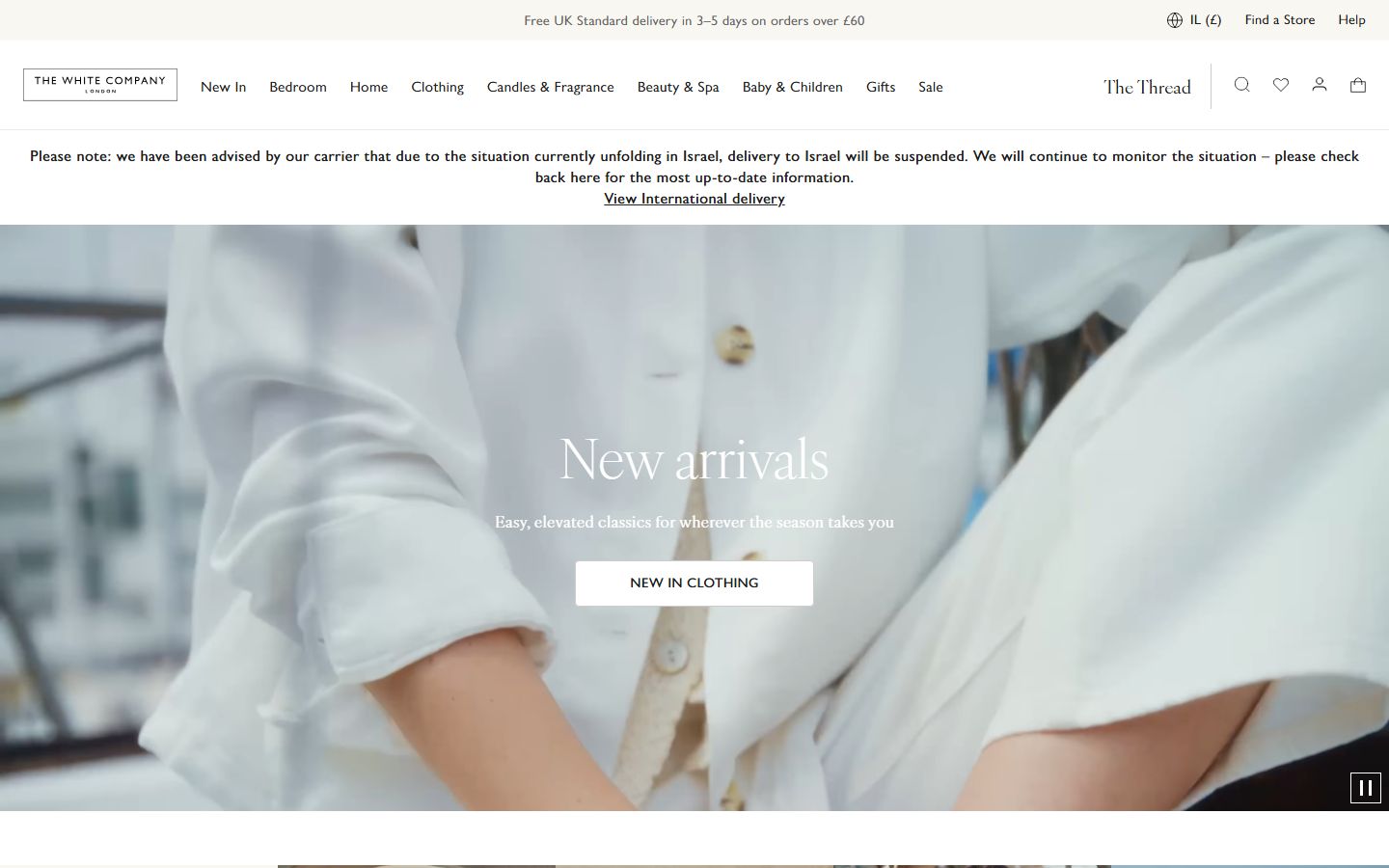
Open thewhitecompany.com and the first thing you see is not Egyptian cotton or a founding story. It is a sale banner. Below that, another promotion. Then a discount code. The homepage reads like a brand in distress — clearance messaging stacked on top of clearance messaging — when the reality is a profitable, expanding business with a loyal following. This is a design choice, not a financial necessity, and it is eroding the very perception of quality that justifies the price point. Customers who arrive expecting accessible luxury are instead trained to expect the next markdown.
The Invisible Origin
Chrissie Rucker’s founding story is genuinely compelling — a woman who could not find beautiful, affordable white bedding and decided to create it herself. It is the kind of origin that brands spend millions trying to fabricate. Yet on the website, it is buried several clicks deep, if it surfaces at all. The homepage offers no trace of the person behind the brand, no hint of why this company exists beyond selling things. In a market where Toast leads with editorial and Soho Home borrows the credibility of its members’ clubs, The White Company’s silence about its own story is a missed opportunity that compounds with every visit.
The Editorial Island
Thread is a well-produced editorial platform. The photography is strong, the content is relevant, and the writing has personality. The problem is that it exists as a separate destination — disconnected from the product pages, the homepage and the customer journey. A reader browsing a Thread article about seasonal tablescaping cannot easily move from inspiration to the linen napkins featured in the photographs. Content and commerce operate in parallel rather than in concert, which means the editorial investment generates brand warmth but fails to convert it into commercial momentum.
What Works
The product photography across the site is consistently excellent. Every image reinforces the brand’s core aesthetic — clean, warm, considered. The bedding and home categories in particular communicate quality through visual restraint, letting the materials speak without over-styling. The store locator and click-and-collect functionality work smoothly, and the site’s navigation across a sprawling product catalogue is surprisingly intuitive for the range it covers. The White Company’s email programme has a strong reputation among its subscribers, with curated edits that feel personal rather than algorithmic. Thread itself, for all its disconnection from commerce, is a genuine editorial asset — the kind of content platform most DTC brands wish they had. The loyalty programme is well-structured and drives repeat purchase without feeling transactional. Mobile performance is solid, with fast load times and a browsing experience that respects the screen size. The gift packaging and presentation — often the final touchpoint before a customer shares the brand with someone else — remains a quiet strength.
The Wider Pattern
This is a pattern we keep seeing across UK retail — brands with strong physical identities and compelling founding stories that default to conversion-first tactics online. The logic is understandable: discount banners drive short-term revenue. But the long-term cost is brand erosion. We saw something similar with Grind, where a brand built on neighbourhood coffee shop credibility had to reconcile that identity with a DTC subscription model. The White Company faces an amplified version of the same tension. When your entire brand promise is quality and taste, leading with price signals undermines the foundation. Toast has shown that editorial-led commerce can sustain premium pricing. The Conran Shop proves that design authority translates to digital without discount dependency. The White Company has every ingredient to follow that path — it just has not assembled them yet.
If We Were Starting Fresh
We would begin by removing the sale-first hierarchy from the homepage. Promotions have a place, but they should not be the first — or second, or third — thing a customer sees. The opening experience should communicate what The White Company stands for: Chrissie Rucker’s founding story, the Egyptian cotton, the sourcing standards. Let the brand earn the price before offering to discount it.
Thread should be woven directly into the shopping experience rather than living as a separate destination. When a Thread article features a product, the path from inspiration to basket should be seamless — one click, not a new tab and a search. This is not a technology challenge; it is an editorial and UX integration that most modern platforms support natively.
Material sourcing should be visible on product pages. Where the cotton comes from, how the linen is woven, why the cashmere costs what it costs. These are not marketing claims — they are the reason the brand exists. Making them visible justifies the premium and gives returning customers a reason to pay full price rather than waiting for the sale.
The competitive set has moved. Toast builds its entire digital presence around editorial storytelling. Soho Home borrows cultural credibility from its physical spaces. The White Company has its own version of both — a genuine origin story and a genuine editorial platform — but neither is doing the work it should be doing on the homepage. The ingredients are all there. They just need assembling.
Wondering if YOUR brand has the same gaps?
We will tell you -- for free. Our team will analyse your website and brand, then send you an honest review.
Get Your Brand ReviewFeature Your Review
Display this badge on your website to showcase your independent brand review.