Hotel Chocolat
Industry: Retail & DTC
Verdict: “The only UK chocolatier that grows its own cacao, and the website never takes you to the estate.”
Reviewed: April 2026
Who They Are
Hotel Chocolat was founded by Angus Thirlwell and Peter Harris, beginning life as an online chocolate tasting club before expanding into physical retail. The company now operates over 130 boutique stores across the UK and owns Rabot Estate — a working cacao plantation in Saint Lucia that doubles as a boutique hotel. This makes Hotel Chocolat the only UK chocolatier with genuine grain-to-bar provenance. The Velvetiser, a home chocolate-drink maker, has achieved cult status among its customer base. VIP.ME, the brand’s loyalty programme, drives repeat purchase, and the subscription model (originally the tasting club) remains a core revenue channel. Hotel Chocolat competes with Godiva, Prestat and Thorntons, though none of those competitors can claim anything close to the same vertical integration. The brand was briefly acquired by Mars in 2023 but continues to operate independently.
What We Noticed
The Seasonal Gifting Default
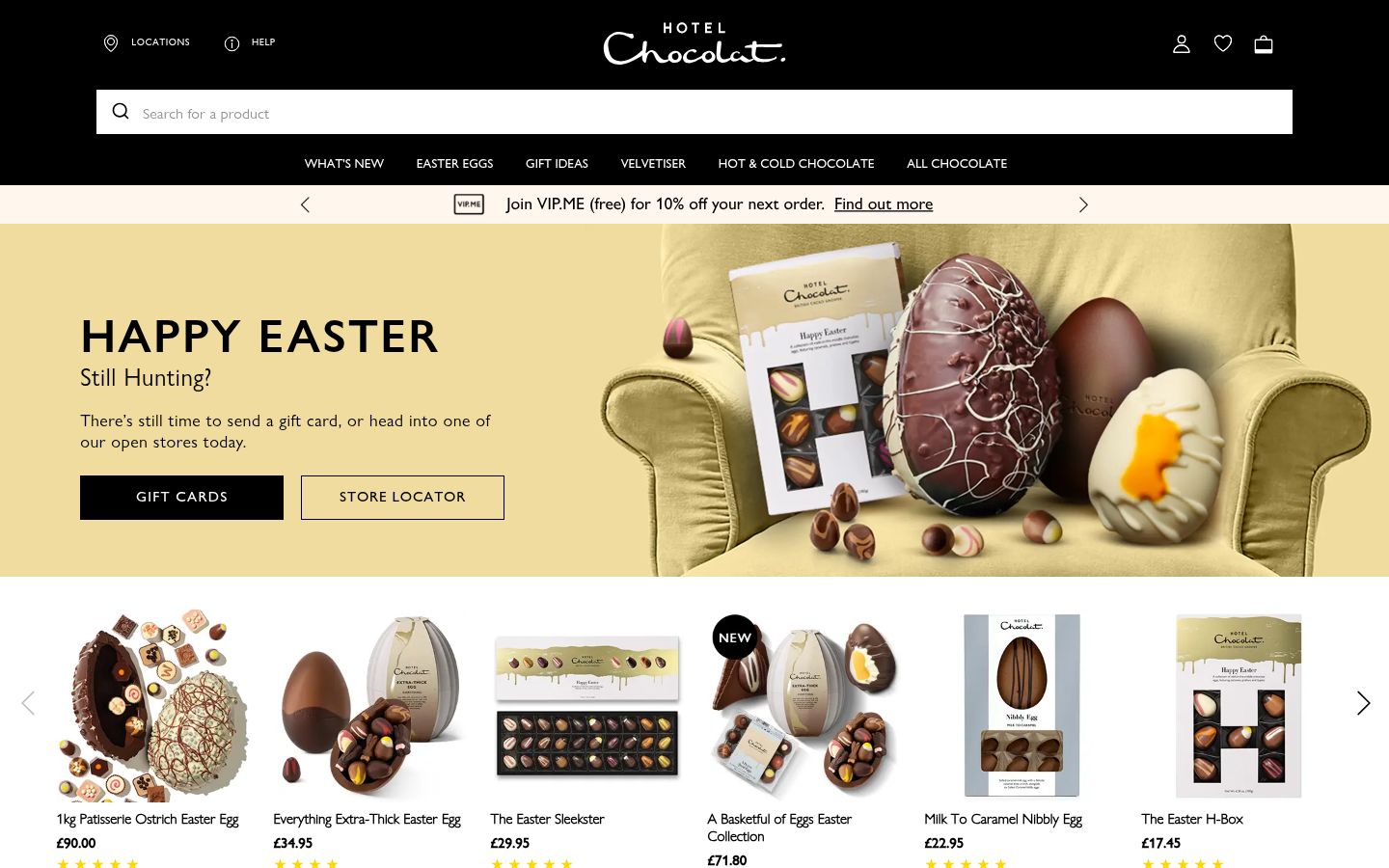
Hotel Chocolat’s homepage is a calendar. It changes with the season — Easter, Mother’s Day, Valentine’s, Christmas — and each rotation brings a fresh grid of gift boxes, hampers and collections. This is commercially logical: chocolate is a gifting category, and seasonal moments drive a significant share of revenue. But when gifting is the only story the homepage tells, the brand looks like every other premium chocolatier online. Thorntons has gift boxes. Godiva has gift boxes. The thing that Hotel Chocolat has and nobody else does — a cacao estate in Saint Lucia — is nowhere in the opening experience. The website defaults to what the brand sells rather than why it is different.
The Estate Gap
Rabot Estate is extraordinary. A UK chocolate company that grows its own cacao, runs a hotel on the plantation and brings that provenance into every product. It is the kind of brand asset that most food-and-drink companies would build their entire identity around. On the website, the estate is a sub-page — reachable if you know to look for it, invisible if you do not. There is no visual connection between the homepage and Saint Lucia. No cacao trees above the fold. No plantation photography alongside the product grid. The physical gap between Dorset and the Caribbean has become a digital gap too, and the brand’s most powerful story is the one customers are least likely to encounter.
The Velvetiser Without the Ritual
The Velvetiser has its own loyal following — a home appliance that turns chocolate flakes into restaurant-quality drinks. It is a genuine product innovation in a category that rarely produces them. But on the site, it is presented as a product to buy rather than a ritual to adopt. The Velvetiser page focuses on the machine and the flakes without building the emotional world around it — the morning routine, the evening wind-down, the hosting moment. In a market where Nespresso turned a coffee machine into a lifestyle and Le Creuset turned a pot into a kitchen identity, the Velvetiser has the same potential. It is just not being framed that way.
What Works
The product photography is strong and consistent. Chocolate is a category where visual quality directly affects perceived taste, and Hotel Chocolat’s imagery delivers — rich colours, careful composition, textures that feel almost tactile on screen. The tasting-club subscription model is well-executed, with clear tiers, genuine discovery built into each box and a sense of curation that feels personal. The VIP.ME loyalty programme is more generous than most, and its integration into the shopping experience is smooth. Store pages carry individual character, and the click-and-collect system bridges online and offline effectively. The “How We Make Chocolate” content, when a customer finds it, is detailed and genuine — including bean fermentation, roasting and conching processes. The corporate gifting section is well-structured for its audience. Mobile performance is solid, and the checkout flow is clean. The Velvetiser product page itself has strong photography and clear usage instructions.
The Wider Pattern
Food and drink brands with genuine provenance stories face this tension constantly — the pull between seasonal commerce and origin storytelling. We have seen it across the sector. Grind, which we reviewed previously, navigated a similar gap between its neighbourhood-cafe identity and its DTC subscription model. The difference is that Hotel Chocolat’s provenance asset is not a vibe or a neighbourhood — it is a physical plantation in the Caribbean. That is a harder thing to waste, and a more obvious thing to use. Godiva leans on Belgian heritage. Prestat holds a royal warrant. Neither actually grows cacao. Hotel Chocolat does, and the website buries it beneath Easter eggs. The pattern is familiar, but the missed opportunity here is larger than most.
If We Were Starting Fresh
We would put Saint Lucia on the homepage. Not as a link, not as a sub-page — as the emotional centre of the entire digital experience. The opening moment should take the customer to the estate, show them cacao growing, and then bring them forward through the process to the finished product in their hand. This is the journey that no competitor can replicate, and it should be the journey the website tells.
Product pages should carry provenance information as standard. Where the cacao was grown, how it was processed, what makes this bar different from commodity chocolate. These details already exist in the brand’s knowledge base — they just need to surface where customers are making buying decisions.
The Velvetiser deserves to be positioned as a ritual, not an appliance. A dedicated section that builds the world around the product — morning routines, hosting moments, seasonal recipes — would elevate it from a purchase to a lifestyle choice. Nespresso proved this model. The Velvetiser has the product quality to support it.
The seasonal gifting grid does not need to disappear. It needs context. When a customer sees an Easter collection, they should also see the estate where the cacao was grown. When they buy a gift box, the packaging story — how the chocolate was made, where it came from — should be part of the unboxing. The brand already owns every link in the chain from tree to box. The website should show it.
Wondering if YOUR brand has the same gaps?
We will tell you -- for free. Our team will analyse your website and brand, then send you an honest review.
Get Your Brand ReviewFeature Your Review
Display this badge on your website to showcase your independent brand review.