Pigeon Organics
Industry: Retail & DTC
Verdict: “Soil Association certified and designed to be handed down — but you would not know it from the homepage.”
Reviewed: April 2026
Who They Are
Pigeon Organics makes children’s clothing from certified organic cotton. The collections are designed with longevity in mind — pieces intended to be handed down between siblings, between families, between generations. The brand holds Soil Association certification, which is the UK’s most rigorous organic standard, covering everything from the cotton itself to the dyes and finishes used in production. The ethical supply chain is audited, not just claimed. A 4.9-star Feefo rating across hundreds of reviews suggests that the customers who find the brand tend to stay. The Shopify store is clean and functional, and a separate wholesale site serves independent retailers. Seasonal collections rotate, but the design language stays consistent — soft palettes, timeless shapes, nothing that screams trend.
What We Noticed
The strongest credential in the room, treated as a footnote
Soil Association certification is not easy to get. It is not a badge you buy or a claim you make in your marketing copy — it is an externally audited standard that covers the entire supply chain from raw material to finished garment. In the organic children’s clothing category, it is the gold standard. Pigeon Organics has it. Frugi does not (Frugi holds B Corp and GOTS). Little Green Radicals holds GOTS but not Soil Association. This is a genuine competitive differentiator, and it sits below the fold on the homepage. Parents who are actively searching for certified organic children’s clothes — the exact audience this brand exists for — have to scroll past a product grid to discover that Pigeon Organics holds the certification they care about most.
Product grid where a philosophy should stand
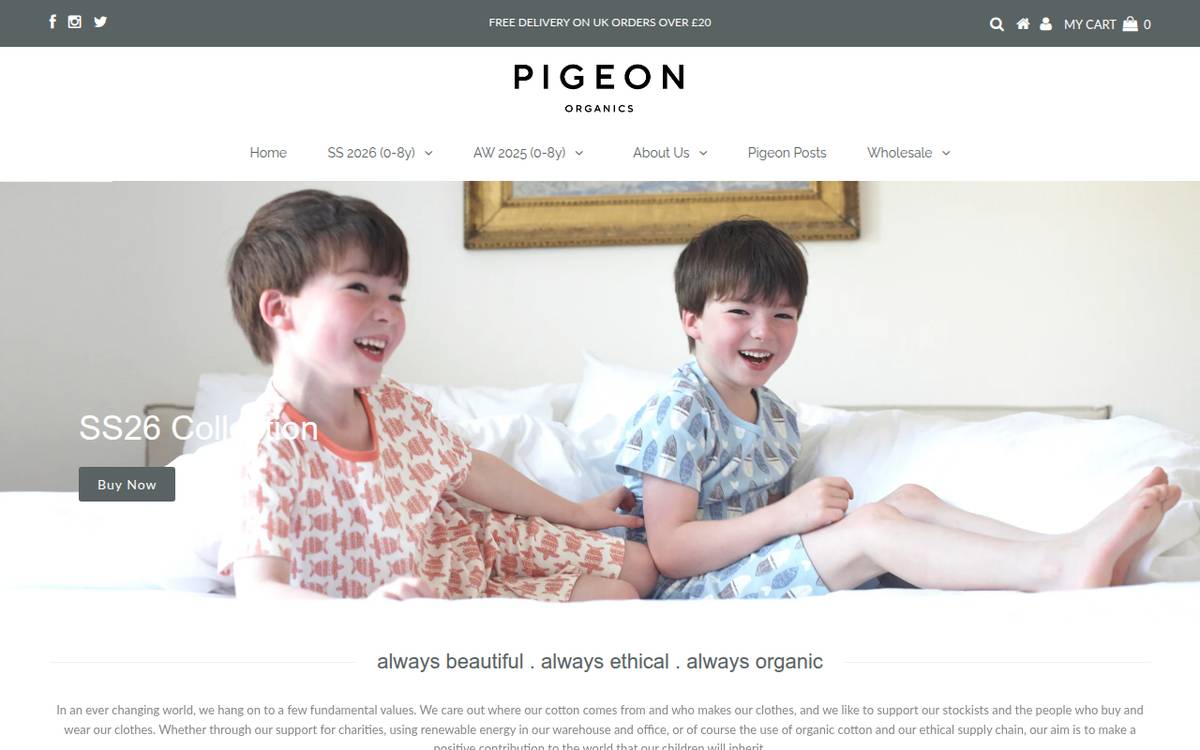
The homepage opens with seasonal product tiles. New arrivals. Bestsellers. This is the standard Shopify structure, and it works perfectly well for brands whose primary proposition is the product itself. But Pigeon Organics is not selling clothing — it is selling a philosophy of longevity. “Designed to be handed down through families” is a powerful positioning statement, but it does not appear until you look for it. The homepage does not communicate why these clothes are different from any other children’s range. It shows you what is available. It does not tell you what it stands for.
The invisible founder
Behind every independent children’s clothing brand there is someone who decided that the existing options were not good enough. That person — their motivation, their standards, their story — is what separates a brand from a label. Pigeon Organics has no visible founder narrative on its homepage. No name, no face, no story of why this particular brand exists. In a category where trust is paramount — parents are choosing what touches their children’s skin — the absence of a human voice is a missed connection.
What Works
The Soil Association certification is the standout asset. In a market full of vague sustainability language and self-awarded eco credentials, an externally audited organic standard is rare and valuable. It is the kind of proof point that should anchor every piece of brand communication.
The 4.9-star Feefo rating across a substantial volume of reviews is genuine social proof. This is not a handful of cherry-picked testimonials — it is a sustained pattern of customer satisfaction that demonstrates product quality and service reliability.
The design consistency across collections is quietly impressive. Pigeon Organics does not chase trends. The colour palettes, the silhouettes, the fabric choices — they hold steady from season to season, which reinforces the “handed down” positioning. Clothes that look dated after six months cannot credibly claim to be heirlooms.
The separate wholesale site signals commercial maturity. It means independent retailers are choosing to stock the brand, which is a form of third-party validation that DTC-only brands cannot replicate. Retail buyers are professional sceptics — if they are stocking Pigeon Organics, the product quality holds up to scrutiny.
The Wider Pattern
We see this repeatedly across the brands we review: the stronger the underlying proposition, the more likely the website is to undersell it. Grind had compostable pod innovation and a genuine environmental foundation but led with discount codes. P.Louise had a record-breaking community but presented it with a template storefront. Pigeon Organics has the highest organic certification available in the UK and treats it as secondary information.
The common thread is a kind of digital modesty — brands that have done the hard work of building something genuinely differentiated, then defaulting to generic e-commerce patterns that make them look like everyone else. The Shopify product grid is the great equaliser. It makes a Soil Association certified organic brand look functionally identical to a brand that prints “eco-friendly” on its packaging and calls it a day.
If We Were Starting Fresh
We would build the digital experience around the concept of heritage clothing — pieces designed to outlast the child who wears them first. The homepage would open with the Soil Association certification front and centre, not as a badge in the footer but as the opening statement of what makes Pigeon Organics different from every other children’s clothing brand on the market.
A brand story film concept — even as a static visual narrative initially — would give the “handed down” philosophy a human face. Real families, real hand-me-downs, real wear patterns over time. The kind of content that makes the longevity claim tangible rather than abstract.
Seasonal lookbook experiences would replace the standard product grid, showing the clothes in context rather than on white backgrounds. Children wearing them. Gardens, kitchens, parks. The clothes living the life they were designed for.
The founder story would become visible — not as a long biography, but as a presence throughout the site. The voice behind the standards. The reason the certification matters. The person who decided that organic was not a marketing angle but a non-negotiable.
Pigeon Organics has already done the hardest thing in sustainable fashion: earning a certification that most competitors cannot or will not pursue. The digital experience just needs to make that achievement impossible to miss.
Wondering if YOUR brand has the same gaps?
We will tell you -- for free. Our team will analyse your website and brand, then send you an honest review.
Get Your Brand ReviewFeature Your Review
Display this badge on your website to showcase your independent brand review.