The Kind Pet
Industry: Retail & DTC
Verdict: “The kindest pet brand on the shelf, with the quietest website in the category.”
Reviewed: April 2026
Who They Are
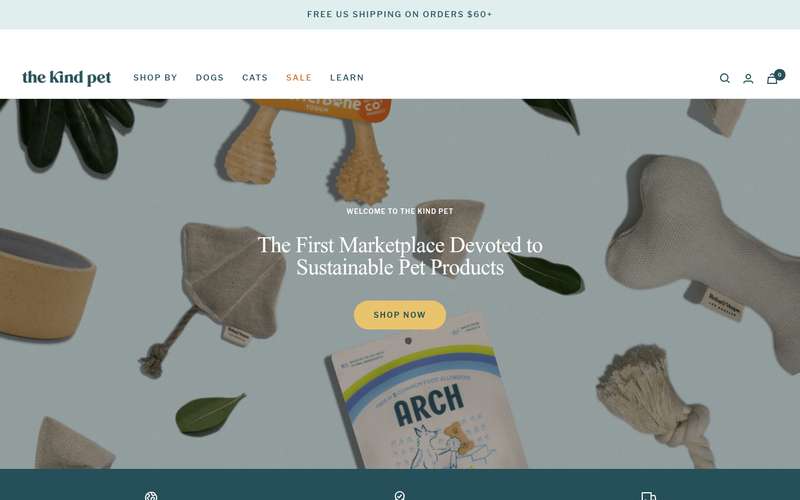
The Kind Pet sells sustainable and ethical pet products with a holistic approach to pet care. The range covers food, treats, accessories and grooming products, all built around natural ingredients, ethical sourcing and eco-conscious packaging. The brand maintains a blog covering pet health and eco-living topics, positioning itself as more than a shop — a resource for pet owners who want to make better choices. The Shopify store is clean, the product photography is good, and the overall experience is competent and well-organised. The brand name itself is a promise: kindness, to pets and to the planet.
What We Noticed
Clean design, thin content
The Kind Pet’s Shopify store is well-built. The navigation is clear, the product pages load quickly, the photography is consistent and professional. As a functional e-commerce experience, it works. But “works” is not a positioning. The site is clean in a way that borders on sparse. Product descriptions are functional rather than editorial. The sustainability story — which is the brand’s reason for existing — is present but not prominent. You can find the information, but you have to look for it. In a category where competitors like Lily’s Kitchen wrap every product in storytelling and Edgard & Cooper lead with their “fresh, planet-friendly” manifesto, The Kind Pet’s restraint reads less as confidence and more as silence.
Sustainability credentials kept at arm’s length
The Kind Pet’s products are made with natural ingredients, ethically sourced materials and eco-conscious packaging. These are not trivial claims — they represent genuine supply chain decisions that cost more and require more effort than the conventional alternative. But the credentials live on a separate page. They are not integrated into the product experience. A customer browsing a natural dog treat sees a product photo and a description. They do not see the sourcing story, the packaging choice, the environmental comparison with conventional alternatives. The proof is available, but it is not present at the point of purchase.
A community that does not exist yet
Pet ownership is inherently social. People talk about their pets, share photos of their pets, seek advice about their pets. Brands in this category that build community features — user-generated content, advice forums, loyalty programmes with a social dimension — create switching costs that pure product quality cannot. The Kind Pet has none of this. No visible community features, no user-generated content, no impact reporting that lets customers feel part of something larger than a transaction. The blog covers pet health topics competently, but it functions as a content library rather than a community hub.
What Works
The brand name is genuinely strong. “The Kind Pet” is simple, memorable and emotionally resonant. It immediately communicates values without needing explanation. In a crowded pet products market, a name that says exactly what you stand for is a significant asset.
The product photography is consistent and professional. Clean backgrounds, good lighting, accurate colour representation. For an online pet products brand, where customers cannot touch or smell the products before buying, visual quality directly affects conversion. The Kind Pet meets this standard.
The blog content, while structurally underutilised, demonstrates subject matter authority. The articles on pet health and eco-living are well-researched and genuinely useful. They are not thinly disguised product pitches — they are informational resources that build trust over time. This is a content foundation that could support a much more prominent editorial strategy.
The product range coherence is notable. Everything in the catalogue connects to the same set of values — natural, ethical, sustainable. There are no compromises or odd additions that undermine the positioning. The range is tight, consistent and credible.
The Wider Pattern
We keep finding the same structural tension in the sustainable and ethical retail brands we review. Pigeon Organics holds Soil Association certification — the UK’s most rigorous organic standard — but buries it below a product grid. Grind built a compostable pod innovation that genuinely solves the environmental problem with coffee capsules but leads with discount codes. The Simple Folk has cultivated a slow living community around values that extend far beyond clothing but serves them a standard e-commerce homepage.
The pattern is this: brands that have invested in doing the right thing — the harder sourcing, the better materials, the genuine certifications — consistently under-invest in communicating why it matters. The assumption seems to be that the product will speak for itself. But in a digital environment where every brand claims to be sustainable and every product page looks roughly the same, the product cannot speak for itself. The communication is the product experience.
If We Were Starting Fresh
We would rebuild the digital experience as a mission-led marketplace. Every product page would include its sustainability story alongside the product description — where the ingredients come from, why the packaging was chosen, how it compares to conventional alternatives. Not as a separate page you can visit if you are curious, but as an integrated part of the buying experience. Kindness would be visible, not just claimed.
A sustainability scoring system — simple, visual, applied to every product — would make the brand’s values tangible and comparable. Customers could see at a glance which products have the lowest environmental impact, which use the most locally sourced ingredients, which packaging is home-compostable versus recyclable. Transparency would become a feature, not a footnote.
Supplier spotlights would bring the sourcing story to life. Who grows these ingredients? Where is this packaging made? What does ethical sourcing actually look like in practice? The makers and growers behind the products would become visible, giving the “kind” in The Kind Pet a human dimension.
Impact reporting — the cumulative effect of customer purchases on packaging waste reduction, sustainable sourcing volumes, charitable contributions — would give the community something to rally around. Each purchase would feel like participation in something larger than a transaction.
The Kind Pet has the name, the values, the products and the content foundation. What it needs is volume. Not louder marketing, but a richer, deeper digital experience that makes the kindness impossible to miss.
Wondering if YOUR brand has the same gaps?
We will tell you -- for free. Our team will analyse your website and brand, then send you an honest review.
Get Your Brand ReviewFeature Your Review
Display this badge on your website to showcase your independent brand review.