Elvis & Kresse
Industry: Sustainable Luxury
Verdict: “Luxury handbags made from fire hoses — the most compelling material story in British fashion, told in paragraphs instead of pictures.”
Reviewed: April 2026
Who They Are
Elvis & Kresse was founded in 2005 by Kresse Wesling and James Henrit after discovering that London’s decommissioned fire hoses were being sent to landfill. They began rescuing the hoses and handcrafting them into luxury bags, belts, and accessories from their workshop in Kent. Twenty years later, the brand has expanded into other waste streams — leather off-cuts from Burberry’s manufacturing, reclaimed printing blankets, and parachute silk — while donating fifty percent of profits to charitable causes. The Kent workshop doubles as a visitor experience, offering design workshops, farm tours, and a holiday cottage. It is a brand that has turned waste rescue into a luxury business, and a luxury business into a destination.
What We Noticed
The physical and the digital are different brands
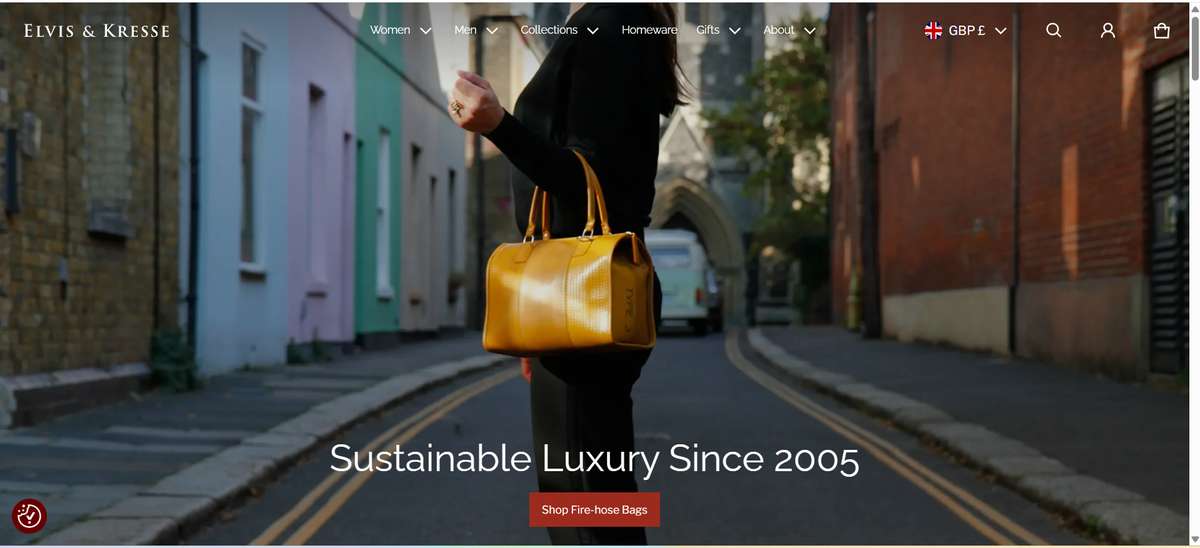
Visit Elvis & Kresse’s Kent workshop and you see fire hoses being unrolled, cut, and stitched into bags. You see the Burberry leather off-cuts sorted and prepared. You see the waste becoming the product. It is an experience that makes the proposition visceral and unforgettable. Visit elvisandkresse.com and you see a well-structured e-commerce site with lifestyle photography and product grids. The headline — “Sustainable Luxury Since 2005” — is accurate but restrained. The fire hose story is organised into product categories (Decommissioned Fire-hose, Rescued Leather & Fire-hose) rather than presented as a journey. The most compelling material transformation story in British fashion is being navigated through a dropdown menu.
A Burberry partnership that whispers
Elvis & Kresse’s collaboration with Burberry — rescuing leather off-cuts from the luxury house’s manufacturing process — is the kind of partnership most sustainable brands would build their entire identity around. It validates the craft at the highest level of the luxury industry. It answers the quality question before it is asked. And on the website, it sits as one material category among several. The partnership is not invisible, but it is not given the weight it deserves. A dedicated section showing the Burberry leather’s journey from cutting room floor to finished Elvis & Kresse product would do more for brand credibility than any amount of sustainability copy.
Impact communicated as principle, not as evidence
Fifty percent of profits go to charity. That is an extraordinary commitment — one that puts Elvis & Kresse in a different category from brands that donate a fraction or offset their impact with token gestures. But the website treats this as a stated principle rather than a demonstrated impact. How much has been donated? To which causes? What has it funded? The numbers, the stories, the tangible outcomes — these are the things that make a charitable commitment feel real rather than rhetorical. The fire hose rescue itself raises the same question: how many tonnes of hose have been diverted from landfill since 2005? Twenty years of waste rescue should produce a number worth leading with.
Experiences as the hidden differentiator
The Experiences section — design workshops, farm and workshop tours, a holiday cottage — is unlike anything offered by any competitor in the sustainable luxury space. Stella McCartney does not invite you to her studio. Bottletop does not offer a stay at their workshop. Elvis & Kresse has turned its production facility into a destination, which is both a revenue stream and a brand-building exercise. But this section sits quietly in the navigation alongside the product categories. For a brand competing on story and craft, the chance to experience both in person is the ultimate differentiator. It deserves far more prominence than a link in the menu.
What Works
The material categorisation — organising products by rescued material rather than just by product type — is a smart structural decision. It reinforces the brand’s reason for existing with every browse. When you shop by “Decommissioned Fire-hose” or “Reclaimed Printing Blanket,” you are constantly reminded that these products have a story no conventional brand can match.
The product photography is strong, with lifestyle context shots that position the bags as genuine luxury items rather than novelty objects. This matters. The risk with upcycled materials is that the product feels like a compromise — interesting but not desirable. Elvis & Kresse’s photography eliminates that risk. The bags look like luxury bags. The fact that they were once fire hoses is the unexpected bonus, not the caveat.
The twenty-year track record is itself an asset. In a market crowded with sustainability claims from brands launched last year, Elvis & Kresse has been doing this since 2005. That longevity is proof that the model works — commercially, environmentally, and aesthetically.
The Wider Pattern
Across the brands we have reviewed, the gap between physical experience and digital presence is the most consistent finding. Greene King’s pubs have two centuries of character in the woodwork, but the website defaults to stock photography. Billy Tannery operates a working microtannery on a Midlands farm, but the tanning process lives below the fold in a paragraph. Elvis & Kresse has a workshop that visitors describe as transformative, but the website presents it as a standard e-commerce catalogue.
The sustainable luxury sector faces a particular version of this challenge. These brands compete on story and process, not just on product. But the digital experience — the channel through which most customers first encounter the brand — tends to default to the conventions of product-first e-commerce. Category grids. Lifestyle photography. Add-to-cart buttons. The story that makes the product special gets compressed into an About page rather than woven through the entire browsing experience.
If We Were Starting Fresh
The entire digital experience would be built around the concept of rescue-to-luxury. The homepage would open not with a product hero but with the material — a decommissioned fire hose, a Burberry leather off-cut, a printing blanket — and then show what it becomes. The transformation would be the journey the visitor takes, not a paragraph they read.
The Burberry partnership would be given dedicated, prominent treatment: the off-cuts arriving, the selection process, the finished product. This is not just a material source. It is a story about what the luxury industry discards and what can be made from its margins.
The Experiences section would be elevated from a navigation link to a central part of the brand’s digital identity. Imagery and video from workshops and tours would appear throughout the site, not just on a dedicated page. The impact data — hoses rescued, leather diverted, money donated — would be displayed as living numbers, updated and impossible to miss.
Elvis & Kresse has spent twenty years building one of the most compelling stories in British luxury. The website needs to tell it with the same conviction the workshop shows it.
Wondering if YOUR brand has the same gaps?
We will tell you -- for free. Our team will analyse your website and brand, then send you an honest review.
Get Your Brand ReviewFeature Your Review
Display this badge on your website to showcase your independent brand review.