Chiltern Candle Co
Industry: Wellness
Verdict: “Handmade luxury candles from the Chiltern Hills, sold through a website builder that belongs to another decade.”
Reviewed: April 2026
Who They Are
Chiltern Candle Co is a luxury vegan candle brand, handmade by founder Trish in the Chiltern Hills. Every candle is hand-poured in small batches using natural wax, with scent profiles designed around British seasons and landscapes. The brand positions itself in the premium segment of the UK candle market, alongside Earl of East, The Candle Brand and Evermore London — brands where customers expect craft credentials, thoughtful packaging and a digital experience that reflects the care behind the product. Chiltern Candle Co has the maker story, the provenance, the artisan process and the named location that premium homeware brands spend years trying to build. The candles are vegan, the ingredients are natural, and the production is genuinely small-batch — not “small-batch” as a marketing claim printed on a factory-made product.
What We Noticed
The Platform Mismatch
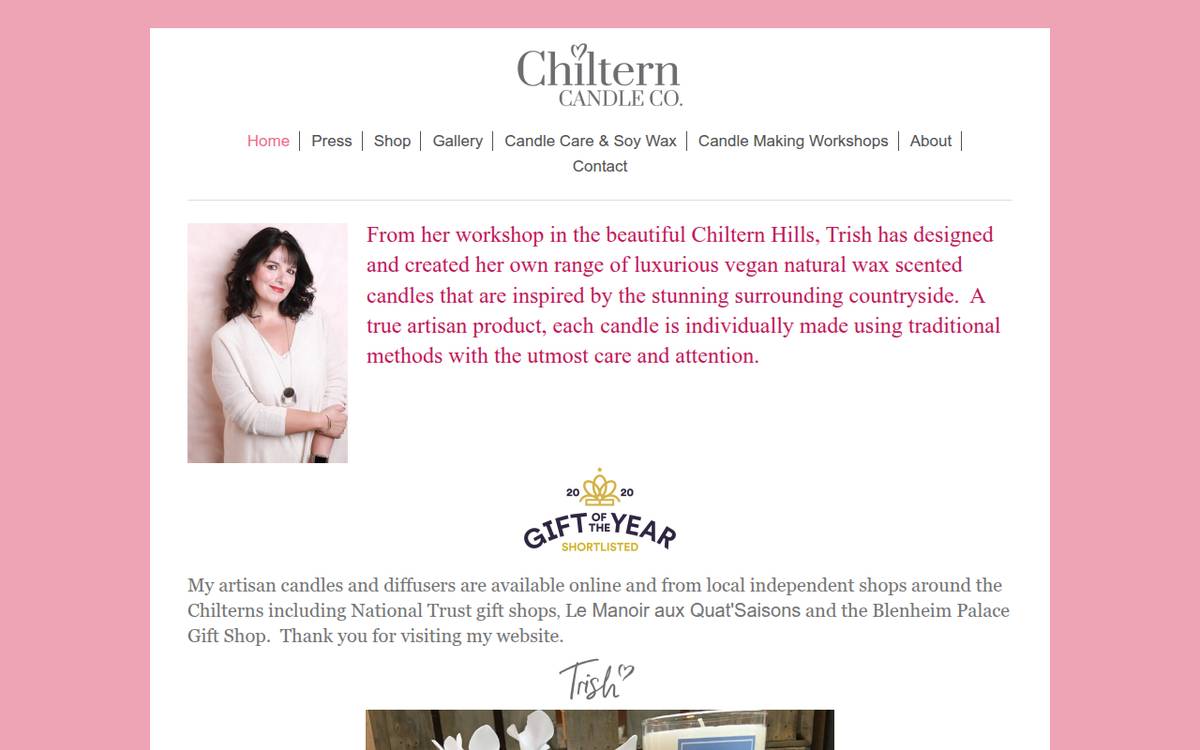
Chiltern Candle Co’s website runs on a basic IONOS website builder. This is a platform designed for tradespeople, local service businesses and sole traders who need a functional web presence at minimal cost. It is not designed for luxury artisan brands that compete on craft, aesthetics and sensory storytelling. The gap between what the product is and what the website communicates is the widest we have encountered in any brand review. The candles are luxury. The maker story is genuine. The website looks like it was built by someone who needed to get something online quickly and never came back to it. The templates, the typography, the layout constraints and the limited interaction design all belong to a category of web presence that actively undermines premium positioning.
The Invisible Maker
Trish is the brand. She makes the candles by hand in the Chiltern Hills. That sentence alone — a named maker, a named place, a handmade process — is more compelling than the entire current website. Yet the maker story is compressed into a paragraph that carries the same visual weight as a shipping policy. In the luxury candle market, the maker is the differentiator. Earl of East built its brand around Niko and Paul in Hackney. Evermore London tells detailed stories about fragrance development and ingredient sourcing. The Candle Brand photographs its workshop and shows the pouring process. Chiltern Candle Co has an equally genuine maker story and presents it with less prominence than the terms and conditions.
The Sensory Deficit
Candles are a sensory product. Customers cannot smell a website, which means the digital experience has to work harder than almost any other product category to communicate the sensory proposition. This requires atmospheric photography, evocative scent descriptions, lifestyle imagery that places the candle in a context and a visual language that triggers the same emotional response the product delivers in person. The current website has none of this infrastructure. Product images are functional rather than atmospheric. Scent descriptions are lists rather than narratives. The visual environment does not evoke warmth, craft or the Chiltern Hills landscape — it evokes a template that has not been customised beyond changing the logo and uploading product photos.
What Works
The product itself carries genuine credibility. The commitment to natural wax and vegan formulations is consistent across the range, and the hand-poured process is real rather than performative. The Chiltern Hills provenance is specific and evocative — it grounds the brand in a particular landscape rather than the generic “handmade in the UK” claim that dozens of candle brands use. The scent range appears thoughtfully curated rather than exhaustively broad, which suggests a maker who understands that quality requires restraint. The brand name itself works well — “Chiltern Candle Co” is clear, geographic and carries an artisan register without trying too hard. The commitment to vegan formulation and natural wax positions the brand correctly for the environmentally conscious segment of the luxury candle market. The fact that every candle is made by one person in one place is a genuine provenance claim that scales of production make impossible for larger competitors.
The Wider Pattern
The luxury candle market in the UK has matured significantly over the past decade. Earl of East, Evermore London, The Candle Brand and a tier of independent makers have collectively raised expectations for what a premium candle brand’s digital presence should look and feel like. Clean typography, atmospheric photography, editorial scent descriptions, visible maker stories and packaging design that works as interior decor — these are now table stakes, not differentiators.
We see a version of this platform mismatch across small artisan brands in several sectors. The product quality outpaces the digital presentation because the maker’s skills are in the product, not in web design — which is entirely understandable. But in a market where the first encounter with a brand is almost always digital, the website is performing the same function as a shop window. A luxury candle sold through a basic website builder is the equivalent of a handmade product displayed on a folding table at a car boot sale. The setting contradicts the product.
Grind, the coffee brand we reviewed, has the opposite problem — a sophisticated digital presence that leads with conversion mechanics rather than its genuine story. Chiltern Candle Co’s challenge is more fundamental. Before it can decide what story to tell, it needs a platform capable of telling one.
If We Were Starting Fresh
We would build the entire digital experience around Trish. A named maker, a named place, a handmade process — this is the brand’s competitive advantage, and it should be the organising principle of every page. The homepage would open with the Chiltern Hills, the workshop, the hands pouring wax. Not as an “about us” afterthought but as the entry point to the brand. Every product page would connect the candle back to its maker and its place of origin, because that provenance is what justifies the premium price point and distinguishes Chiltern Candle Co from factory-made competitors using the same “artisan” language.
The visual language would be warm, textural and atmospheric. Natural materials, soft lighting, the Chiltern landscape. The kind of photography and design that makes a visitor feel the warmth of the candle before they have lit one. Scent descriptions would be narrative rather than functional — telling the story of where the fragrance comes from and what it evokes, not just listing top, middle and base notes.
The platform itself would need to be rebuilt entirely. A modern e-commerce experience with considered typography, generous whitespace, and the kind of interaction design that signals “luxury” from the first page load. The current IONOS builder cannot deliver this, regardless of how much content is added to it. The product deserves a digital home that matches its quality, and building that home is the single highest-impact investment the brand could make.
Wondering if YOUR brand has the same gaps?
We will tell you -- for free. Our team will analyse your website and brand, then send you an honest review.
Get Your Brand ReviewFeature Your Review
Display this badge on your website to showcase your independent brand review.