Monzo
Industry: Professional Services
Verdict: “The bank that started a movement, now presenting itself as a feature comparison table.”
Reviewed: April 2026
Who They Are
Monzo is the UK’s leading digital bank, founded in February 2015 and born from one of the most remarkable crowdfunding campaigns in British business history — raising over one million pounds in 96 seconds on Crowdcube, setting a record and creating a generation of customer-investors who felt genuine ownership of the institution they were banking with. Today, Monzo serves more than 15 million personal and business customers, holds a full UK banking licence and operates from offices near Liverpool Street and in Cardiff. The coral debit card became a cultural signifier — spotting one in a queue was a tribal marker, a signal that this person had opted out of high street banking and into something that felt like it belonged to them. The mission statement is “Making money work for everyone.” Against Starling Bank, Revolut and Chase UK, Monzo was the bank that did not just offer better features. It offered belonging.
What We Noticed
The origin story that vanished
Monzo’s crowdfunding record was not just a financing event. It was the founding myth of a new kind of bank — one built by the people who would use it. Over a million pounds in 96 seconds. Investors who became customers who became evangelists. A community forum where product decisions were debated in public, where feature requests became roadmap items, where the line between bank and customer blurred in a way that no traditional institution could replicate. This story is worth more than any marketing campaign because it cannot be fabricated. Starling cannot claim it. Revolut cannot claim it. Chase certainly cannot claim it. And on monzo.com, it is gone. The about page mentions “building a bank, together” without explaining what that means. The crowdfunding record, the community forum’s role in product development, the early beta programme that created a waiting list of hundreds of thousands — none of it is visible from the front door. The founding myth has been filed away, replaced by a sign-up button and a product comparison.
The coral card in a feature table
The coral card was never just a debit card. It was a cultural object — bright, unmistakable, deliberately unlike the muted greys and blues of high street banking. Pulling out a coral Monzo card was a conversation starter. It signalled something about the person using it. The website still uses the card imagery as a visual anchor, and the product photography (pearlescent for joint accounts, neon for under-16s) shows that Monzo still understands the card as an identity marker. But the card now sits inside a product comparison framework — free tier, mid-tier, Max at seventeen pounds a month. The cultural object has been reduced to a feature carrier. The card that once meant “I bank differently” now means “here are my plan benefits.”
Community as archived feature
Monzo’s community forum was not a nice-to-have. It was the engine of product development. Users proposed features, debated trade-offs, reported bugs and shaped the product in real time. This was transparently collaborative development at a scale no other bank attempted. The forum still exists. But it is not surfaced in the main navigation. The about page acknowledges community-driven development (“We’re building Monzo together”) without demonstrating it. The community has been quietly moved from the centre of the brand to the periphery — still alive, still active, but no longer part of the story Monzo tells about itself. For a bank whose entire origin was community, this is not a design choice. It is an identity shift.
Utility positioning in a commodity market
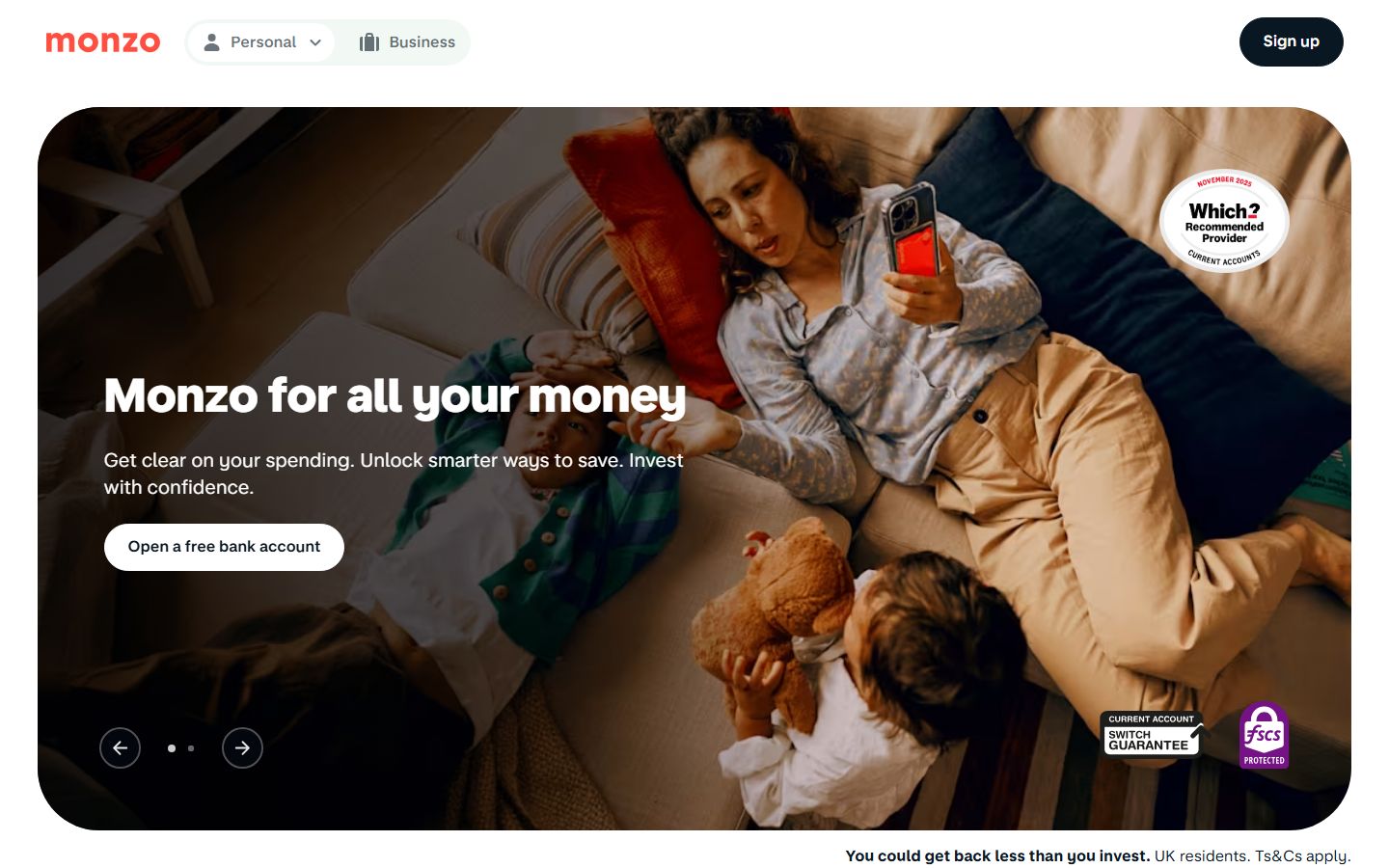
The homepage leads with “Open an account for free.” The current account page presents three tiers with feature comparisons: savings interest rates, travel insurance levels, cashback percentages. This is rational product marketing. It is also exactly what Starling, Revolut and Chase do. When Monzo competes on features, it competes on a playing field where Revolut has more features, Starling has profitability, and Chase has JPMorgan’s balance sheet. Monzo cannot win a feature race against three well-funded competitors who are all optimising the same comparison table. What Monzo can do — what only Monzo can do — is tell the story of a bank that was built by its customers. And the website has stopped telling it.
What Works
The product architecture is thoughtfully segmented. Age-specific accounts (under-16s, 16-17s), joint accounts and tiered personal plans show a bank that thinks about customer life stages rather than just account types. This is product design maturity that competitors have been slower to replicate.
The brand voice remains distinctive. Even the cookie notice is conversational and slightly cheeky — a small detail that signals the Monzo personality has not been entirely corporate-washed. The tone of voice guidelines referenced on the about page suggest the brand still cares about how it sounds, even if the website structure no longer gives that voice enough room to operate.
The visual design is clean, modern and confident. The coral palette remains immediately recognisable. The card product photography — different colours and finishes for different account types — turns a commodity product into a visual identity system. This is design intelligence.
The mission statement — “Making money work for everyone” — is genuinely inclusive and commercially smart. It positions Monzo as a bank for people who feel excluded or overwhelmed by traditional banking, which is a large and underserved audience.
The Wider Pattern
Across the brands we have reviewed, we see a recurring trajectory: companies that built their audience through story and community gradually shift their digital experience toward utility and conversion. Grind, the DTC coffee brand, has compostable innovation and a Shoreditch origin story — and leads with discount codes. Lush has the most radical ethical commitments in beauty — and buries them beneath seasonal collaborations. The brand that people fell in love with becomes the brand that presents a comparison table.
Monzo’s version of this trajectory is the most dramatic because the gap between origin and current presentation is the widest. This is not a company that added a community forum as a marketing tactic. The community was the company. The crowdfunding investors were the first customers. The forum shaped the product. The coral card was a tribal marker. Every element of Monzo’s early identity was built on the idea that this bank belonged to its users. The website now presents Monzo as a service provider with competitive rates, which is true but incomplete — like describing a rock band by listing the equipment they use.
If We Were Starting Fresh
We would rebuild the digital experience around the concept of “The Bank You Built.” The crowdfunding story, the community forum’s role in product development, the early beta programme, the coral card phenomenon — these would not be archived on an about page. They would be the front door. Not as nostalgia, but as proof of a fundamentally different relationship between a bank and its customers.
The product tiers would still exist — 15 million customers need clear product information. But they would be framed within the community narrative. “You helped build this bank. Here is what it offers you.” The comparison table would become a participation story. Features would be contextualised: “This feature was requested by 12,000 community members.” “This savings tool was co-designed with forum users.” Let the product be the evidence of the community, not a replacement for it.
The community forum would return to the main navigation. Not as a legacy feature, but as a living demonstration of the thing that makes Monzo structurally different from every competitor. Starling has operational excellence. Revolut has feature velocity. Chase has institutional backing. Monzo has something none of them can replicate: a founding story where the customers were the investors and the product was built in public. That story is Monzo’s most valuable asset. The website should treat it accordingly.
Wondering if YOUR brand has the same gaps?
We will tell you -- for free. Our team will analyse your website and brand, then send you an honest review.
Get Your Brand ReviewFeature Your Review
Display this badge on your website to showcase your independent brand review.