Byfield Consultancy
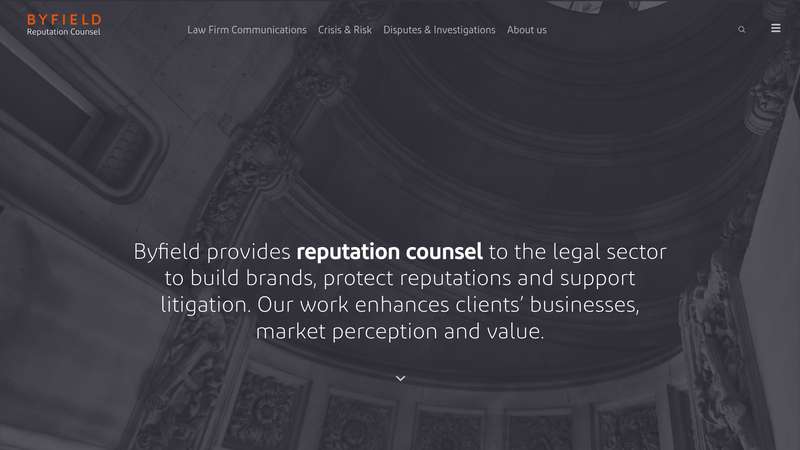
Screenshot of Byfield Consultancy’s website, captured April 2026
Byfield Consultancy
Industry: Legal & Law
Verdict: “The PR firm that speaks exclusively to lawyers, through a website that could be any consultancy.”
Reviewed: April 2026
Who They Are
Byfield Consultancy is a PR and communications consultancy that works exclusively with the legal sector. This is not a generalist agency that happens to have a few law firm clients. It is a practice built entirely around understanding how the legal market works — how firms compete for talent and clients, how legal media operates, how professional services reputations are built and maintained. In a market where most PR agencies serve multiple sectors and bring generalist frameworks to specialist problems, Byfield has chosen depth over breadth. Their competitors include Infinite Global, Kysen PR, and Communicate Strategic Directions — agencies with varying degrees of legal sector focus but none with quite the same purity of specialisation.
What We Noticed
The cobbler’s shoes
There is a particular kind of dissonance that occurs when a consultancy advising others on presentation fails to present itself well. Byfield Consultancy tells law firms how to build their profiles, manage their reputations, and communicate their distinctiveness. The website through which it makes this case runs on WordPress with WPBakery — a page builder that peaked around 2017 and whose design constraints are visible on every page. The layout patterns, typography choices, and imagery belong to an earlier era of web design. The content is strong. The expertise is evident. But the visual wrapper undercuts the authority of the advice being given. When your business is helping law firms look credible, your own credibility is on display every time someone visits your website.
Specialism without visual identity
Byfield’s legal-sector exclusivity is its most valuable asset. No other dimension of the business is as commercially powerful as the fact that this is all they do. But the website does not express this specialism visually. Remove the words “legal” and “law firm” from the copy, and the site could belong to any PR consultancy in any sector. The design language carries no signals of legal expertise — no visual cues drawn from the sector, no architectural choices that reflect how legal professionals evaluate service providers, no design decisions that would make a managing partner think “this firm understands my world.” The specialism exists in the text. It does not exist in the experience.
Expertise buried in convention
Byfield clearly knows its subject. The services described, the approach articulated, the understanding of legal market dynamics — all of this reads as genuinely expert. But the website packages this expertise in the most conventional possible format: services page, about page, team page, contact page. There is no thought leadership architecture, no insight hub, no structured content that positions Byfield as the voice of legal communications. For a PR consultancy, the absence of visible thought leadership is particularly striking. The firm’s own content strategy does not demonstrate the kind of profile-building it presumably recommends to clients.
Mobile as an afterthought
The mobile experience compounds the dated feel. Responsive design was not a primary consideration when the WPBakery layouts were built, and it shows. Elements stack awkwardly, typography scales poorly, and the overall experience on a phone — where an increasing proportion of professional research happens — feels like a desktop site being tolerantly displayed on a smaller screen rather than a designed mobile experience.
What Works
The legal-sector exclusivity is the real standout. In professional services, specialism commands premium positioning. A PR consultancy that works only with law firms does not need to explain why it understands the legal market — the business model does that automatically. This is a structural advantage that generalist competitors cannot replicate without abandoning other revenue streams.
The expertise evident in the content is genuine. Byfield clearly understands the nuances of legal communications — how rankings work, how lateral hire announcements should be handled, how thought leadership positions firms in the market. This is not surface-level knowledge dressed up as specialism. It is the kind of operational understanding that comes from years of working within a single sector.
The team’s longevity and depth of relationships in the legal market are implied through the client work described. In PR, relationships are the product. A firm that has maintained legal-sector relationships over an extended period has a compounding advantage that new entrants cannot easily challenge.
The Wider Pattern
Across the legal sector firms we have reviewed, a consistent theme emerges: specialists whose digital presence fails to reflect their specialisation. Bexley Beaumont is a B-Corp certified purpose-led firm with a brochure-era website. Hawkswell Kilvington is an award-winning construction law specialist wearing its parent group’s hand-me-down template. Byfield Consultancy adds a service-provider variation on this theme — a firm that is entirely about how law firms present themselves, presenting itself generically.
The irony in Byfield’s case is sharper than most, because the firm’s own service is reputation and presentation. But the underlying dynamic is the same one we see across the sector: firms treat the website as a thing to be filled in rather than a platform to be designed. The legal market is full of genuine specialists whose digital presence defaults to generalist templates. The firms and agencies that break this pattern — that make their specialism visible in every dimension of their digital presence, not just the copy — will find that the investment pays back through higher-quality enquiries, better talent attraction, and the pricing power that comes from being perceived as a category leader rather than a participant.
If We Were Starting Fresh
The direction for Byfield Consultancy starts with aligning the visual identity to the verbal proposition. If Byfield is the PR consultancy that speaks exclusively to lawyers, the website should feel like it was designed for lawyers. This does not mean conservative or traditional — it means considered, authoritative, and distinctive in the specific ways that legal professionals respond to. Typography, colour, spacing, and imagery should all signal “this firm lives in your world.”
Thought leadership needs architectural prominence. A PR consultancy should be a publishing operation. Case studies, sector insights, commentary on legal market trends, perspectives on how the business of law is changing — this content should be the backbone of the site, not an afterthought. Every article Byfield publishes is simultaneously advice to prospects and proof of expertise.
The platform itself needs replacing. WPBakery is the constraint. A modern WordPress build — or a move to a headless CMS — would unlock the visual and interactive possibilities that the current page builder prevents. For a firm advising clients on presentation, the website is not just a marketing channel. It is a portfolio piece. It should demonstrate, not just describe, what great legal communications look like.
Wondering if YOUR brand has the same gaps?
We will tell you -- for free. Our team will analyse your website and brand, then send you an honest review.
Get Your Brand ReviewFeature Your Review
Display this badge on your website to showcase your independent brand review.