Contra Agency
Industry: Legal & Law
Verdict: “An award-winning digital agency whose own case studies show the work but not the results.”
Reviewed: April 2026
Who They Are
Contra Agency is a long-established digital agency specialising in complex digital solutions. The agency has accumulated industry recognition over a sustained period — this is not a young studio riding a wave of early projects, but a mature operation with a deep portfolio of technical work. Contra builds sophisticated digital products and platforms, often for organisations with complex requirements. In the UK digital agency market, they compete alongside Torchbox, CTI Digital, and Clearleft — agencies that have each carved out clear positions in terms of sector focus, methodology, or philosophy.
What We Noticed
Awards without outcomes
Contra Agency has won awards. The portfolio displays technically accomplished work. But there is a critical absence running through the case studies: results. Each project shows what was built — the platform, the interface, the technical solution — without showing what it achieved. No performance metrics. No user adoption figures. No business impact data. No before-and-after comparisons. In a market where clients increasingly evaluate agencies on proven outcomes rather than visual portfolios, this absence is not a minor omission. It is the difference between “we can build things” and “what we build works.” Awards validate the craft. Outcomes would validate the investment.
The portfolio-as-gallery problem
The case study section functions as a gallery. Projects are displayed, described, and illustrated. But galleries are for showing — they are not for persuading. A prospect evaluating digital agencies is not looking for the most beautiful portfolio. They are looking for evidence that the agency can solve problems like theirs and deliver measurable value. The current structure invites browsing rather than conviction. A visitor can admire the work without ever being given a reason to believe it worked. This is a structural issue, not a content issue — the information architecture treats case studies as exhibits rather than arguments.
The dark brand advantage
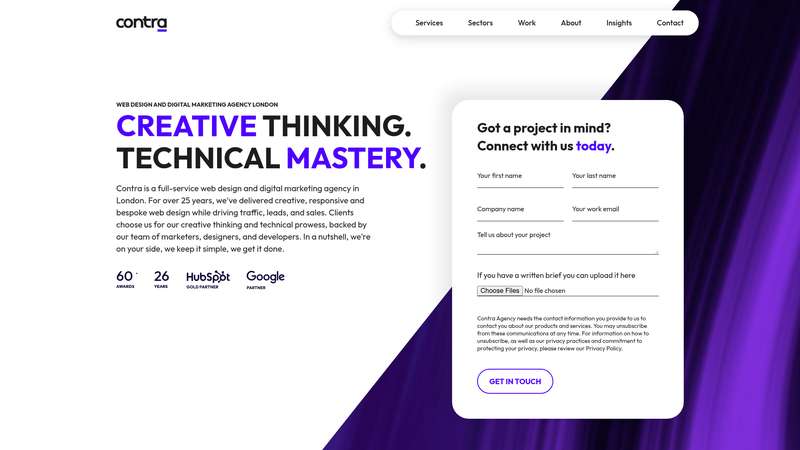
Contra’s visual identity deserves separate acknowledgement because it represents a genuine strategic asset. The dark, bold aesthetic is immediately distinctive. In a market where most agencies default to white backgrounds and sans-serif minimalism, Contra’s brand stands out. It signals confidence, technical seriousness, and a refusal to follow the crowd. This visual identity does real commercial work — it creates recognition and communicates personality before a single word is read. The problem is that the brand’s visual distinctiveness is not matched by commercial distinctiveness in the case studies. The outside of the building is memorable. The inside needs furnishing.
Sector navigation gaps
For an agency that has worked across multiple sectors over many years, the path from “I am in [sector]” to “here is relevant work” is not clearly defined. A prospect from healthcare, education, or the public sector has to browse the full portfolio to find work relevant to their context. Sector-specific landing pages — with filtered case studies, relevant expertise, and tailored messaging — would transform passive browsing into active engagement. The volume of work Contra has produced is an asset; the current architecture does not let prospects navigate it efficiently.
What Works
The visual identity is the standout. Dark, bold, and immediately recognisable — Contra’s brand is one of the most distinctive in the UK agency market. This is not a cosmetic choice. It is a positioning decision that communicates confidence and technical seriousness. In a market of visual conformity, distinctiveness is a competitive advantage.
The longevity of the agency is itself a proof point. Digital agencies fail at a high rate. An agency that has survived and continued to win awards over an extended period has demonstrated something that newer studios cannot claim: durability, adaptability, and the operational maturity to deliver complex work reliably over time.
The technical depth evident in the portfolio — complex builds, sophisticated platforms, challenging integrations — signals capability that simpler agencies cannot match. The work itself is not in question. The communication of its impact is.
The Wider Pattern
The “work without results” problem is not unique to Contra Agency. Across the firms and agencies we have reviewed, a pattern repeats: impressive capability presented without evidence of impact. Bexley Beaumont has won UK Business of the Year but presents its awards without narrative. KP Law takes on Google and M&S but lists its cases as bullet points. Contra Agency builds complex digital solutions and shows them as gallery pieces.
The underlying issue is the same in every case: these organisations have earned credibility through their work but have not structured their digital presence to communicate that credibility in the language prospects use to make decisions. Prospects do not ask “what have you built?” They ask “what happened when you built it?” Torchbox, one of Contra’s competitors, has started to answer this question — case studies include impact data, client outcomes, and measurable results. The agencies that follow this pattern are not just telling a better story. They are making it easier for prospects to justify the decision internally. In an era of procurement committees and ROI scrutiny, “we built something beautiful” is the beginning of the conversation. “It delivered these results” is the close.
If We Were Starting Fresh
The direction for Contra is clear: add results to the portfolio. Every case study should be restructured around the format of challenge, solution, and outcome. The work itself is strong enough to withstand scrutiny — it just needs the evidence layer. This means going back to clients for metrics, or at minimum, structuring case narratives around the business problems solved and the outcomes observed.
Sector authority pages would unlock the commercial value of the agency’s breadth. Rather than one portfolio for all prospects, sector-specific pages — with filtered work, tailored messaging, and sector expertise — would allow Contra to speak directly to the verticals where it has the deepest experience. An agency that has worked across healthcare, education, and the public sector has sector knowledge worth displaying. Right now, that knowledge is implied by the portfolio rather than stated as a capability.
The dark brand should be protected and extended. It is a genuine asset. But it needs to carry substance, not just style. The visual confidence of the brand should be matched by the commercial confidence of the content — results data, client testimonials with metrics, and thought leadership that positions Contra as an authority on complex digital delivery, not just a practitioner of it.
Wondering if YOUR brand has the same gaps?
We will tell you -- for free. Our team will analyse your website and brand, then send you an honest review.
Get Your Brand ReviewFeature Your Review
Display this badge on your website to showcase your independent brand review.