BIBICO
Industry: Sustainable Fashion
Thesis: Fair trade womenswear with artisan partners on two continents, presented through a template that could belong to any Shopify store.
Reviewed: April 2026
Who They Are
BIBICO is an ethical womenswear label founded in 2007 by Snow, a Spanish-born designer based in Bath. Snow spent her early career at Zara, where she watched production cycles compress from seasonal collections to one per week. She left to prove that a more sustainable approach to fashion was viable. Nineteen years later, BIBICO produces two collections per year in small runs, using organic cotton, pure wool, and lyocell sourced from artisan manufacturers in India, Nepal, and Italy. Two of the brand’s main producers are members of the World Fair Trade Organisation, providing work and social support to women from disadvantaged backgrounds. Products sit at the GBP 125–199 range, positioning BIBICO firmly in the premium ethical segment.
What We Noticed
The Story Behind the Menu
BIBICO’s most powerful content — its artisan partnerships, its founder’s journey from fast fashion to slow, its commitment to WFTO-certified producers — lives behind a dropdown menu labelled “Behind BIBICO.” There are six pages of genuinely compelling material here: Our Story, Our Journey, Our Producers, Our Materials, Fair Trade Clothing, and Mulesing Free Wool. The problem is location. These pages sit in the navigation, separate from the shopping experience, visited only by the already-curious. A first-time visitor browsing the dress collection will see product images, prices, and size options. They will not see the woman in India who made the dress, the organic cotton field where the fabric originated, or Snow’s personal reason for starting the brand. The story exists. It simply never meets the shopper.
Template Confidence vs. Brand Confidence
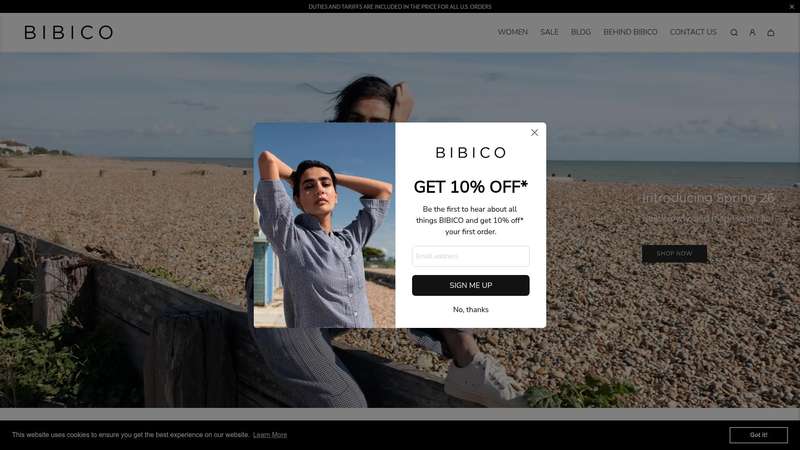
The website is built on a clean, functional Shopify theme. It works well — navigation is logical, product photography is consistent, the checkout flow is smooth. But the template is doing the heavy lifting, and the brand is doing very little on top of it. The homepage follows a pattern you will find on thousands of Shopify stores: hero banner, category tiles, product carousel, testimonials, newsletter signup, blog. Nothing in the visual language signals that this brand has a 19-year history of fair trade manufacturing. Nothing says “this is different.” The hero banner reads “Spring Allure — Clothing inspired by simplicity, nature & care.” It is pleasant. It is also interchangeable with a hundred other Shopify womenswear stores. The “Timeless, easy-to-wear clothing made with natural and sustainable fabrics” headline beneath it could be Thought, could be People Tree, could be any ethical fashion label. The unique elements — the WFTO partnerships, the artisan workshops, Snow’s personal journey from Zara’s weekly cycles to two collections a year — are absent from the first impression. The theme is competent. Competence, at a GBP 169 price point, is not enough.
Provenance Stops at the Fabric Composition
Product pages list fabric type, care instructions, and sizing. For a conventional retailer, that would be adequate. For a brand whose entire proposition is built on how and where its clothes are made, it is a missed opportunity. There is no maker attribution, no origin detail, no visual connection to the artisan workshop. Compare this with People Tree, which integrates producer stories into individual product listings, or Seasalt Cornwall, which ties every collection to a specific landscape. BIBICO’s product pages sell the garment. They do not sell the reason the garment matters.
The Founder Voice Is There — Barely
Snow’s story is one of BIBICO’s strongest assets. A Zara-trained designer who walked away from fast fashion to build something better — that is a narrative with genuine power. The About page tells this story well, in Snow’s own voice. The “Handpicked by Snow” collection in the navigation hints at personal curation. But these are isolated moments. Snow’s perspective does not carry through to collection descriptions, product stories, or the blog. The voice appears when you go looking for it. It does not shape the experience of browsing and buying.
What Works
The product photography is clean and consistent, with a natural, unforced aesthetic that suits the brand’s character. The “Handpicked by Snow” navigation item is a smart touch — it suggests personal involvement and taste, which is exactly what independent brands need to communicate. Customer testimonials are specific and credible (“most comfortable trousers ever — they actually fit”), suggesting genuine loyalty rather than manufactured endorsement. The blog, though infrequently updated, shows real editorial potential — the “Wash Less & Wear Longer” care guide is the kind of content that builds trust with a sustainability-minded audience. And the fabric-based navigation (Organic Cotton, Wool, Lyocell) is a genuinely useful way to let material-conscious shoppers find what they want.
The Wider Pattern
Across the ethical fashion brands we have reviewed, BIBICO’s situation is the most common: a brand with a genuine, verifiable sustainability story that presents itself through the same visual language as every other Shopify store. The physical product is differentiated. The digital experience is not. We see this pattern in homewares (Woven Rosa, with its artisan partners in Morocco and Portugal) and in food and drink (where provenance claims on packaging rarely translate to the website). The brands that solve this — Lush, with its maker profiles on every product, or The White Company, with its consistent visual identity across every touchpoint — treat their website as an extension of their brand story, not as a shop with an About page bolted on. The gap between what BIBICO is and what its website communicates is not a design problem. It is a storytelling architecture problem.
If We Were Starting Fresh
BIBICO does not need a rebrand. The product is strong, the story is real, the customers are loyal. What it needs is a digital experience that treats the brand’s provenance, its maker relationships, and its founder’s voice as core shopping content rather than supplementary reading. Every product page should feel like a window into the workshop where it was made. Every collection should carry the thread of why these clothes exist. The goal is not to add more content. It is to move the content that already exists — the artisan stories, the material sourcing, Snow’s personal perspective — from the margins of the site to the centre of the shopping experience.
Wondering if YOUR brand has the same gaps?
We will tell you -- for free. Our team will analyse your website and brand, then send you an honest review.
Get Your Brand ReviewFeature Your Review
Display this badge on your website to showcase your independent brand review.