Billy Tannery
Industry: Retail / Sustainable Luxury
Verdict: “British leather from rescued goat hides — a supply chain story the website mentions but never shows.”
Reviewed: April 2026
Who They Are
Billy Tannery is a microtannery on a Midlands farm, founded by Jack Millington after he discovered that not a single goatskin left over from the UK food industry was being tanned on home soil. The brand now runs its own vegetable tanning operation — one of a handful in Britain — producing bags, wallets, and accessories entirely from goat hides that would otherwise be discarded. It is a genuinely rare proposition: a British leather brand that controls every step from raw hide to finished product, operating from the same farm where the leather is tanned. A collaboration with Cheaney, the Northamptonshire shoemaker, extends the range into footwear. The bespoke and hospitality division serves hotels and restaurants looking for British-made leather goods with a provenance story.
What We Noticed
A supply chain told in sentences, not sequences
Billy Tannery has the most vertically integrated leather supply chain of any small brand in Britain. Goat hides arrive from the food industry. They are vegetable-tanned on-site using methods that predate industrial chemistry. Artisans cut and stitch the finished leather into products that ship from the same farm. That is an extraordinary sequence — and the website tells it in a paragraph of body text below the fold. The headline reads “A new kind of leather co.” which is accurate but abstract. The tanning drums, the hide selection, the stitching benches, the finished bag hanging in the workshop — none of these moments appear as the first thing a visitor sees. The process is described rather than demonstrated. For a brand whose entire proposition is how the product gets made, the making is strangely invisible.
Content depth versus design quality
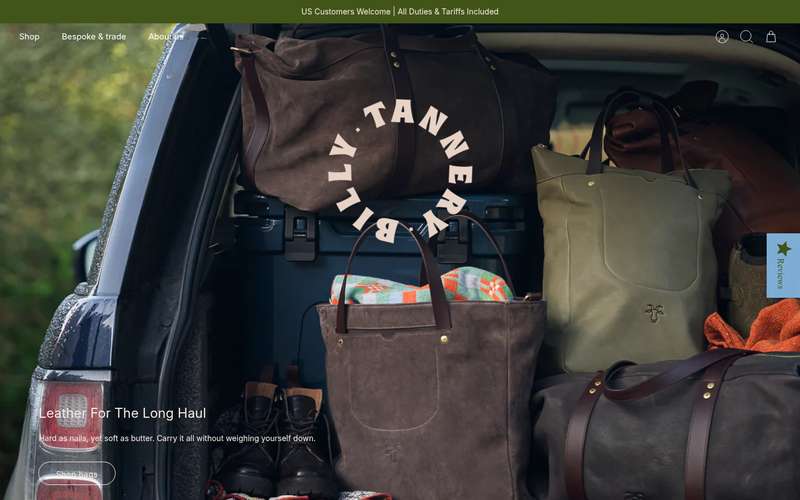
The visual design is clean, confident, and genuinely premium. Product photography is excellent — natural lighting, minimal backgrounds, close-ups that let you almost feel the grain of the leather. The Shopify build is well-executed. But the content sitting inside that design framework is thin. There is no editorial section. No long-form pieces about vegetable tanning versus chrome tanning. No essays about the economics of goat hide waste in the UK food industry. No process journal. The brand has one of the most interesting stories in British manufacturing, and the website treats it as a single “About Us” page rather than an ongoing conversation. The design says “we are serious.” The content says “we have said what we needed to say.”
The sustainability claim without the evidence
Every premium leather brand now claims sustainability. Billy Tannery’s claim is substantively different — they are rescuing a waste material and processing it with traditional, low-chemical methods — but the website does not make that distinction clearly enough. There are no impact metrics. No comparison of vegetable tanning versus chrome tanning in environmental terms. No data on how many hides are rescued annually or what would happen to them otherwise. The sustainability story is stated as a fact rather than built as a case. A visitor comparing Billy Tannery to any other brand claiming “sustainable leather” has no way to evaluate whose claim is stronger. The evidence exists. It just has not been published.
Mobile as a compression, not a translation
The desktop experience has room to breathe. The hero image fills the viewport, the typography sits comfortably, the product grids give each item space. On mobile, the same content compresses rather than being reimagined. The animated logo overlay scales down. The supporting text tightens. The browsing experience works — nothing breaks — but it loses the sense of space and craft that the desktop conveys. For a brand positioned on tactile quality and artisanal production, the mobile experience feels functional where it should feel considered.
What Works
The product photography is the strongest asset on the site. Each piece is shot in natural light against minimal backgrounds that let the leather speak. The close-up detail shots — showing grain texture, stitch quality, the way the leather ages — do more to communicate quality than any headline could. The Billy x Cheaney collaboration is presented with the same visual standard, and the pairing itself is smart: two British makers, different crafts, shared values.
The “Bespoke & Trade” section signals commercial maturity. Most DTC leather brands treat B2B as an afterthought. Billy Tannery positions it as a genuine division, offering hospitality and corporate clients access to the same materials and craftsmanship. This is not just revenue diversification — it reinforces the brand’s credibility. A hotel choosing your leather for its interiors says something different from a consumer buying a wallet.
The brand voice, when it appears, is honest and specific. “After discovering that not one goatskin left over from the UK food industry was being tanned on home soil, we decided to do something.” That is a founding statement with genuine weight.
The Wider Pattern
Across the brands we have reviewed, there is a recurring gap between the strength of a supply chain story and the depth of its digital telling. Grind has compostable coffee pods that solve the biggest environmental objection to the category — but its homepage leads with discount codes. Elvis & Kresse transforms decommissioned fire hoses into luxury bags — but presents the transformation in paragraphs rather than immersive visuals. Billy Tannery fits the same pattern: a supply chain story so unusual it would stop you mid-sentence at a dinner party, told on a website that treats it as background context.
The brands that convert supply chain stories into premium pricing are the ones that show the process, not just describe it. Transparency in sustainable luxury is not a paragraph on an About page. It is the entire browsing experience — from the raw material to the finished product, visible at every stage.
If We Were Starting Fresh
The tannery itself would become the centre of the digital experience. Not the products. Not the product categories. The farm, the drums, the hides, the artisans. The journey from discarded goatskin to finished leather bag is inherently cinematic — it involves animals, agriculture, chemistry, craft, and a genuine argument about industrial waste. That journey would be the homepage.
Products would be presented as the output of a process, not as standalone items in a grid. Each product page would link back to the stage of production it represents — this bag started as a hide that arrived on this date, was tanned for this many weeks, was stitched by this person. The sustainability case would be built with data: hides rescued, chemical comparisons, carbon footprint versus imported leather. The editorial layer would match the visual quality — long-form content about British tanning history, the economics of goat hide waste, the difference between vegetable and chrome tanning.
Billy Tannery has already done the hardest thing: built a vertically integrated, genuinely sustainable leather supply chain in Britain. The website needs to show that chain, not just mention it.
Wondering if YOUR brand has the same gaps?
We will tell you -- for free. Our team will analyse your website and brand, then send you an honest review.
Get Your Brand ReviewFeature Your Review
Display this badge on your website to showcase your independent brand review.