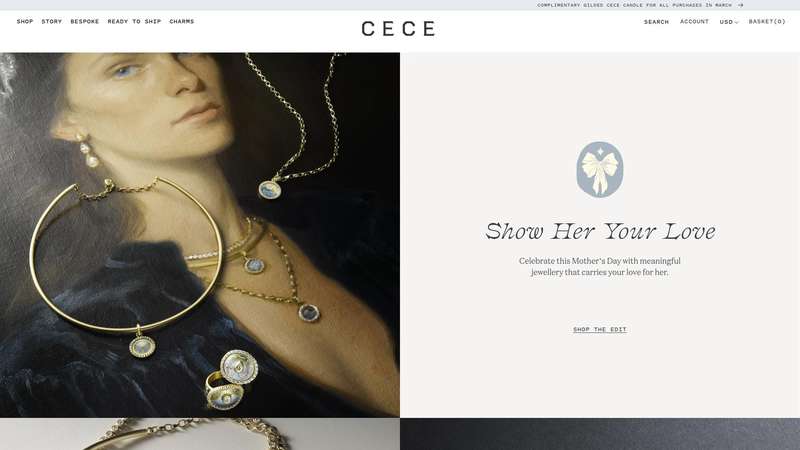
Cece Jewellery
Industry: Fine Jewellery
Thesis: Hand-enamelled talismans on solid gold — a craft process invisible on the product page.
Reviewed: April 2026
Who They Are
Cece Jewellery is a London-based fine jewellery brand founded by Cece Fein-Hughes. Every piece is hand-enamelled on 18ct gold, designed as a personal talisman imbued with meaning and storytelling. Collections range from playful reimaginings of British idioms (“The Devil Is In The Detail”) to diamond heirlooms and one-of-a-kind charms. Prices span from around GBP 3,000 for signet rings to over GBP 22,000 for statement pieces, placing Cece firmly in the fine jewellery segment. The brand also offers a bespoke service, inviting customers into “an intimate journey of creation and storytelling.” The photography is painterly and atmospheric — pieces are shot alongside fine art, candlelight, and velvet, evoking Renaissance still life rather than conventional product imagery. The Instagram presence is strong, consistent, and visually distinctive.
What We Noticed
The Craft That Never Appears
Cece Jewellery’s primary differentiator is hand-enamelled work on solid 18ct gold. This is a rare, labour-intensive process — each piece is painted by hand, fired, and finished individually. No two are identical. It is the kind of provenance that luxury houses build entire campaigns around: the enamel being applied, the colours emerging from the kiln, the goldsmith at the bench. The homepage states this in a single line: “Hand-enamelled on solid 18ct gold, Cece Jewellery is an ode to the alchemy of fine jewellery craft.” There is a “Behind the Pieces” page. But on the product pages themselves — where a customer is deciding whether a GBP 5,000 ring justifies its price — the making process is absent. The customer sees the finished talisman. They do not see the alchemy. At this price point, the distance between a photograph of a ring and a photograph of a ring being made is the distance between a product and a story worth paying for.
Sold Out as Dead End
The bestsellers section presents four pieces, all marked “Sold out.” The newest arrivals include a GBP 17,703 locket and a GBP 22,556 charm — both also sold out. In isolation, this signals demand. In the customer experience, it creates frustration. There is no waitlist. There is no “notify me when available.” There is no prompt suggesting the bespoke service as an alternative (“Love this piece? Let us create something similar, made just for you”). The sold-out state is a dead end rather than a doorway. For a brand that offers bespoke work, every sold-out page should be an invitation to commission, not a closed door.
The Bespoke Service Hidden in Plain Sight
The “Make it Bespoke” offering appears on the homepage as one block among several, and has its own page with evocative copy. But given the frequency of sold-out stock, the bespoke service may be Cece’s most important revenue channel. If so, it is dramatically under-positioned. Competitors like Foundrae treat personalisation as a core experience, not an add-on. Alighieri builds narrative depth around each piece that naturally invites custom requests. Cece’s bespoke page describes the process beautifully — “a personal mythology, crafted in gold and enamel” — but this description sits in the same visual hierarchy as a product carousel. The invitation to create something unique should be the heartbeat of the site, not a sidebar.
Narrative Fragments Without a Through-Line
The brand is rich in narrative material. Collection names are thoughtful (“The Devil Is In The Detail”). The concept of “personal talismans” is emotionally resonant. The “Teachings” page promises the meaning behind each piece. But these narrative elements are distributed across the site as isolated blocks rather than woven into a coherent editorial journey. A customer browsing the collection encounters fragments of story — a phrase here, a reference there — without a sustained narrative that carries them from discovery to desire. The Instagram feed, embedded on the homepage, ironically does more storytelling work than the site’s own content architecture.
What Works
The photography is the brand’s defining strength. The painterly, candlelit aesthetic — pieces shot alongside fine art and rich textures — creates an atmosphere that most jewellery brands cannot achieve. This is not product photography. It is image-making. The result is an immediate, visceral sense of the world Cece inhabits, and by extension, the world the customer is invited into. The “Skeleton Lovers Pendant” and “To The Moon & Back Ring” are pieces with genuine emotional charge — they feel like meaningful objects, not decorative ones. The bespoke copy, where it appears, is genuinely well-written (“an intimate journey of creation and storytelling” is the kind of language that earns trust at this price point). And the collection theming shows a designer who thinks in narratives, not just aesthetics.
The Wider Pattern
The gap between physical craft and digital representation is perhaps the most persistent challenge in fine jewellery e-commerce. We see it across the sector: the more distinctive the making process, the less likely it is to appear on the product page. Cece shares this pattern with other craft-led jewellers, but also with artisan brands in other categories — ADKN London, whose London studio and 14-hour trench coats are documented in blog posts but absent from product pages, and P.Louise, whose behind-the-scenes beauty content drives engagement precisely because it shows the process alongside the product. The brands that close this gap — showing the making, not just the made — consistently command stronger price justification and deeper customer loyalty.
If We Were Starting Fresh
Cece Jewellery does not need a different aesthetic. The photography, the narrative instinct, and the product itself are all exceptional. What the digital experience needs is architecture that matches the brand’s depth. The hand-enamel process should be visible on every product page — not as a text description, but as imagery and video that shows the craft in progress. The bespoke service should be elevated from a page among pages to the central invitation of the site. And the sold-out state should become a gateway to commission rather than a dead end. The goal is not to add more content. It is to build a digital atelier where the craft, the story, and the commerce exist as a single, seamless experience.
Wondering if YOUR brand has the same gaps?
We will tell you -- for free. Our team will analyse your website and brand, then send you an honest review.
Get Your Brand ReviewFeature Your Review
Display this badge on your website to showcase your independent brand review.