Fable & Co
Industry: Legal & Law
Verdict: “A strategy-led agency presenting itself as a portfolio — the thinking is invisible.”
Reviewed: April 2026
Who They Are
Fable & Co is a branding and design agency that creates brand strategies, visual identities, and digital experiences. The agency positions itself as strategy-led — the work begins with thinking, not aesthetics. They serve clients across sectors, with a portfolio that demonstrates genuine design capability and a client list that includes recognisable names. In a crowded UK agency market, Fable & Co has chosen to differentiate on depth of thinking rather than volume of output. Their competitors include Bunch, Ragged Edge, and DesignStudio — agencies that have each found ways to make their strategic process visible to prospects before a single meeting takes place.
What We Noticed
The invisible methodology
Fable & Co says it is strategy-led. The website shows design. Case studies present the finished visual identity, the completed website, the polished campaign — but the strategic thinking that informed those decisions is absent. A visitor sees what was made. They do not see why it was made, what alternatives were considered, what research shaped the direction, or what strategic framework underpinned the creative output. This is the difference between a portfolio and a case for hiring. A portfolio shows capability. A strategic narrative shows how that capability is applied. The thinking is Fable & Co’s stated differentiator, and it is the one thing the website does not display.
The consultancy-studio gap
There is a meaningful commercial difference between being perceived as a design studio and being perceived as a brand consultancy. Studios compete on aesthetics and are compared on portfolio. Consultancies compete on thinking and are compared on process. Fable & Co’s positioning says consultancy. Its website says studio. The site architecture prioritises gallery-style project display over any articulation of methodology, strategic frameworks, or intellectual approach. This is not a semantic distinction — it affects pricing power, client expectations, and the types of briefs the agency attracts. A consultancy can charge for strategy. A studio is often asked to skip it.
Case studies without causation
The project pages show strong visual work. But they follow a pattern: the brief, the visual solution, the deliverables. What is missing is the connective tissue — the insight that led to the direction, the strategic choice between options, the reasoning behind the visual decisions. Every agency shows beautiful work. The agencies that win on strategy show why the work looks the way it does. Ragged Edge, one of Fable & Co’s direct competitors, structures its case studies around the strategic narrative first, with the visual work serving as evidence of the thinking. The result is that a prospect finishes reading feeling they understand how Ragged Edge thinks, not just what they make. Fable & Co’s case studies do not yet achieve this.
Content depth as a signal
The website does not include substantial thought leadership, methodology articles, or frameworks that would signal the depth of strategic thinking happening behind the scenes. For an agency whose value proposition is “we think before we design,” the absence of visible thinking is conspicuous. In the agency market, content depth has become a proxy for strategic capability. Prospects evaluate whether an agency can think about their brand by reading how that agency thinks about its own.
What Works
The design craft is genuinely strong. The portfolio demonstrates real visual capability — these are not template-driven projects but considered, distinctive brand identities. The quality of the output is not in question.
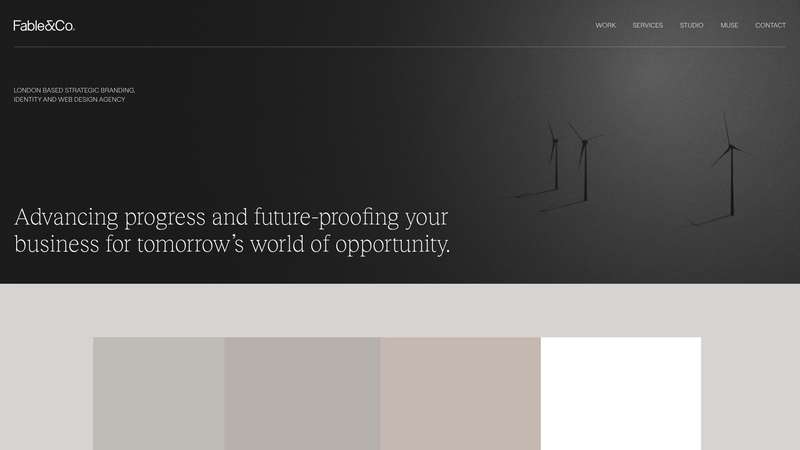
The visual identity of Fable & Co itself is clean and confident. The agency practices what it preaches in terms of aesthetic standards. The website is well designed as an object. The issue is what the design communicates, not how it looks.
The decision to position on strategy rather than aesthetics is the right commercial choice. In a market where AI tools are making baseline visual design increasingly accessible, the agencies that will hold premium positioning are those that can demonstrate strategic value. Fable & Co has made the right bet — it just has not yet made that bet visible to prospects browsing the website.
The Wider Pattern
The “invisible strategy” problem is not unique to Fable & Co. Across the agencies and professional services firms we have reviewed, a pattern repeats: the thing that makes a firm genuinely valuable is the thing most poorly communicated on the website. Bexley Beaumont’s B-Corp certification — buried below the fold. Beyond Law Group’s multi-brand model — fragmented across six websites. Fable & Co’s strategic methodology — hidden behind a portfolio.
The firms and agencies that have closed this gap tend to share one characteristic: they treat their website as a demonstration of their thinking, not just a catalogue of their output. Ragged Edge shows strategy. Pentagram shows process. The best consultancies in any sector make their methodology visible before a prospect ever picks up the phone. In professional services, the product is the thinking. If the thinking is invisible, the product is invisible — and what remains is a portfolio competing on aesthetics in a market where aesthetics alone is becoming a commodity.
If We Were Starting Fresh
The direction for Fable & Co is to make the thinking visible. Case studies should be restructured around the strategic narrative — the insight, the choice, the reasoning — with the visual work serving as evidence rather than centrepiece. This does not mean less design in the portfolio. It means more context around the design.
A methodology section — not a page of buzzwords but an honest articulation of how Fable & Co approaches brand strategy — would give prospects a reason to believe the “strategy-led” claim before seeing a single project. Thought leadership content — articles, frameworks, perspectives on branding — would further establish the intellectual credibility that the positioning promises.
The site architecture itself should shift from gallery to narrative. Rather than project tiles arranged in a grid, the experience should guide a visitor through Fable & Co’s worldview: what the agency believes about branding, how those beliefs inform its process, and what that process produces. The portfolio remains essential. But it stops being the whole story and starts being the evidence for a larger argument about why strategy-led branding produces better outcomes.
Wondering if YOUR brand has the same gaps?
We will tell you -- for free. Our team will analyse your website and brand, then send you an honest review.
Get Your Brand ReviewFeature Your Review
Display this badge on your website to showcase your independent brand review.