Finisterre
Industry: Retail & DTC
Verdict: “A cold-water surf brand whose website has forgotten the ocean.”
Reviewed: April 2026
Who They Are
Finisterre was founded in 2003 by Tom Kay from a flat above a surf shop in St Agnes, Cornwall. The brand takes its name from the shipping forecast area — Finisterre, meaning “end of the earth” — and was built for the specific reality of cold-water surfing in the British Isles. Not California sunshine and boardshorts, but January Atlantic swells, 8-degree water and coastline that demands serious kit. Finisterre was one of the UK’s earliest B Corp-certified fashion brands, building recycled and natural materials into its supply chain before sustainability became a standard marketing claim. The company operates stores in London, Bristol, Edinburgh and St Ives, and competes with Patagonia, Passenger and Saltrock — though its positioning sits in a distinct space between Patagonia’s activism and Passenger’s lifestyle storytelling.
What We Noticed
The Missing Coastline
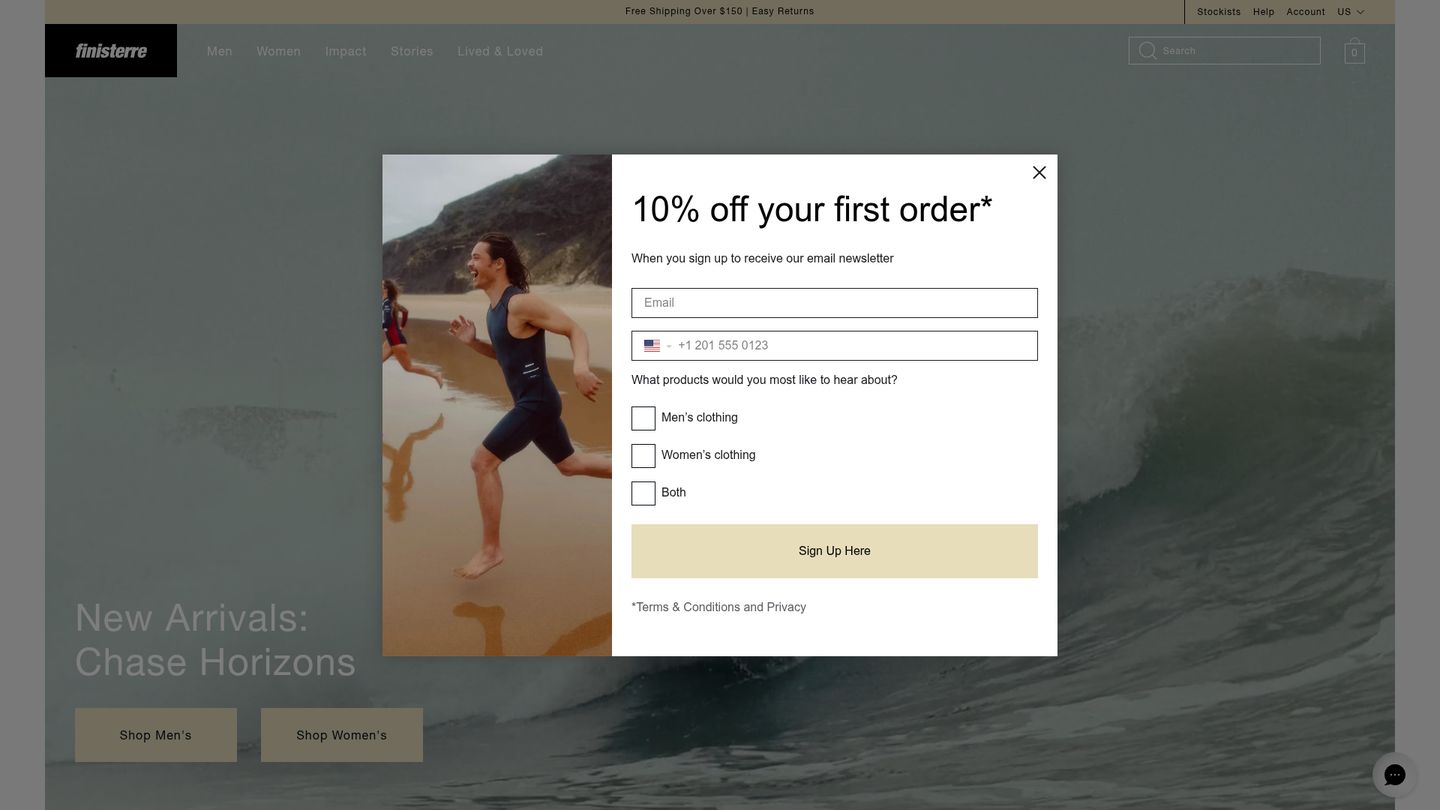
Finisterre’s homepage opens with a product grid. Jackets, fleeces, layering pieces — well-photographed, cleanly laid out, commercially sensible. What is absent is the ocean. There is no Atlantic above the fold. No Cornwall. No cold water. A visitor arriving with no prior knowledge of the brand would see a competent outdoor clothing retailer, indistinguishable from dozens of others. The very thing that makes Finisterre singular — its relationship with a specific coastline and a specific kind of surfing — has been designed out of the first impression. The name means “end of the earth,” and the website looks like it could be based in a retail park.
The Compartmentalised Conscience
Finisterre’s sustainability credentials are genuine and deep. B Corp certification, recycled materials, natural fibres, repair programmes, wetsuit recycling. But on the website, these commitments live in a dedicated sustainability section — a silo that a customer must actively seek out. The product pages carry minimal material-sourcing information. The homepage carries none. Sustainability has been treated as a content category rather than as a lens through which every product is presented. When Patagonia puts environmental impact data on every product page, it makes sustainability inseparable from the purchase decision. Finisterre has the credentials to do the same. It just has not connected them to the shopping experience.
The Founder in the Background
Tom Kay’s founding story has real texture — a surfer who could not find kit that worked in cold water, who started making it above a shop in a Cornish village. It is specific, it is authentic, and it is the kind of origin that luxury and outdoor brands spend years trying to construct. On the website, it is buried. The homepage offers no trace of the founder, the founding moment or the specific problem the brand was created to solve. In a market where Patagonia’s Yvon Chouinard is inseparable from the brand, and where Passenger’s Ben Mercer weaves his story through the entire digital experience, Finisterre’s founder has been quietly moved to the “about” page.
What Works
The product photography is excellent. Finisterre’s imagery captures real environments — actual coastline, actual weather, actual cold — which is a meaningful distinction from brands that shoot everything in a studio or on a Californian beach. The colour palette across the site is restrained and consistent, reflecting the brand’s aesthetic without feeling sterile. The repair and resale programme is well-documented, with clear instructions and a process that feels genuinely considered rather than bolted on. The wetsuit recycling initiative — one of the first in the UK — is a real differentiator that few competitors can match. Size guides are detailed, and the returns process is straightforward. The journal section carries strong long-form content about surfing culture, environmental projects and material innovation. Store pages have individual personality, particularly St Ives, which communicates place in a way the homepage does not. The email programme is well-curated and carries more brand personality than the website itself.
The Wider Pattern
This is a tension we see across outdoor and lifestyle brands that have grown beyond their founding geography — the pull between scalable e-commerce and place-specific identity. Patagonia resolved it by making activism the homepage, not the product grid. Passenger resolved it by building the founder’s lifestyle into every touchpoint. Finisterre has not yet resolved it, and the result is a website that could belong to any mid-premium outdoor brand. We saw a version of this in our food-and-drink reviews — brands with strong physical identities that flatten when translated to digital. The difference here is that Finisterre’s identity is not just aesthetic. It is geographical. Cornwall and the Atlantic are not brand attributes — they are the reason the company exists. Losing them online is losing the brand’s centre of gravity.
If We Were Starting Fresh
We would put the ocean on the homepage. Not as a background image behind a product grid, but as the opening experience — the Atlantic, the Cornish coast, the reality of cold-water surfing that the brand was built for. The first five seconds should tell a visitor that this is not another outdoor clothing shop. This is a brand that comes from a specific place, solves a specific problem and was founded by a surfer who could not find what he needed.
Sustainability should be woven into the product pages, not compartmentalised. Every jacket, every fleece, every base layer has a material story — where the recycled polyester comes from, how the merino is sourced, what the environmental footprint looks like. That information should sit alongside the price and the size guide, not on a separate page that most customers will never visit.
Tom Kay’s founding story should be visible from the homepage. Not as a corporate history, but as a living narrative — the surf shop in St Agnes, the first prototypes, the reason this brand exists. Patagonia made Yvon Chouinard’s story synonymous with the brand. Finisterre has the same opportunity with a founder who is still actively shaping the business.
Cornwall should be a texture that runs through the entire digital experience — in the photography, in the language, in the way the stores are presented. The St Ives store page already does this well. The question is why the rest of the site does not follow its lead. When your brand is named after a shipping forecast area, the sea should be inescapable.
Wondering if YOUR brand has the same gaps?
We will tell you -- for free. Our team will analyse your website and brand, then send you an honest review.
Get Your Brand ReviewFeature Your Review
Display this badge on your website to showcase your independent brand review.