Fitness Worx
Industry: Fitness / Gym Chain
Verdict: “A family-built brand wearing a franchise costume.”
Reviewed: April 2026
Who They Are
Fitness Worx is a Midlands-born gym group founded in 2014 by Jack Gibson and his father Rich, who built their first facility in Kenilworth with their own hands. The chain now operates 10 locations stretching from Bristol to the Midlands, with an expansion target of 25 sites from Manchester to London. Each site offers 24-hour access across approximately 10,000 square feet, equipped with Nautilus and StarTrac machines, Hyrox training areas, saunas, and over 150 weekly classes. Among those classes is Baby Worx, a programme where parents train alongside their babies. Membership sits at 45 pounds per month with a single membership granting access to all locations.
What We Noticed
The invisible founder story
Jack Gibson and his father Rich did not franchise a format. They built their first gym by hand, literally constructing the space themselves before opening the doors in Kenilworth. That origin story is the single most powerful brand asset Fitness Worx possesses, and the website barely mentions it. In a market dominated by PureGym, The Gym Group, and JD Gyms, which compete on price, scale, and corporate efficiency, a father-and-son founding narrative is the one thing those brands cannot replicate. Every budget chain would trade a hundred locations for an authentic founding story with that level of texture. Yet the website treats the Gibson family history as supplementary information rather than the cornerstone of the brand’s identity.
Programme differentiation lost in the class list
Baby Worx, where parents bring their babies to train alongside them, is a genuinely original programme. It solves a real problem for new parents who want to maintain fitness but cannot arrange childcare. In a sector where class offerings blur together across competitors, this is a standout. The problem is presentation. Baby Worx appears as one line item in a list of 150 weekly classes, given no more prominence than a standard spin session or circuits class. There is no dedicated section, no imagery, no testimonials from parents who use it. The programme that could define the brand in local markets sits undifferentiated in a timetable.
Pricing as a hidden advantage
At 45 pounds per month for multi-site, 24-hour access with premium equipment, saunas, and Hyrox areas, Fitness Worx occupies an unusual position: meaningfully better than budget gyms on facilities, meaningfully cheaper than boutique studios. That value proposition is strong, but the pricing is buried. A prospective member visiting the website cannot quickly determine what membership costs without navigating through multiple pages. In a market where PureGym puts pricing on every landing page, this friction is unnecessary. The 45 pound figure is not a weakness to hide. It is a competitive advantage to lead with.
Generic energy where specific character should be
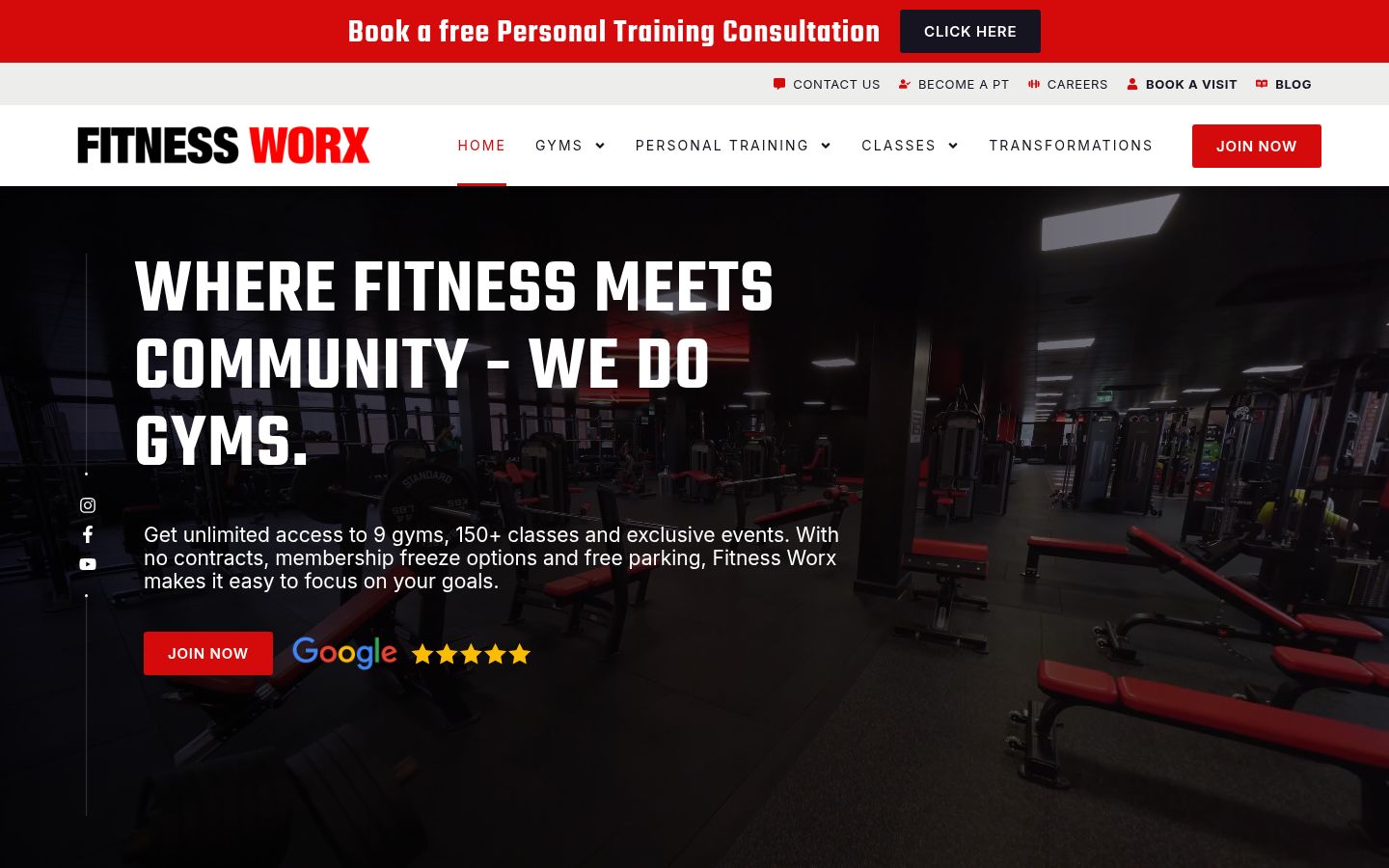
The dark-mode, high-energy aesthetic is competent. Bold typography, strong colour, motivational language. The problem is that it is interchangeable with any mid-market gym brand in the country. The visual language communicates “gym” without communicating “Fitness Worx.” The text is heavy and repetitive, cycling through the same motivational phrases that every competitor uses. There is no video content showing the actual spaces, the equipment, or the community. A visitor cannot distinguish this from a PureGym or JD Gyms landing page on visual identity alone, which is a missed opportunity for a brand with a genuinely different story to tell.
What Works
The multi-site, single-membership model is well structured and creates genuine convenience for members who live or work across different areas. The equipment standard, Nautilus and StarTrac across all locations, is a clear step above what budget competitors offer, and the inclusion of saunas and Hyrox training areas adds tangible differentiation at the facility level. The “Friends Get Benefits” referral programme is a smart mechanism for community-driven growth, and the 24-hour access model removes one of the most common friction points in gym membership.
The ambition to scale from 10 to 25 locations shows a business with momentum, and the geographic strategy of filling the corridor from Manchester to London via the Midlands is pragmatic rather than scattered.
The Wider Pattern
This pattern of buried differentiation is something we encounter repeatedly across the brands we review. Wild Nutrition, which we examined alongside Fitness Worx, has its own version of the same challenge: a clinically trained founder and a patented supplement methodology that the website presents as secondary content rather than the lead story. In both cases, the thing that makes the brand genuinely different from its competitors requires effort to discover.
For fitness brands specifically, the challenge is acute. The budget gym sector has commoditised the category so thoroughly that most gym websites now look and sound identical. Dark backgrounds, motivational copy, equipment shots, pricing tables. The brands that break through this noise are the ones that lead with something personal: a founding story, a community programme, a point of view on training that is not interchangeable with the chain next door. Fitness Worx has all of those elements. The website simply does not foreground them.
We see this in hospitality too. From boutique hotels to independent restaurant groups, the operational reality of what makes a brand special often lives one click deeper than the homepage, where most visitors never reach.
If We Were Starting Fresh
The direction would be to anchor the entire brand experience in what makes Fitness Worx structurally different from every budget chain: it was built by hand, by a family, and it still operates with that mentality. The Gibson story would not sit on an “About” page. It would inform the visual language, the tone of voice, and the way each location is introduced. Programmes like Baby Worx would receive dedicated positioning as signature offerings rather than appearing as line items in a timetable. Pricing would be visible and confident, framed against what members actually get for 45 pounds compared to the budget alternatives. And the expansion story, from one hand-built gym to 25 locations, would be told as a mission narrative rather than a corporate milestone. The goal would be to ensure that the brand’s growth feels like the continuation of a family’s ambition, not the replication of a format.
Wondering if YOUR brand has the same gaps?
We will tell you -- for free. Our team will analyse your website and brand, then send you an honest review.
Get Your Brand ReviewFeature Your Review
Display this badge on your website to showcase your independent brand review.