Green People
Industry: Wellness
Verdict: “A pioneer of organic beauty with a homepage that reads like a clearance sale at a health food shop.”
Reviewed: April 2026
Who They Are
Green People was founded in 1997 by Charlotte Vohtz after her young daughter Alexandra developed severe skin allergies and eczema. Charlotte discovered that most products labelled “natural” contained less than 1% natural ingredients. Unable to find anything gentle enough for her daughter’s skin, she formulated her own. By 1999, Charlotte was invited onto a Soil Association committee to help design the world’s first standards for organic beauty products. Green People became the world’s first certified organic skincare brand. The company remains an independent family business based in Sussex, with over 50,000 five-star customer reviews, more than 300 industry awards, and a product range spanning skin care, hair care, body care, sun care, toothpaste, baby products, men’s grooming, and a wellbeing range launched in Alexandra’s name. Alexandra Kay passed away in 2021 at the age of 28 from complications of Ehlers-Danlos Syndrome, an incurable connective tissue disorder. The wellbeing range continues in her memory.
What We Noticed
The crowded shelf
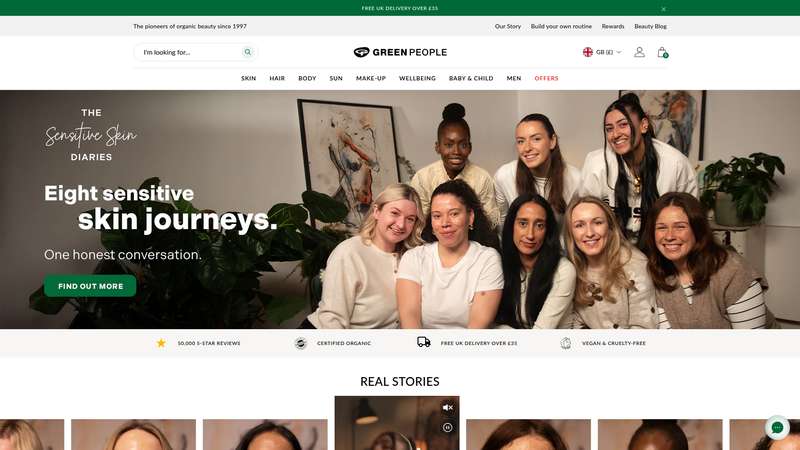
The Green People homepage presents itself like a well-stocked health food shop where every product is fighting for eye contact. Category roundels across the top (Offers, Skin Care, Sun Care, Hair Care, Body Care, Wellbeing, Baby & Child, Toothpaste, Men). A hero banner. Trust badges. A “Shop by Concern” filter. Product cards with star ratings and “Add to Bag” buttons. A bestsellers carousel. A testimonial slider. A blog section. A newsletter signup. An SMS signup. A loyalty scheme link. A subscription link. Each element is individually reasonable. Together, they create a homepage that asks the visitor to process a dozen competing signals before they have understood what Green People is or why it matters. The brand that helped write the standards for organic beauty greets new visitors with the same visual density as a Shopify clearance page.
The founder three scrolls away
Charlotte Vohtz helped create the regulatory framework for organic beauty. She formulated products for a daughter whose skin could not tolerate what the industry called “natural.” That daughter grew up to launch her own wellbeing range before passing away at 28. This is one of the most powerful founding stories in British beauty — and it sits below multiple product grids, below the testimonials carousel, below the “Shop by Concern” section. A small tile reads “Our story” with a thumbnail image and two sentences of introduction. The emotional and scientific heart of the brand has been compressed into a content block that most visitors will never reach.
The science beneath the commerce
Green People’s genuine expertise — botanical formulation, organic certification standards, sensitive skin science — lives in blog posts. The “Natural Beauty Blog” contains substantive articles: SPF guides, ingredient deep-dives, authored pieces by named experts. This is real editorial content, the kind that builds trust and authority. But it appears below the fold, after the product grids and promotional widgets, framed as supporting content rather than the brand’s voice. The knowledge that makes Green People credible is treated as supplementary reading rather than the lens through which every product should be understood.
Conversion mechanics as wallpaper
The homepage runs on Rebuy-powered upsell widgets, “Special Offer” prompts in the slide-out cart, a 20% newsletter discount, an SMS signup, and a loyalty scheme badge. Each is a standard Shopify conversion tool. But when every surface of the experience is optimised for the next click, the brand voice gets squeezed into the gaps between commerce widgets. Neal’s Yard Remedies — a direct competitor — leads with its apothecary heritage and lets the ethical positioning drive the purchase decision. Pai Skincare strips its digital experience back to essentials: sensitive skin expertise, clean design, quiet confidence. Green People has a stronger founding story and deeper scientific credentials than either. The website does not reflect that.
What Works
The “Shop by Concern” navigation is genuinely useful. For a brand whose core audience is people with sensitive, reactive, or problematic skin, allowing visitors to filter by Sensitive Skin, Anti-Ageing, Dry Skin, or Spots & Acne is smart information architecture. It meets the customer where they are — with a problem, not a product category.
The review volume is extraordinary. Individual products carry hundreds or thousands of verified reviews: 2,401 for the Scent Free Sun Cream SPF30, 1,499 for the Scent Free 24-Hour Cream, 886 for the Scent Free Shampoo. In organic beauty, where scepticism about efficacy is the primary purchase barrier, this density of social proof is a genuine competitive asset. No competitor in the certified organic space comes close.
The blog content is substantive and authored. Articles like “Essential guide to SPFs and UV protection” (18-minute read, authored by Lucy Thorpe) demonstrate the kind of editorial depth that builds topical authority. This is not content marketing filler. It is expert-led education.
The product range breadth — from baby toothpaste to anti-ageing serums, from men’s grooming to sun care — under a single certified organic standard is a genuine achievement of formulation. Most organic brands specialise in one category. Green People covers the full spectrum.
The Wider Pattern
Purpose-driven beauty brands face a consistent structural challenge as they scale: the mission that built the audience gets pushed further down the page to make room for the product catalogue. We see this with Lush, whose six ethical pillars — the most radical commitments in mainstream beauty — live in the footer while seasonal collaborations occupy the hero. We see it with Neal’s Yard, which has the heritage but increasingly defaults to promotional mechanics on its homepage. Green People’s version of this tension is perhaps the most acute, because the founding story is not just compelling marketing — it is a genuine scientific contribution to an industry that was, by Charlotte’s own account, lying to its customers about what “natural” meant. A brand that rewrote the rules on organic beauty ingredients should not need to compete with its own “Special Offer” widgets for attention.
If We Were Starting Fresh
We would make Charlotte the front door. Not as a founder bio buried on an “About” page, but as the lens through which every product, every ingredient, and every formulation decision is understood. This is a brand built by a mother who could not find safe skincare for her daughter and ended up helping create the certification standards for an entire industry. That story is the brand. It should be the first thing a visitor encounters.
The ingredient expertise would move from the blog to the product experience. Every product page would connect the formulation back to the science — why this ingredient, how it was sourced, what Charlotte’s team discovered about its interaction with sensitive skin. The 50,000 reviews would be woven into this narrative, not as a trust badge in the header bar, but as evidence that the science works.
The homepage would breathe. Fewer widgets, fewer promotional signals, more space for the brand to communicate what it actually is: the world’s first certified organic skincare company, built from a mother’s refusal to accept that “natural” meant nothing. The commerce would still be there. But the visitor would understand why these products exist before being asked to buy them.
And Alexandra’s story would be honoured properly. Not as a timeline entry on a subpage, but as the emotional thread that connects Green People’s past to its present — a reminder that this brand was always, from the very first formulation, about protecting the people who need it most.
Wondering if YOUR brand has the same gaps?
We will tell you -- for free. Our team will analyse your website and brand, then send you an honest review.
Get Your Brand ReviewFeature Your Review
Display this badge on your website to showcase your independent brand review.