Greene King
Industry: Hospitality
Verdict: “A brewer since 1799 with 2,600 pubs — and a homepage that reads like a voucher book.”
Reviewed: April 2026
Who They Are
Greene King was founded in 1799 by Benjamin Greene in Bury St Edmunds, Suffolk. The brewery still operates on the same site, producing IPA, Abbot Ale, Old Speckled Hen, and a range of seasonal and craft beers. The company has grown to become the UK’s largest pub retailer, operating over 2,600 pubs across England, Wales, and Scotland through a mix of managed and tenanted models. The pub portfolio spans several sub-brands — Hungry Horse (value family dining), Flaming Grill (casual dining), Chef & Brewer (premium dining), and others — each targeting a different segment of the eating-out market. Greene King is, by the numbers, the most established and most widely distributed pub company in Britain: 225 years of brewing, nearly 3,000 venues, and a beer that has been brewed in the same Suffolk town since George III was on the throne.
What We Noticed
Promotional mechanics as the front door
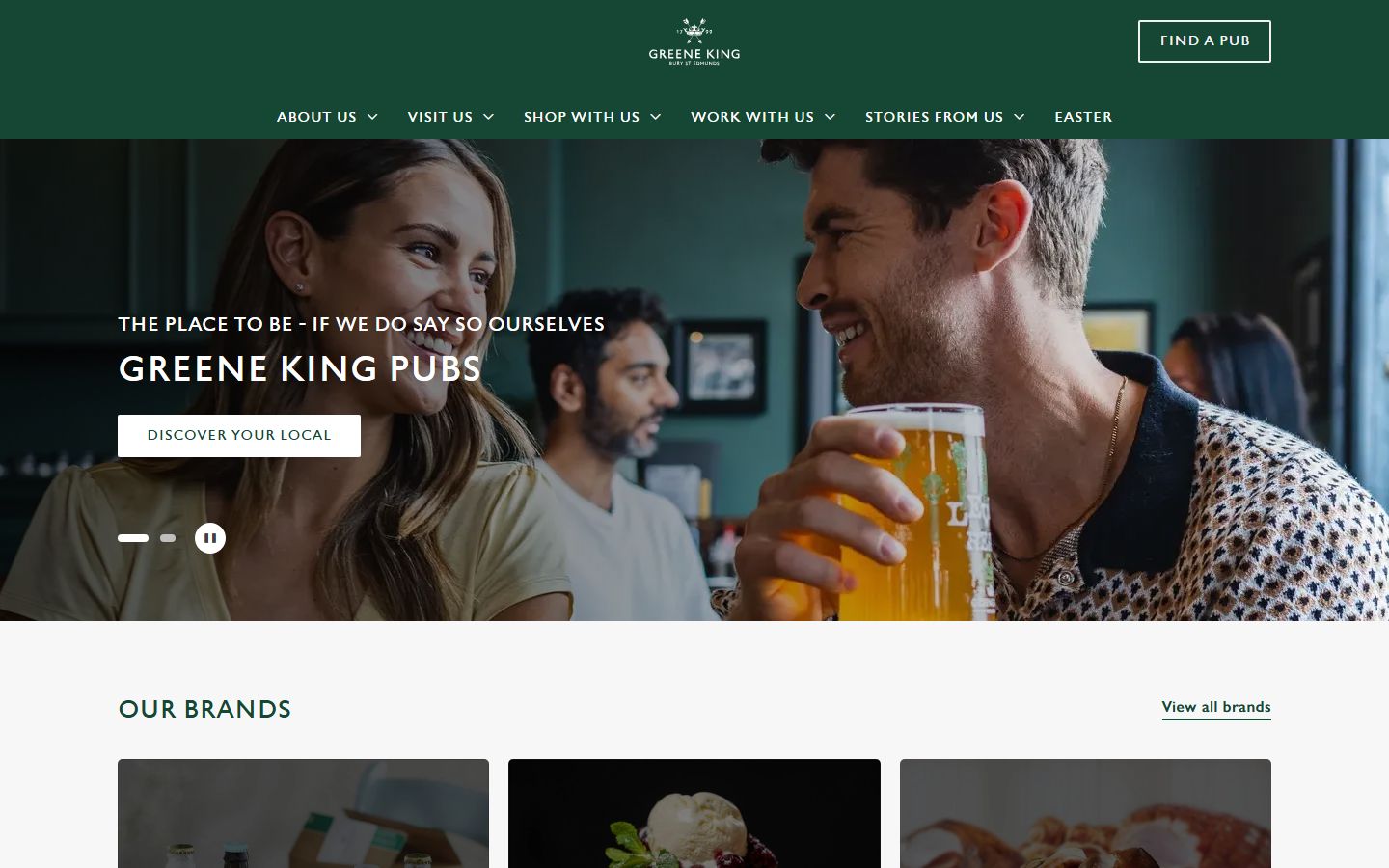
Open the Greene King homepage and the first impression is of offers. Percentage discounts, seasonal promotions, app download incentives, loyalty rewards. The visual hierarchy is structured around conversion: what can you save, what can you claim, what deal is running this week. This is a brand that has been brewing beer since 1799 — a heritage that predates most of its competitors by a century or more — and it greets visitors with the same promotional language as a fast-food chain. The offers are not the problem. Every pub company runs promotions. The problem is that the promotions have displaced the brand. The front door of Greene King’s digital presence sells savings. It does not sell Greene King.
Heritage buried under multi-brand architecture
The Sitecore-powered website functions as a hub for Greene King’s portfolio of sub-brands. Hungry Horse, Flaming Grill, Chef & Brewer — each has its own positioning and audience. The operational logic of this structure is sound: different customers want different experiences, and sub-brands allow Greene King to address multiple market segments. But the brand architecture comes at a cost to the parent brand’s identity. Greene King itself — the brewer, the 225-year story, the Suffolk brewery, the ales — becomes the holding company rather than the hero. The heritage is not denied. It is simply not given prominence. A visitor could browse the site, find a pub, book a table, and leave without ever understanding that Greene King is one of England’s oldest breweries with an unbroken connection to a single town.
Scale without story
Two thousand six hundred pubs is an extraordinary number. It means Greene King has a presence in nearly every significant town in England. Each of those pubs has a local identity — a building, a community, a regulars’ bar, a quiz night. Together, they form one of the largest community networks in the country. But the website treats this scale as a logistical fact rather than a narrative asset. The pub finder is functional. The listings are practical. But there is no sense of what 2,600 pubs actually means — for the communities they serve, for the local economies they support, for the social infrastructure of the country. Scale at this level is not just a business metric. It is a story about Britain’s relationship with its pubs.
What Works
The brewing heritage is the real thing. This is not a brand that adopted “craft” language in 2015. Greene King has been brewing on the same site for over two centuries. IPA, Abbot Ale, and Old Speckled Hen are household names with genuine provenance. The Suffolk brewery is a physical anchor that connects the corporate brand to something tangible, specific, and historically significant. In a market where “authenticity” is routinely manufactured, Greene King’s is inherited.
The sub-brand portfolio, while it complicates the parent brand, does solve a real commercial problem. Hungry Horse addresses value-conscious families. Chef & Brewer targets premium diners. Each sub-brand can pursue its segment without compromising the others. The portfolio covers the full spectrum of pub dining in a way that no single-brand competitor can match.
The managed and tenanted pub model gives Greene King both operational control (managed houses) and entrepreneurial diversity (tenanted pubs where individual publicans bring their own character). The tenanted model in particular keeps local identity alive — a tenanted Greene King pub in a Yorkshire village will feel different from one in a Cornish town, because the publican makes it different.
The Wider Pattern
Across the brands we have reviewed, the tension between conversion mechanics and brand storytelling is the most common digital compromise in hospitality. Chaiiwala leads with a limited-time menu item rather than Indian street food culture. BrewDog, which built a cult on punk identity, sells itself like a supermarket end-cap. Greene King, with the deepest heritage of any pub company in Britain, leads with voucher codes. The pattern is consistent: brands default to measurable, short-term conversion tactics because they are easier to justify in a quarterly review. The heritage, the story, the cultural meaning — these drive long-term brand equity, but they are harder to measure in a dashboard. The brands that sustain premium positioning are the ones that resist the gravitational pull of the discount banner.
If We Were Starting Fresh
We would rebuild the homepage around the brewery. A brewer since 1799 — that is the front door. The Suffolk brewery, the ales, the two centuries of unbroken craft. This is what makes Greene King different from Mitchells & Butlers, from Marston’s, from every pub company that retails food and drink without making it.
The sub-brands would sit within this identity rather than replacing it. Each one would connect back to the parent brand’s brewing heritage — the beer in your glass at Hungry Horse came from the same brewery that has been operating since the 18th century. The promotional offers would move from the hero space to the supporting layer: still present, still functional, but not the first thing a visitor sees.
The 2,600-pub network would be reframed as a story about community. Britain’s largest network of local gathering places, each one different, each one part of the same 225-year tradition of brewing and welcoming. The scale is not just a number. It is a national infrastructure of social spaces, and the digital experience would make that significance visible.
Wondering if YOUR brand has the same gaps?
We will tell you -- for free. Our team will analyse your website and brand, then send you an honest review.
Get Your Brand ReviewFeature Your Review
Display this badge on your website to showcase your independent brand review.