House of Gods
Industry: Hospitality
Verdict: “The theatre is built; the programme notes are missing.”
Reviewed: April 2026
Who They Are
House of Gods is a maximalist boutique hotel chain with properties in Edinburgh, Glasgow, and London. Founded in 2019 by brothers Mike Baxter (interiors and creative) and Ross Baxter (operations and construction), the brand grew from The Baxter Hostel on Edinburgh’s Cowgate into a portfolio of theatrically designed hotels that promise “rock-and-roll glamour without premium price tags.” The properties are styled around three stated influences: the romance of the Orient Express, the opulence of Versailles, and the hedonism of Studio 54. Each location features a Sacred Garden rooftop bar, rooms ranging from The Cabin to the Presidential Suite, and interiors dense with disco balls, Gucci Heron wallpaper, copper clawfoot bathtubs, and red velvet. Backed by Imbiba investment and OakNorth Bank financing, the brand has its sights on five or more locations within three years of the London opening.
What We Noticed
The Conversion Gap
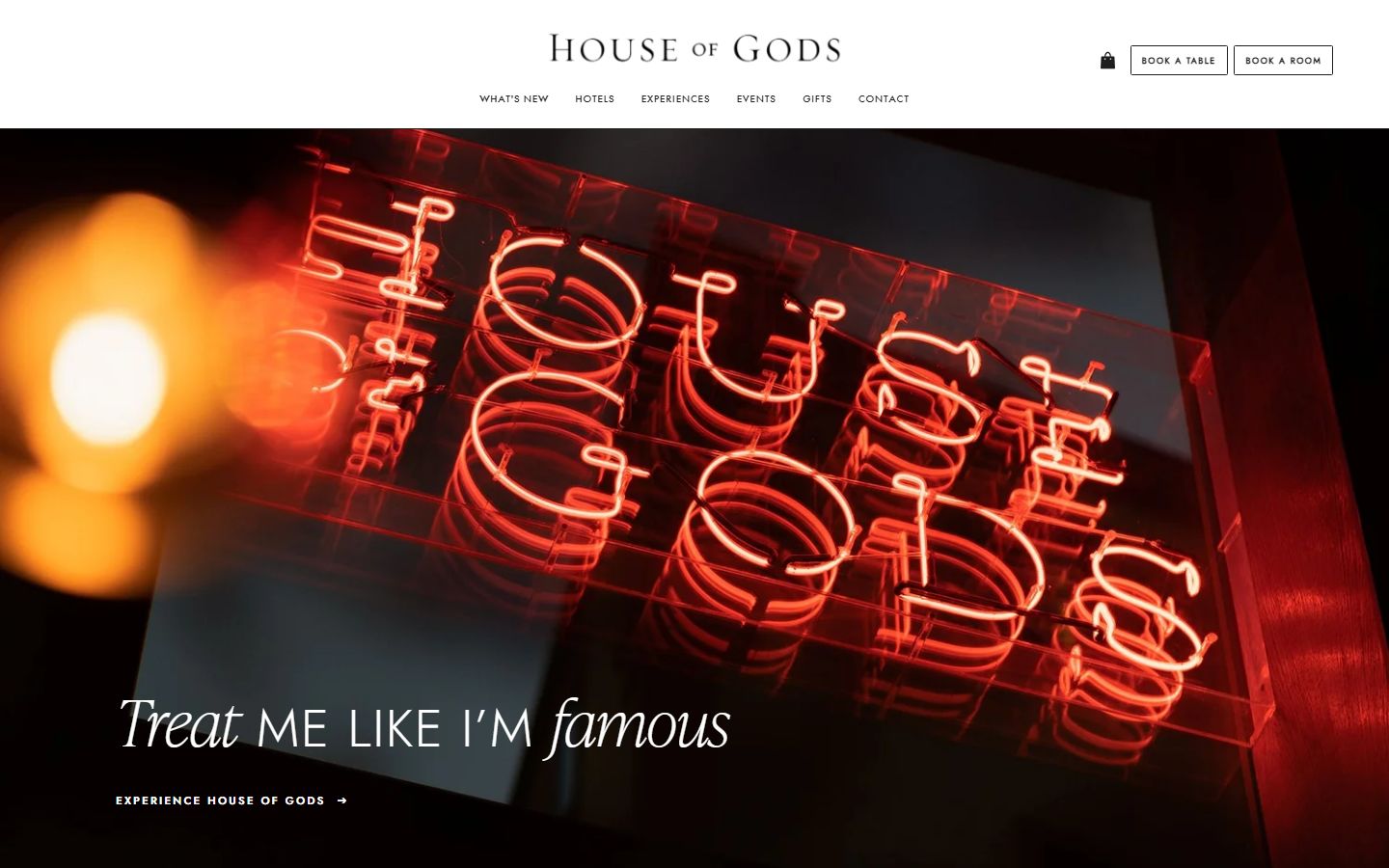
House of Gods has one of the most distinctive visual identities in UK boutique hospitality. The black, crimson, and gold palette is immediately recognisable. The photography is atmospheric. The brand voice, with lines like “You are the headline act” and “Lights. Camera. You.”, is genuinely confident rather than performatively edgy. None of this is the problem. The problem is that the website communicates mood without building a case. A first-time visitor browsing the Edinburgh property sees beautiful rooms but receives very little information about what staying there actually feels like, what the Sacred Garden is, or why the pricing sits where it does. The aesthetic does the heavy lifting. The content does not follow through.
Physical Spectacle, Digital Restraint
Walk into the Glasgow Sacred Garden with its 3,000 flowers and dark wood panelling and you understand the brand in seconds. The physical spaces tell stories. The website, by contrast, is surprisingly restrained for a brand that describes itself as “maximalist by design.” There is no founder narrative online. The Baxter brothers, whose journey from a 46-bed hostel to a multi-city hotel group is genuinely compelling, are invisible. Individual rooms lack their own stories. The Sacred Garden, which is arguably the brand’s most distinctive asset and “a social media paradise” in the company’s own words, does not have the prominence its reputation deserves. The gap between the physical experience and the digital one is wider than it needs to be.
Booking as an Exit
The booking flow directs visitors to an external Mews system. This is operationally sensible but experientially jarring. A guest moves from moody, atmospheric brand pages into a functional reservation interface. For a brand built on theatrical immersion, every transition point matters. The handoff from brand world to booking world is one of those seams that becomes visible precisely because everything around it is so carefully designed.
Social Proof in the Wings
House of Gods has a TripAdvisor rating of 9.1 out of 10 and press validation from The Times, The Telegraph, and Forbes. These are strong signals. They sit quietly in the background rather than working as conversion tools. For a brand competing against Artist Residence, The Pig, and the growing wave of design-led boutique hotels, third-party endorsement is one of the fastest ways to close the gap between “this looks interesting” and “I’m going to book.”
What Works
The brand identity is the standout. House of Gods has achieved something genuinely difficult: a maximalist aesthetic that feels intentional rather than cluttered. The deep red and gold palette carries theatrical weight without tipping into pastiche. The brand voice is equally well-calibrated, managing to be provocative (“Push It”) while remaining inviting. This is not a brand that needs to find its personality; it already has one, and it is distinct from every competitor in its set. The Hoxton is minimal and democratic. The Pig is rural and understated. Mama Shelter shares the maximalist impulse but with a different cultural register. House of Gods occupies its own territory: glamour as a democratic right, not an exclusive privilege.
The Sacred Garden concept is also genuinely smart as a brand platform. A rooftop bar that travels with the brand across cities gives House of Gods a repeatable social anchor that most boutique hotels lack. The London venue, with 300-person capacity, is a significant hospitality destination in its own right.
The Wider Pattern
Across the hospitality brands we have reviewed, a pattern keeps surfacing: physical experiences that are extraordinary, paired with digital presences that do not match the ambition. House of Gods is perhaps the clearest example. This is a brand built on sensory overload, on walking into a room and feeling something shift. The website, competent as it is, does not replicate that feeling.
We see the same tension at Sketch London, where twenty years of artist collaborations and five distinct rooms are compressed into a reservation-focused website. Both brands have solved the hardest problem in hospitality, creating spaces people genuinely want to be in, but neither has translated that spatial storytelling into digital storytelling. The pattern repeats in different registers across Tortilla and Hub Box, where strong operational brands with clear physical identities present themselves online with less personality than they deserve.
The underlying issue is consistent: hospitality brands invest heavily in the built environment because that is where the customer experience happens. The website is treated as a booking utility. But for a growing number of guests, the website is the first room they walk into.
If We Were Starting Fresh
The direction for House of Gods is not aesthetic. The visual identity is strong and should not be reworked. The opportunity is narrative. The brand has a founder story it is not telling, rooms with personalities it is not introducing, a rooftop concept it is not showcasing, and social proof it is not deploying. The digital experience should feel like the first act of the stay: atmospheric, confident, and rich with detail that builds anticipation. The goal would be to close the gap between “this looks beautiful” and “I understand exactly what I am paying for and I want it.” That is a conversion problem dressed as a content problem, and it is eminently solvable.
Want Us to Review Your Brand?
We will analyse your visual identity, website, and competitive position, then publish our findings. You get early access 48 hours before it goes live.
Wondering if YOUR brand has the same gaps?
We will tell you -- for free. Our team will analyse your website and brand, then send you an honest review.
Get Your Brand ReviewFeature Your Review
Display this badge on your website to showcase your independent brand review.