Jeopardy Hospitality
Industry: Hospitality
Verdict: “Yorkshire pubs with individual histories, presented through a group site that makes them feel interchangeable.”
Reviewed: April 2026
Who They Are
Jeopardy Hospitality is a Yorkshire-based group operating a collection of pubs that combine heritage buildings with contemporary dining. The venues sit across the Yorkshire countryside — village pubs, coaching inns, and listed properties, each with its own architectural character and its own community. The food is chef-led and seasonal, a step above the standard pub menu without losing the informality that makes a pub a pub. The model is that great cooking belongs in buildings with history, served alongside real ales and good wine in rooms where the walls have stories. Jeopardy is not a chain in the conventional sense. It is a group of individual pubs under common ownership, each operating with its own character while sharing a commitment to food, drink, and the kind of atmosphere that only comes from buildings that have been welcoming people for a long time.
What We Noticed
Individual histories, collective presentation
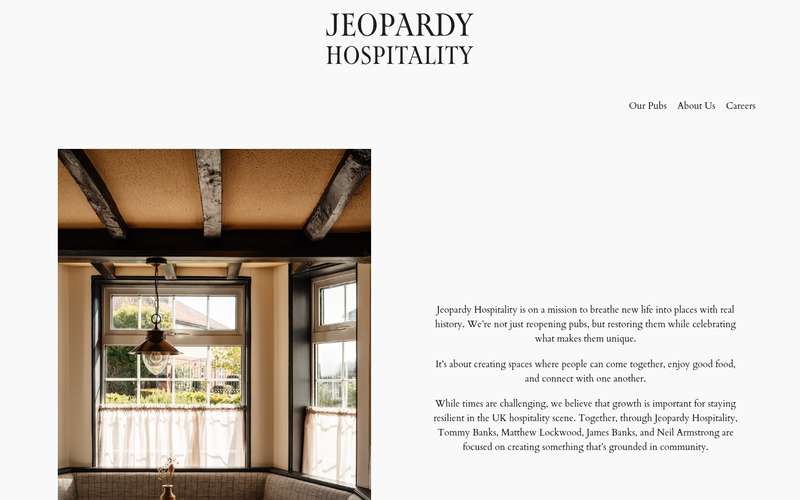
Each Jeopardy venue occupies a building with its own story. Some are centuries old. Some sit at the heart of villages that have gathered around them. Some are coaching inns that once served travellers on roads that predate the motorway network. These histories are not interchangeable — a 17th-century coaching inn on a drovers’ road is a fundamentally different proposition from a Georgian village pub on a market square. But the group website presents them through a consistent template structure that smooths out these differences. Each venue gets a page. Each page follows a similar format. The information is there — location, menu, booking — but the stories are not. A visitor can find each pub. They cannot yet feel why each pub is different from the others, or why the building matters as much as the menu.
The group brand eclipsing the venue brands
There is an inherent tension in hospitality groups between the parent brand and the individual venues. The group brand needs consistency for operational and marketing efficiency. The venue brands need individuality to reflect their unique characters. Jeopardy’s website currently leans toward the group side of this tension. The navigation, the visual treatment, the editorial voice — all serve the idea of “Jeopardy Hospitality” rather than the idea of each specific pub. This is a structural choice, not a quality failure. But it means that a potential guest looking for a specific kind of evening — a fireside dinner in a coaching inn, a Sunday lunch in a village local — cannot easily distinguish which Jeopardy venue offers which experience. The group identity works against the venue identities.
Yorkshire as backdrop, not brand
Yorkshire is one of England’s most characterful regions — rolling dales, stone villages, market towns, and a food culture that ranges from Wensleydale cheese to Michelin-starred restaurants. Jeopardy’s pubs sit within this landscape, drawing on local ingredients and serving communities that are distinctly Yorkshire. But the website does not fully leverage the regional identity. Yorkshire is mentioned but not explored. The suppliers are not named. The landscape is not evoked. For a group of countryside pubs, the countryside itself is strangely absent from the digital experience. The Pig Hotels have made the kitchen garden a central character in their brand. Jeopardy could make the Yorkshire landscape — its farms, its producers, its seasons — the equivalent character.
What Works
The chef-led model is a clear differentiator. In a market saturated with pub chains where the food is assembled rather than cooked, Jeopardy’s commitment to proper kitchens with real chefs in every venue sets a quality floor that the chains cannot match. This is not a group that happens to serve food in pubs — it is a group built around the belief that pub food can be genuinely good.
The heritage buildings themselves are irreplaceable assets. You cannot build a 300-year-old coaching inn. You can only find one and look after it. Each Jeopardy venue inherits the atmosphere, the proportions, and the accumulated character of a building that has served its community for generations. This architectural authenticity is a competitive moat that no new-build gastro-pub concept can cross.
The Yorkshire focus is strategically sound. By concentrating in a single region, Jeopardy builds local recognition, supplier relationships, and community trust that a nationally dispersed group could not achieve. Each venue reinforces the others. A guest who discovers one Jeopardy pub through a local recommendation is likely to try another.
The Wider Pattern
Across the hospitality brands we have reviewed, multi-venue groups consistently struggle with the same structural tension: how to present a collection of individual properties without making them look like chain outlets. Greene King, with 2,600 pubs, has resolved this by essentially abandoning individual identity in favour of promotional mechanics. The Pig Hotels, with fewer than ten properties, have resolved it by giving each venue a distinct regional identity and kitchen-garden narrative. Jeopardy sits between these scales — large enough to need a group identity, small enough that each venue’s individuality still matters. The navigation structure of the website is where this tension becomes visible, and it is where the solution lives.
If We Were Starting Fresh
We would restructure the website around each venue as a destination in its own right, connected by a group philosophy rather than a group template.
Each pub would get a page designed to convey its specific character: the building’s history, the kitchen’s focus, the village it sits in, the walk you would take before lunch, the producer who supplies the cheese. The design language would share a family resemblance across venues — enough consistency to signal a common standard — without imposing uniformity. A coaching inn should feel different from a village local, even on screen.
The group brand would shift from “Jeopardy Hospitality presents: a list of pubs” to “Jeopardy Hospitality: the idea that Yorkshire’s best buildings deserve Yorkshire’s best cooking.” The connecting thread is the philosophy, not the template. Each venue proves the thesis in its own way, in its own building, in its own village. The website would invite visitors to discover which version of that thesis suits their evening.
Wondering if YOUR brand has the same gaps?
We will tell you -- for free. Our team will analyse your website and brand, then send you an honest review.
Get Your Brand ReviewFeature Your Review
Display this badge on your website to showcase your independent brand review.