Le Pain Quotidien UK
Industry: Hospitality
Verdict: “A Belgian bakery built on the communal table, with a UK website that feels like a franchise afterthought.”
Reviewed: April 2026
Who They Are
Le Pain Quotidien was founded in Brussels in 1990 by Alain Coumont, a chef who could not find bread good enough for his restaurant. So he started baking his own, opened a bakery, and placed a long wooden communal table at its centre — a table where strangers would sit together and share the experience of eating. That table became the brand’s signature. Thirty-five years later, Le Pain Quotidien operates across multiple countries, serving organic bread, tartines, pastries, and coffee in spaces designed around the same idea: food is better when it is shared. The brand’s name translates as “the daily bread,” and the philosophy is exactly that — simple, honest, daily. The UK operation runs its own digital presence and a chain of bakery-cafes across London and the south east.
What We Noticed
A founding story told nowhere
Alain Coumont’s story is the kind of origin narrative that brands pay consultants to invent. A chef who could not find bread he liked, so he baked his own. A single piece of furniture — the communal table — that became a philosophy of hospitality. A name that means “the daily bread” in a language that is not English, carrying the warmth of a Belgian morning ritual. This is specific, authentic, and impossible to replicate. It is also almost entirely absent from the UK website. The site presents Le Pain Quotidien as a place to order food. There is no founder story, no explanation of the communal table concept, no narrative about why this bakery exists. The “About” section, if present, does not convey the depth of the brand’s origins. A visitor encountering Le Pain Quotidien for the first time online would have no idea that this is a brand with a 35-year Belgian heritage and a founding philosophy built around shared eating.
Template constraints visible in the experience
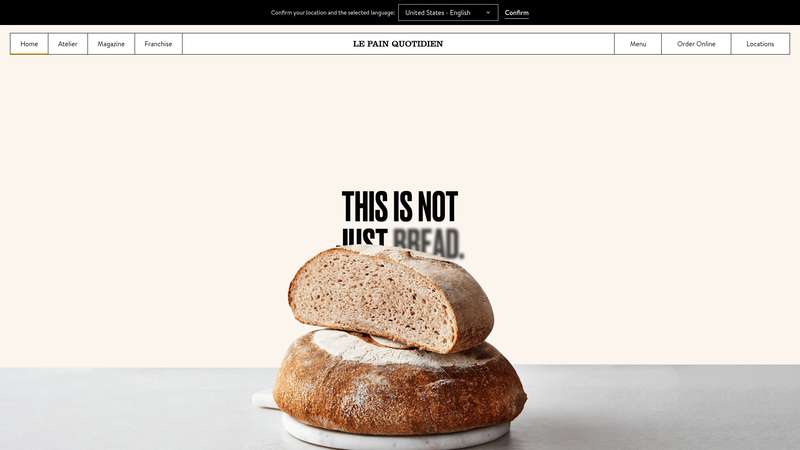
The UK site operates within what appear to be template limitations that restrict how the brand can present itself. Navigation feels generic. Visual hierarchy is flat. The photography, while functional, does not carry the warmth or artisanal quality that the physical bakeries embody. There is a gap between walking into a Le Pain Quotidien — with its wooden tables, open kitchens, and the smell of fresh bread — and visiting the website, which could belong to any mid-market cafe chain. The template does what templates do: it organises information efficiently. But Le Pain Quotidien is not selling information. It is selling an experience rooted in craft, community, and Belgian baking tradition. The digital framework cannot express any of that.
Belgian identity replaced by generic cafe positioning
Le Pain Quotidien is Belgian. This matters. Belgium has a baking tradition as deep and specific as France’s, with its own breads, its own pastries, its own approach to the morning meal. The brand’s name is French — not because it is French, but because Brussels is bilingual and the bakery was born in a Francophone tradition. This cultural specificity is a competitive advantage. GAIL’s is British. Ole & Steen is Danish. Paul is French. Le Pain Quotidien is Belgian, and that distinction is meaningful. But the UK website does not assert this identity. There are no references to Belgian baking tradition, no Belgian ingredients highlighted, no visual cues that connect the brand to its country of origin. The result is a brand that feels geographically rootless — a cafe that could be from anywhere, which means it is from nowhere.
What Works
The communal table concept, where it survives in the physical spaces, is a genuine differentiator. No other bakery chain in the UK is built around a single piece of furniture that embodies a philosophy. The long wooden table is not decoration — it is a design decision that says something about how Le Pain Quotidien believes people should eat. This is distinctive, ownable, and deeply connected to the brand’s origins.
The commitment to organic ingredients provides a substantive quality claim. In a market where “artisan” has become meaningless through overuse, organic certification is verifiable and specific. It gives the brand a quality floor that competitors who use the word “artisan” without organic sourcing cannot match.
The menu itself — tartines, simple salads, bread-forward meals — is coherent with the brand’s philosophy. Le Pain Quotidien’s food is not trying to be a restaurant. It is trying to be the best version of daily bread. This restraint is a strength. The product matches the name.
The Wider Pattern
Across the brands we have reviewed, origin story burial is one of the most common patterns in hospitality. Greene King has brewed since 1799 and leads with promotional offers. The Cornish Bakery is expanding nationally but leaves Cornwall in the name only. Le Pain Quotidien has one of the most specific founding stories in the sector — a chef, a table, a city, a philosophy — and presents itself as a generic cafe chain. The pattern is this: as brands scale, they strip away the distinctive elements that made them worth scaling in the first place. The operational needs of multi-site consistency override the editorial needs of brand identity. The website becomes a menu and a location finder, and the story that built the brand disappears into an “About” page that no one reads.
If We Were Starting Fresh
We would rebuild the UK digital presence around the communal table as both a physical object and a philosophical idea.
The homepage would not lead with menu items or promotions. It would lead with the table — the reason this bakery exists. Alain Coumont’s story would sit prominently, told simply: a chef who baked his own bread and built a restaurant around the idea that eating is better when shared. The Belgian identity would be visible throughout — not as a marketing angle, but as the honest context for why the bread tastes the way it does, why the menu looks the way it looks, and why there is a long wooden table in the middle of every bakery.
Each UK location would feel like a chapter of the same story rather than a franchise outpost. The organic commitment would be presented as a natural extension of the founding philosophy: daily bread, made properly, with ingredients that deserve the name. The digital experience would feel like walking into the bakery — warm, unhurried, and built around something worth sharing.
Wondering if YOUR brand has the same gaps?
We will tell you -- for free. Our team will analyse your website and brand, then send you an honest review.
Get Your Brand ReviewFeature Your Review
Display this badge on your website to showcase your independent brand review.