Lush
Industry: Retail & DTC
Verdict: “The most radical ethics in beauty, hidden at the bottom of the page.”
Reviewed: April 2026
Who They Are
Lush was founded in 1995 by Mark Constantine and Liz Weir from a shop in Poole, Dorset. The company invented the bath bomb, pioneered packaging-free cosmetics and built its reputation on a set of ethical commitments that most brands would consider commercially reckless. Lush quit Instagram and Facebook. It refused to sell through Amazon. It runs its own in-house manufacturing and sources ingredients through a direct ethical buying programme. The brand operates around six pillars: fighting animal testing, ethical buying, 100% vegetarian formulations, naked (packaging-free) products, freshest cosmetics and digital ethics. This is not a company that adopted sustainability because it became fashionable — it was militant about these positions before the rest of the industry noticed. Lush competes with The Body Shop, Aesop and Dr. Bronner’s, though “competes” understates the gap between Lush’s operational commitment and what most of its peers actually do.
What We Noticed
The Buried Manifesto
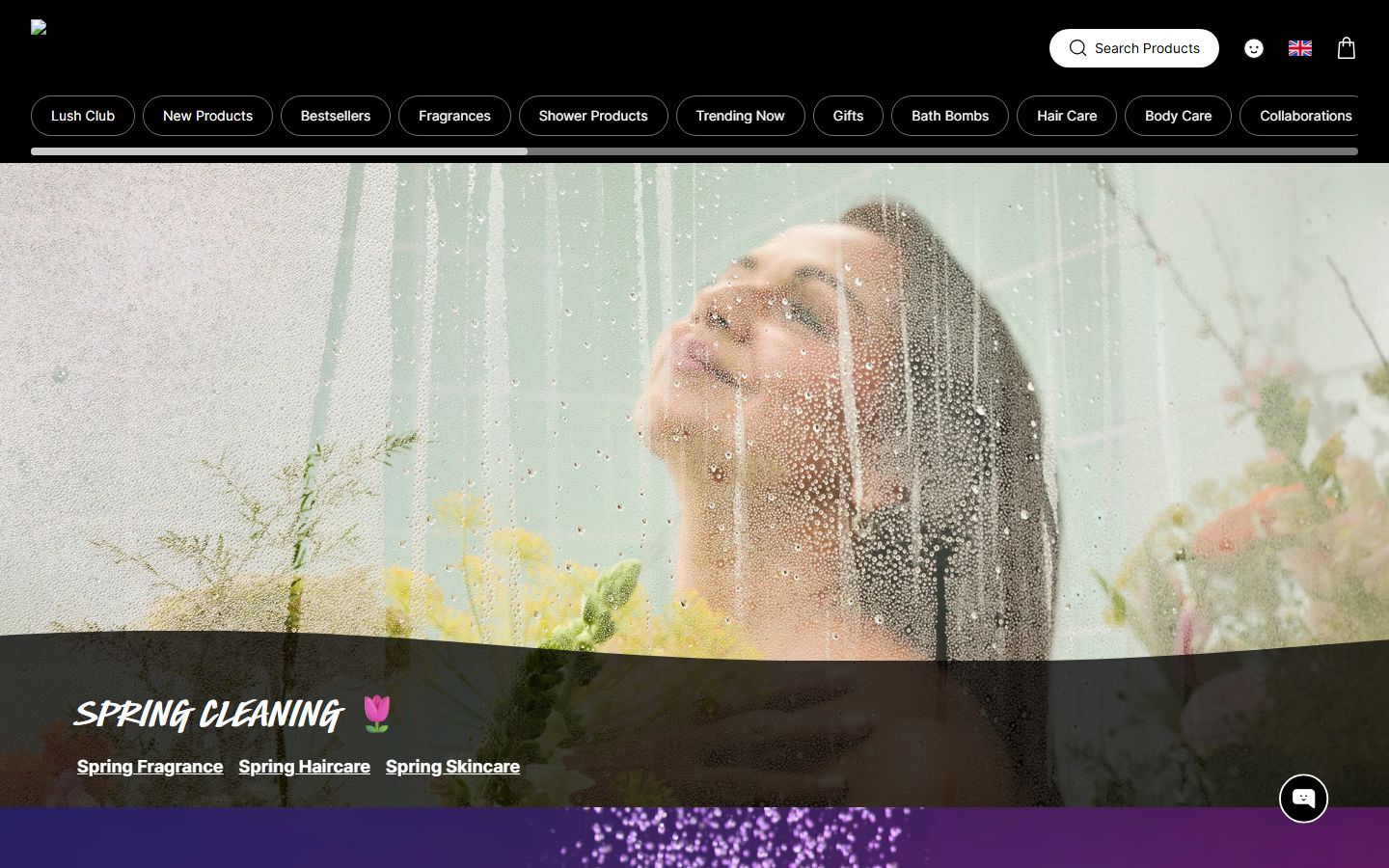
Lush’s six ethical pillars are the single most differentiating thing about the brand. No mainstream beauty company has a comparable set of commitments, and none has paid the commercial price Lush has paid to maintain them. Walking away from Instagram cost real revenue. Refusing Amazon costs real distribution. Yet on the website, these pillars live in the footer — the digital equivalent of the fine print. A first-time visitor scrolling the homepage would encounter a Super Mario collaboration, seasonal gift sets and product grids before finding any trace of the ideology that makes Lush worth choosing. The manifesto exists, but it has been relegated to the part of the page most people never reach.
The Collaboration Camouflage
The homepage leads with brand collaborations and seasonal campaigns that could belong to any beauty retailer. There is nothing wrong with a Super Mario partnership in isolation, but when it occupies the space where the brand’s founding convictions should sit, it creates a visual identity that is indistinguishable from competitors who have none of Lush’s ethical depth. The Body Shop — a brand with a fraction of Lush’s operational commitment to activism — does a better job of surfacing its values above the fold. That is not a design detail. It is a strategic misalignment between what the brand is and what the website communicates.
The Missing Voice
Lush has always had a distinctive voice — confrontational, warm, occasionally eccentric. The in-store experience is built on it. Staff will tell you which products are vegan, where the ingredients come from, and why the brand does not use certain chemicals, unprompted. Online, that voice is flattened into standard e-commerce copy. Product descriptions are functional rather than principled. The tone reads like it was written by a category manager, not by a company that once ran a campaign with a naked person in a shop window to protest animal testing. The activist personality that built the brand has been edited out of the digital experience.
What Works
The product pages themselves are well-structured. Ingredient lists are transparent, with individual ingredients linked to sourcing information — a level of supply-chain visibility that most beauty brands would never attempt. The naked packaging programme is clearly explained when you find it, and the “how to use” content for solid shampoos and conditioner bars is practical and well-illustrated. Lush’s manufacturing transparency — showing which factory made the product and when — remains a genuine differentiator that no competitor replicates at scale. The Lush Lens feature, which uses visual search to identify unwrapped products, is clever and functional. Store pages are strong, with individual store personality coming through in a way that reflects the in-store experience. The charity pot programme is well-documented and the brand’s campaigning history, when you navigate to it, is presented with conviction and depth. The site’s accessibility features are solid, and mobile performance is reliable.
The Wider Pattern
We see this repeatedly with purpose-driven brands that have scaled — the values that built the business get pushed further down the page as the product catalogue grows. P.Louise, a beauty brand we reviewed recently, faces a version of this tension between founder personality and commercial scaling. But Lush’s case is more acute because the ethical position is not a marketing angle — it is the operational reality of the entire business. When Dr. Bronner’s puts its manifesto on the bottle, every customer encounter reinforces the brand’s reason for existing. When The Body Shop redesigned its digital presence, activism moved to the homepage. Lush has the deepest ethical commitment in the category and the weakest digital expression of it. The gap between what the brand does and what the website shows is wider here than anywhere else we have looked.
If We Were Starting Fresh
We would make the six pillars the front door. Not a footer link, not an “about us” page — the actual entry point to the digital experience. A first-time visitor should understand within five seconds that Lush is not a normal beauty retailer. The pillars should function as navigation, as storytelling, and as the frame through which every product is presented.
The founding story needs to be visible. Mark Constantine and Liz Weir built this company on convictions that cost them money, and that story is more compelling than any seasonal campaign. It should sit alongside the product experience, not behind it.
Product pages should lead with why, not what. “This shampoo bar replaces three plastic bottles” is a stronger opening than a scent description. Every product in the range exists because of an ethical decision — the website should make that decision visible at the moment of purchase.
The activist voice needs to come back online. Lush’s in-store experience is driven by people who believe in what they are selling. The digital experience should carry that same energy — opinionated, warm, occasionally confrontational. Aesop proves that a strong brand voice scales digitally without dilution. Dr. Bronner’s proves that leading with mission does not suppress conversion. Lush has more to say than either of them. It just needs to say it where customers can hear it.
Wondering if YOUR brand has the same gaps?
We will tell you -- for free. Our team will analyse your website and brand, then send you an honest review.
Get Your Brand ReviewFeature Your Review
Display this badge on your website to showcase your independent brand review.