Lusso Stone
Industry: Luxury Interiors
Verdict: “Hotel-grade luxury for the home, navigated through a menu that feels like a trade catalogue.”
Reviewed: April 2026
Who They Are
Lusso Stone is a luxury bathroom and kitchen brand selling stone baths, designer basins, vanity units, taps, and hardware to homeowners who want the finish of a five-star hotel in their own bathroom. The product range extends across tiles, heating, lighting, electrical, and homeware — a comprehensive offering that covers every surface and fitting in a high-end renovation. Products have appeared in Sky advertising campaigns, and pricing sits in the considered-purchase range: a Picasso White Freestanding Stone Bath starts at GBP 1,397, a Luxe Brushed Gold Thermostatic Shower at GBP 597. The brand runs on Shopify and positions itself with a clear concept: “Hotel to Home.”
What We Noticed
A catalogue structure where a design experience should be
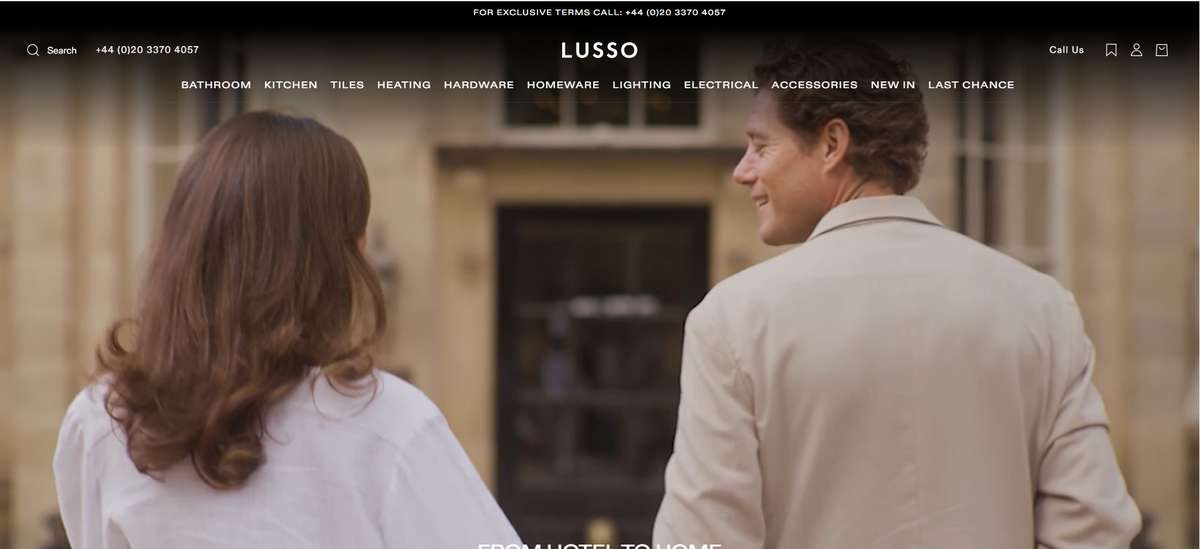
Open lussostone.com and the navigation reveals the depth of the product range. Bathroom. Kitchen. Tiles. Heating. Hardware. Homeware. Lighting. Electrical. Accessories. Expand the Bathroom section and you find Baths, Basins, Vanity Units, Toilets, Showers, and Taps. Expand Baths and you find Stone Baths, Marble Baths, and Freestanding Baths. This is a logical way to organise a trade catalogue. It is not how someone designing their dream bathroom wants to browse. A homeowner renovating a master suite does not think in product subcategories. They think in rooms, in moods, in the feeling they want when they walk in. The navigation answers the question “what type of tap are you looking for?” when the customer is asking “what should my bathroom feel like?”
The hotel promise without the hotel feeling
“Hotel to Home” is a genuinely strong positioning concept. It is specific, aspirational, and immediately understood. Everyone knows the feeling of a hotel bathroom done well — the weight of the fixtures, the warmth of the stone, the sense that every detail has been considered. But the website does not deliver this feeling. There are no room scenes showing completed hotel-grade installations. No before-and-after project galleries. No editorial content about what makes a hotel bathroom different from a residential one. The positioning promises an experience. The website delivers a product grid. The gap between the two is where the entire brand opportunity sits.
The trade voice in a consumer experience
The announcement bar reads: “FOR EXCLUSIVE TERMS CALL: +44 (0)20 3370 4057.” This is trade language. It signals wholesale pricing, volume discounts, professional accounts. For a homeowner arriving at the site after seeing a Lusso Stone bath on an Instagram interiors account, this is a jarring first impression. The navigation depth, the category structure, and the trade-oriented messaging suggest a brand that grew from B2B roots and has not fully redesigned the experience for a consumer audience. Both audiences matter. But they need different front doors.
Strong products, thin context
The product photography is excellent. Close-up shots of brushed gold hardware, the curve of a stone bath, the grain of a natural oak vanity unit — these images communicate quality and craftsmanship. But the products exist in isolation. They are shown against clean backgrounds or in minimal settings, never in a completed room that shows how they work together. For products at this price point, context is everything. A GBP 1,397 bath is a considered purchase. The buyer needs to see it in a finished bathroom, surrounded by the basins and taps and tiles that complete the picture. Individual product shots sell components. Room scenes sell outcomes.
What Works
The product range itself is the clearest strength. Lusso Stone covers every element of a luxury bathroom and kitchen renovation in a single brand. Stone baths, marble basins, brushed gold hardware, natural oak vanities, thermostatic showers — a homeowner or designer can specify an entire room without leaving the site. That level of range coherence is unusual. Most luxury bathroom brands specialise in one category (baths, or taps, or furniture). Lusso Stone offers the complete suite.
The material quality communicated through photography is genuine. The stone baths, in particular, photograph beautifully — the texture, the weight, the curves are all captured in a way that makes the screen feel almost tactile. The pricing strategy is also well-judged: premium enough to signal quality, accessible enough to differentiate from ultra-luxury brands like C.P. Hart and Drummonds.
The “Hotel to Home” concept, despite being underutilised, is itself a valuable asset. It is the kind of positioning line that does real work — it sets an expectation, defines a standard, and gives the customer a reference point for quality. The concept just needs to be built out beyond a tagline.
The Wider Pattern
Across the luxury interiors brands we have reviewed, navigation complexity is the most reliable indicator of a brand that started in trade and has expanded to consumer. The deeper the mega-menu, the more likely the site was designed for a buyer who already knows what they want — a specification, a product code, a category. Consumer buyers, particularly in luxury, browse differently. They start with inspiration, move to exploration, and arrive at product selection. The White Company — a brand we have reviewed in a different context — demonstrates the alternative approach: rooms, occasions, and moods as navigation concepts, with products sitting inside those frames rather than in isolated category trees.
The challenge for brands like Lusso Stone is that the trade navigation works. Professional customers find what they need quickly. The risk of replacing it is real. The opportunity is not to remove the catalogue but to build a consumer experience alongside it — an inspiration-led front door that leads, eventually, to the same products.
If We Were Starting Fresh
The “Hotel to Home” concept would become the organising principle of the entire digital experience. The homepage would open with completed room scenes — a hotel-grade master bathroom, a minimalist ensuite, a statement powder room — each featuring Lusso Stone products in context. Clicking into a room would reveal every product shown, with the option to add each piece or the entire scheme.
A project gallery would show real customer installations alongside the hotel projects that inspired them. The editorial layer would explore what makes a hotel bathroom feel the way it does: the proportions, the material choices, the lighting, the details. This is content that positions Lusso Stone as a design authority, not just a product supplier.
The navigation would offer two paths: “I am designing a room” (inspiration-led, room-based, contextual) and “I know what I need” (the existing catalogue structure, streamlined for professional buyers). Both audiences deserve a front door designed for them. Right now, only one has it.
Wondering if YOUR brand has the same gaps?
We will tell you -- for free. Our team will analyse your website and brand, then send you an honest review.
Get Your Brand ReviewFeature Your Review
Display this badge on your website to showcase your independent brand review.