
Miller Harris
Review dated April 2026, not re-checked since.
Editorial note, 26 October 2026: The date label and wording were updated. This was not a new check of the firm’s website.
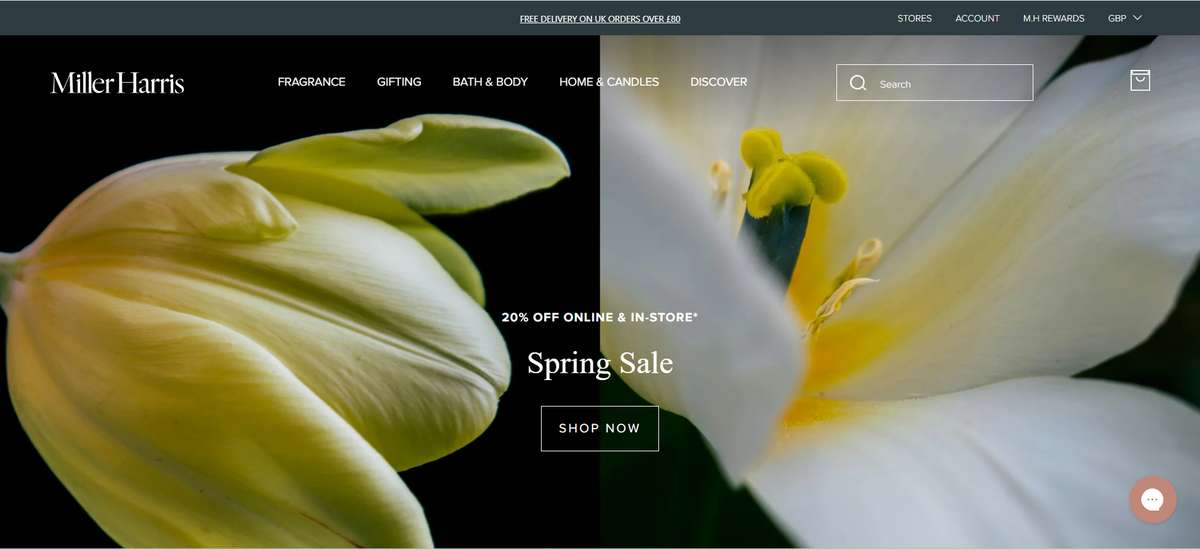
Who They Are
Miller Harris is a London-based independent perfume house, founded in 2000, with boutiques in Covent Garden and on Monmouth Street. The brand’s defining principle is creative autonomy: perfumers are given complete artistic freedom, unconstrained by commercial briefs or market-tested formulas. Collections are organised into four families — Stories, Private, Colour, and Editions — each reflecting a different dimension of the house’s approach. The sustainability commitment is substantive, with upcycled ingredients and a published manifesto. An M.H Rewards programme drives loyalty. Miller Harris positions itself not as a challenger brand but as an alternative altogether: fragrance as artistic expression rather than mass-market product.
What MAAD Noticed
Navigation depth that contradicts the brand’s philosophy
Miller Harris grants its perfumers complete freedom. The website does not extend the same courtesy to its visitors. The mega-menu system is comprehensive to the point of being restrictive: Fragrance breaks into subsections for all fragrances, bestsellers, fragrance families (Floral, Woody, Citrus), and collections. Gifting branches into gift sets, occasion-based selections, and curated inspiration. Bath & Body splits by scent and by type. Home & Candles divides into candles, diffusers, and gift sets. Discover houses the brand story, sustainability, and community. Each category has further subcategories. The structure is logical, but logic is not the problem. The problem is that a brand built on creative exploration presents itself through a navigational framework designed for efficient retrieval. Visitors do not discover a scent by knowing which sub-menu it lives in. They discover it by being led somewhere unexpected.
The brand story lives in a compartment
“At Miller Harris we embody a modern and unconventional artistic spirit.” That statement appears in the About section, under the Discover menu. It is a good statement. But it sits apart from the shopping experience rather than inside it. A visitor browsing fragrances encounters product pages with notes, descriptions, and pricing — the standard architecture of fragrance e-commerce. The artistic story, the perfumer’s inspiration, the creative process that makes Miller Harris distinctive — these live in a separate section that the browsing visitor may never reach. The brand story is available. It is not integrated.
Sustainability as a sidebar, not a thread
Miller Harris uses upcycled ingredients and has published a sustainability manifesto. This is a genuine commitment, not a marketing gesture. But on the website, it lives under Discover > Conscious Fragrance Creation — a section that requires deliberate navigation to find. For a fragrance brand, sustainability could be a powerful differentiator if it were woven through the product experience. Each fragrance page could note which ingredients are upcycled, where they were sourced, and why the perfumer chose them. That integration would turn a stated principle into a felt experience.
The screen cannot replicate the nose, but it can guide it
Every fragrance brand faces the same fundamental challenge: visitors cannot smell a website. Miller Harris has Discovery Sets as an entry point — a practical solution — but the original review did not identify a guided journey for someone who does not know where to start: a scent profiling quiz, a pathway based on preferences, or editorial content that helps a visitor understand whether they are drawn to Stories or Private or Colour. The mega-menu assumes the visitor already knows what they want. For a fragrance house, most visitors do not. They know they want something beautiful. They need the brand to help them find it.
What Works
The dark-themed visual design is genuinely sophisticated. It creates atmosphere in a way that lighter, cleaner e-commerce templates cannot. The dark palette gives the product photography — bottles, textures, ingredients — a gallery-like quality. This is not a brand that looks like it runs on Shopify, even though it does.
The collection structure — Stories, Private, Colour, Editions — is a thoughtful organising principle. Each collection name suggests a mood and a purpose rather than just a scent profile. “Stories” implies narrative. “Private” implies intimacy. “Colour” implies synesthesia. These are evocative entry points that work better than “Floral” and “Woody” for a brand positioned on artistic expression.
The Tea Tonique Extrait launch, featured prominently with video content and the tagline “A limited edition exploration of infusion,” demonstrates that Miller Harris knows how to present individual products with editorial weight. The challenge is extending that treatment beyond hero launches to the everyday browsing experience.
The physical boutiques in Covent Garden and Monmouth Street are themselves assets. They reinforce the artisanal positioning and provide the sensory experience that online cannot. The brand’s task is not to replicate the boutique digitally but to create a digital experience worthy of the same standards.
The Wider Pattern
In luxury DTC, navigation depth is the most consistent indicator of a brand that has prioritised catalogue management over customer experience. The navigation is built for someone who knows they want a Woody fragrance in the Private collection. It is not built for someone who wants to discover Miller Harris.
The luxury fragrance market is moving toward experiential digital design. Miller Harris has the brand depth to compete on experience. The navigation just needs to let it through.
If MAAD Were Starting Fresh
The perfumers would be at the centre of the digital experience. Not as an About page biography, but as the organising principle. Each perfumer’s body of work would be explorable — their inspirations, their process, the ingredients they choose and why. The artistic freedom that defines Miller Harris would be demonstrated through the content, not just claimed in a tagline.
The discovery journey would replace the deep navigation with an intuitive pathway: a scent profiling experience that guides new visitors toward their first Miller Harris fragrance, built around mood and association rather than technical classification. “Warmth or freshness?” is a more useful question than “Floral or Woody?” for someone who has never visited the house.
Sustainability would be threaded through every product page. Not as a badge or a section, but as ingredient-level transparency: this rose oil is upcycled from the perfume extraction process, this vetiver was sourced from this estate. The manifesto would stop being a document and start being a visible practice.
Miller Harris has the rarest thing in luxury fragrance: a genuine philosophy. The website needs to let visitors experience it, not just read about it.
Something wrong? Tell us
Email hello@maad.house with the review address and the point that needs attention. MAAD makes corrections at the existing address with a dated note. A firm can send a reply for publication or ask for same-day takedown.