Rachel Boston Jewellery
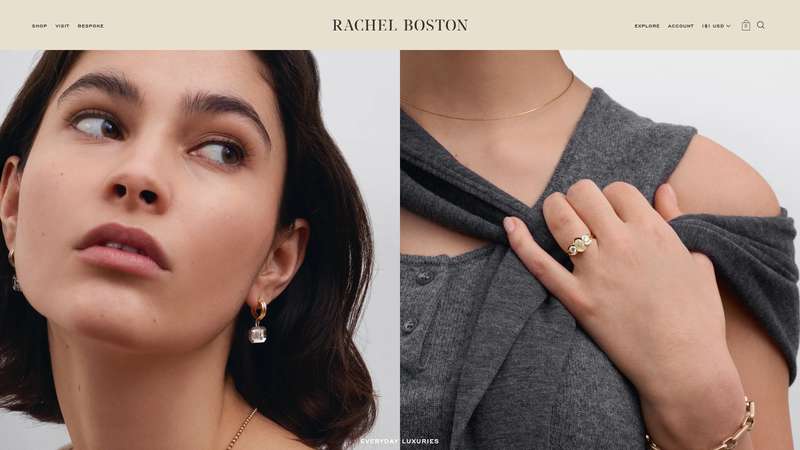
Screenshot of Rachel Boston Jewellery’s website, captured April 2026
Rachel Boston Jewellery
Industry: Retail & DTC
Verdict: “Featured in Vogue and Forbes, and the website charges in dollars.”
Reviewed: April 2026
Who They Are
Rachel Boston is an award-winning jewellery designer working from Redchurch Street in Shoreditch, East London. The brand has built its reputation on reinventing how diamonds are set — using unconventional approaches that allow light to pass through stones in ways traditional settings do not. Bespoke engagement rings and alternative bridal jewellery form a significant part of the business, attracting customers who want something more considered than a high-street solitaire. The brand has been featured in Vogue, Elle, Forbes and Wallpaper*, and uses ethically sourced Single Mine Origin gold across its collections. Rachel Boston competes with Jessica McCormack at the editorial high end, Suzanne Kalan in global contemporary fine jewellery and Sophie Bille Brahe in the Scandinavian architectural space — though Boston’s particular combination of craft innovation and East London sensibility gives the brand a position none of those competitors occupies.
What We Noticed
The Currency Mismatch
A British jeweller, based in Shoreditch, selling primarily to a UK audience, and the website displays prices in US dollars. This is not a minor UX oversight. In fine jewellery, where purchase decisions involve significant consideration and where trust is the primary conversion driver, charging in a foreign currency introduces friction at exactly the wrong moment. It signals that the site was configured for a different market, or that the brand has not prioritised its domestic customer experience. For a first-time visitor considering a bespoke engagement ring — a purchase that might represent months of saving — seeing USD instead of GBP raises questions about where the brand actually operates and who it considers its core customer.
The Scattered Credentials
Rachel Boston has been featured in Vogue, Elle, Forbes and Wallpaper*. These are not niche trade publications — they are the most recognised names in fashion, business and design media. On the website, these credentials are scattered across various pages without a coherent strategy. Press logos do not sit above the fold. Individual features are not linked from product pages. The “as seen in” social proof that would reassure a customer spending several thousand pounds on an engagement ring is present but disorganised. Jessica McCormack, by comparison, integrates editorial credentials directly into the shopping experience, making press validation part of the purchase journey rather than a footnote.
The Hidden Bespoke Path
Bespoke engagement rings are likely the brand’s highest-value offering — both in revenue per transaction and in the long-term customer relationship they create. On the website, the bespoke journey is unclear. A customer who arrives wanting a custom engagement ring must navigate through the site to find the process, understand the timeline and feel confident enough to make contact. The pathway from “I am interested” to “I am in conversation with the designer” has too many gaps. In a category where the bespoke consultation is the product, making that journey intuitive is not a UX nicety — it is the core commercial function of the site.
What Works
The product photography is beautiful. Each piece is shot with care, and the close-up detail work — particularly the unconventional diamond settings — communicates craft in a way that words alone cannot. The stones catch light differently in every image, which is exactly the point of Boston’s design approach and it comes through on screen. The learning blog, when a customer finds it, contains genuinely useful content about gemstones, metals and design choices that positions the brand as an authority rather than just a retailer. The Shoreditch studio itself — Redchurch Street, East London — is a strong brand asset that grounds the business in a specific creative community. The ethical sourcing commitment to Single Mine Origin gold is clearly stated and adds substance to the brand’s positioning. Individual collection pages are well-curated, with a clear aesthetic through-line that communicates a designer’s eye rather than a merchandiser’s grid. The ring sizing guide is practical and detailed, which matters enormously in a category where customers cannot try before they buy.
The Wider Pattern
Independent jewellers face a particular version of the challenge we see across DTC luxury — translating craft, reputation and in-person trust into a digital experience that converts. The stakes are higher than in most categories because the purchase values are significant and the emotional weight is considerable. Jessica McCormack has solved this by building a digital experience that feels like entering a private salon — editorial, curated, intimate. Sophie Bille Brahe uses architectural minimalism to let the jewellery speak. Rachel Boston’s Shopify template, while clean, does not yet carry the weight of the brand’s actual position in the market. We saw a similar gap in our review of P.Louise — a brand whose founder’s personality and press credentials far outstripped what the website communicated. The pattern is consistent: when the brand’s reputation lives primarily offline or in press coverage, the website becomes the weakest link in the customer journey.
If We Were Starting Fresh
We would lead with design philosophy. Rachel Boston’s approach to diamond setting — the unconventional techniques, the way light behaves differently in her pieces — is the single most distinctive thing about the brand. It should be the first thing a visitor encounters, not something they discover after browsing through product grids. A short, visual explanation of the approach would set the brand apart before a single product is shown.
The currency needs to be GBP. This is a UK brand with a UK studio and a primarily UK customer base. Every price should display in pounds sterling, with international currency options available but not defaulted. Trust in fine jewellery is built in details, and the wrong currency erodes it.
Press credentials should be integrated into the shopping experience, not collected on a separate page. When a customer is looking at an engagement ring that costs several thousand pounds, seeing that Vogue featured the designer is not vanity — it is reassurance. Logos above the fold, editorial quotes alongside collections, featured pieces linked to their press coverage.
The bespoke journey needs its own dedicated, clearly signposted section. From the homepage, a customer considering a custom engagement ring should be able to understand the process — consultation, design, timeline, pricing approach — in three clicks or fewer. This is not about revealing every detail upfront. It is about making the first step feel easy and the process feel considered. When bespoke is the brand’s highest-value offering, the path to it should be the most intuitive journey on the site.
Wondering if YOUR brand has the same gaps?
We will tell you -- for free. Our team will analyse your website and brand, then send you an honest review.
Get Your Brand ReviewFeature Your Review
Display this badge on your website to showcase your independent brand review.