RebelStudio
Industry: Wellness
Verdict: “Twenty years of yoga expertise and an osteopathy practice, presented like a class timetable.”
Reviewed: April 2026
Who They Are
RebelStudio is an independent yoga studio in King’s Cross, London, combining yoga instruction with osteopathy practice. The founder brings over 20 years of yoga expertise — a depth of experience that places the studio in a different category from the boutique fitness brands that have proliferated across London over the past decade. The integrated osteopathy offering adds a clinical dimension that pure yoga studios cannot replicate: the ability to understand the body structurally, not just through movement practice. RebelStudio competes with Hotpod Yoga, Fierce Grace and The Light Centre in the King’s Cross wellness corridor, though its combination of two decades of teaching experience and clinical bodywork gives it a positioning that none of those competitors can claim.
What We Noticed
The Timetable-First Architecture
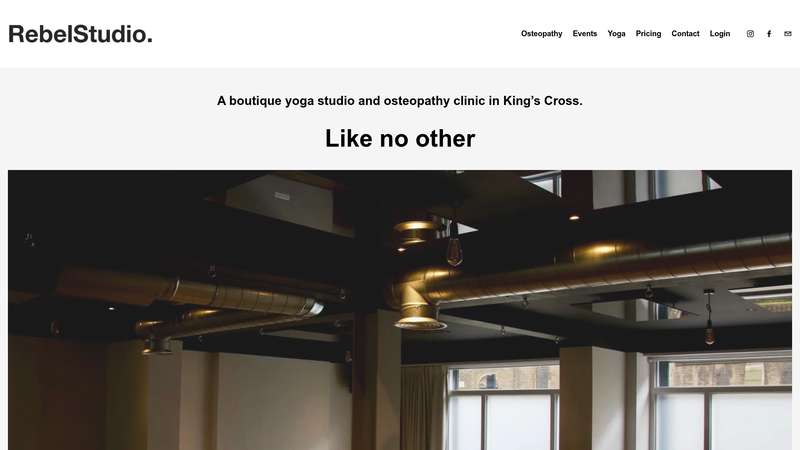
The website is structured around operational information. Class schedules, pricing, location details, booking links. This is the content that a returning student needs — someone who already knows why RebelStudio is different and simply wants to book their next session. It is not the content that a first-time visitor needs. A person searching for yoga studios in King’s Cross and landing on the website will find out what classes are available, when they run and how much they cost. They will not find out why 20 years of expertise matters, what the teaching philosophy looks like in practice, or why combining yoga with osteopathy produces better outcomes than yoga alone. The site is optimised for logistics rather than persuasion.
The Unexplored Integration
The combination of yoga instruction and osteopathy practice is RebelStudio’s most distinctive asset. Most yoga studios teach movement. A few offer workshops on anatomy. Almost none have an integrated osteopathy practice where the same understanding of the body informs both the clinical work and the class design. This integration is the answer to the question every new student asks: “Why should I come here instead of the studio that is closer to my flat?” But the website treats yoga and osteopathy as separate services listed on separate pages, rather than as a unified philosophy of body care. The connection between the two — how osteopathic understanding shapes the teaching, how yoga complements clinical treatment — is implied at best and invisible at worst.
The Authority Gap
Twenty years of yoga expertise is rare. In a market saturated with newly qualified instructors who completed a 200-hour teacher training last year, two decades of continuous practice and teaching represents a depth of knowledge that is genuinely scarce. Yet the website communicates this experience with the same weight and format that a studio founded last year would use. There is no editorial depth — no writing about movement philosophy, no perspective on how yoga practice has evolved, no discussion of the principles that guide the teaching. The expertise exists but the website does not surface it. A visitor has to take on trust that 20 years of experience translates into better teaching, because the site provides no evidence beyond the claim itself.
What Works
The studio’s location in King’s Cross places it in one of London’s most active wellness corridors, with strong foot traffic and a demographic that indexes heavily toward health-conscious professionals. The class offering appears well-structured, with clear descriptions of what each class involves and who it suits. The osteopathy practice gives the studio a clinical credibility that pure yoga brands lack — it signals that the people running this space understand the body at a level beyond standard fitness instruction. The “Rebel” positioning carries an independent, anti-corporate energy that distinguishes the brand from polished chain studios. The pricing structure is transparent, which builds trust with price-sensitive first-time visitors. The combination of yoga and osteopathy under one roof is genuinely convenient for students who would otherwise need to visit two separate practitioners, and the integrated approach presumably informs better outcomes — each modality supporting the other.
The Wider Pattern
Across the wellness sector, we see a consistent gap between practitioner expertise and digital communication. Studios and practices led by deeply experienced founders default to informational websites — timetables, prices, contact forms — because the founder’s energy goes into the practice itself, not the digital presence. This is understandable. But in a market where discovery is overwhelmingly digital, the website is often the only encounter a potential student has with the brand before deciding whether to book.
Lush, the beauty brand we reviewed recently, has a version of this tension — its in-store experience is built on passionate, knowledgeable staff who communicate the brand’s values in every interaction, while the website flattens that personality into standard e-commerce copy. RebelStudio faces the same dynamic in microcosm. The in-studio experience is presumably shaped by 20 years of expertise, the founder’s personality, the integrated osteopathic perspective. Online, all of that is reduced to a class list with booking buttons.
The studios that command premium pricing in London — Fierce Grace, Third Space, The Life Centre — all invest in editorial content that communicates why their approach is different. Not more content. Better content. The kind that makes a visitor feel the philosophy before they attend a class.
If We Were Starting Fresh
We would build the digital experience around the integration story. Yoga and osteopathy, together, under one roof, informed by 20 years of practice. That is the proposition, and it should be the first thing a visitor encounters — not a class timetable. The homepage would communicate the philosophy: why these two disciplines belong together, what 20 years of practice has taught about the body, and what that means for the student experience.
The founder’s voice would be central. Two decades of expertise produces perspectives, opinions and insights that newly qualified instructors simply cannot offer. Long-form content about movement philosophy, the relationship between clinical bodywork and yoga practice, perspectives on common injuries, the evolution of teaching methodology over 20 years — this editorial layer would establish RebelStudio as a wellness authority, not just a studio with availability.
The booking experience would still be frictionless — students need to find classes and book them quickly. But it would sit within a brand experience that communicates why this studio is worth crossing London for, not just convenient because it is near the station. The aspiration would be to make the website feel like a conversation with the founder rather than a kiosk at the reception desk. That is the experience the studio presumably delivers in person. The digital presence should deliver it too.
Wondering if YOUR brand has the same gaps?
We will tell you -- for free. Our team will analyse your website and brand, then send you an honest review.
Get Your Brand ReviewFeature Your Review
Display this badge on your website to showcase your independent brand review.