Russell Simpson
Industry: Property
Verdict: “A family agency in Chelsea and Kensington with a website that belongs in neither.”
Reviewed: April 2026
Who They Are
Russell Simpson is a family-run estate agency specialising in luxury residential property across West London’s prime neighbourhoods: Chelsea, Kensington, Notting Hill, Holland Park, Marylebone, and Soho. The agency also maintains a curated New York portfolio. Properties on their books range from GBP 1.2 million to GBP 27.5 million, encompassing Robert Adam-designed Georgian townhouses, Grade II listed Victorian villas, and newly built family homes. The agency holds 252 off-market properties. What distinguishes Russell Simpson is its editorial programme, “Guides & Stories,” authored by members of the Russell family — Jake, Leo, Hermione, Bertie, and Alan — alongside staff writer Ed Woolgar. Competitors include Savills, John D Wood & Co, and Strutt & Parker.
What We Noticed
The family voice below the fold
Russell Simpson has built something almost no competitor possesses: a genuine editorial programme authored by the family who runs the agency. Jake Russell writes about the history of Lansdowne Road. Leo Russell compares Chelsea and New York’s West Village. Hermione Russell draws parallels between Notting Hill and Brooklyn Heights. Ed Woolgar explores Pavilion Road and Mulberry Walk. These are not ghostwritten blog posts. They are personal, neighbourhood-specific pieces written by people who grew up on these streets and sell homes there today. This is the single most differentiating asset in the agency’s portfolio, and it sits below property carousels, off-market listings, and a New York section on the homepage. The editorial voice exists. The homepage does not lead with it.
Two hundred and fifty-two reasons to call
The off-market portfolio — 252 properties “ready to be discovered” — is presented as a single call-to-action: “Speak to Us.” This is a significant number. In a market where off-market access is the primary reason wealthy buyers choose one agent over another, Russell Simpson has quantified its advantage. But a number and a phone link do not convey the nature of that portfolio. There is no indication of the types of properties held off-market, the price ranges, the neighbourhoods represented. A buyer who has come to the site to understand Russell Simpson’s strength in Chelsea or Notting Hill learns only that 252 properties exist somewhere. The off-market proposition needs to be felt, not just stated.
The physical presence that does not translate
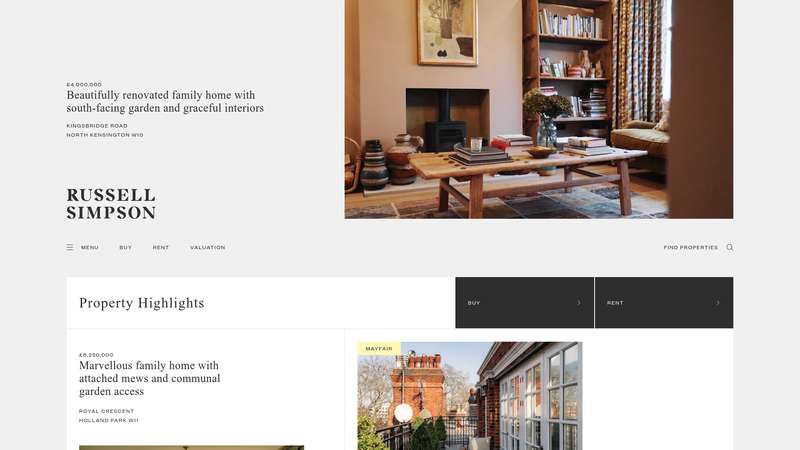
Russell Simpson’s properties are among the most beautiful residential homes in London. Georgian townhouses on Old Church Street. Victorian villas on Clarendon Road. The photography is professional and the property descriptions are detailed. But the digital presentation follows the same visual hierarchy as any property portal: image carousel, price, description, contact form. Properties at GBP 19 million or GBP 27.5 million deserve a presentation that matches their significance. Savills and Knight Frank present prime properties with full-screen imagery, neighbourhood context, and lifestyle positioning. Russell Simpson presents them as listings.
What Works
The Guides & Stories programme is genuinely exceptional. Estate agency editorial is almost always either ghostwritten, generic, or both. Russell Simpson’s content is personal, specific, and authored by named family members with real neighbourhood connections. An article comparing Chelsea and New York’s West Village, written by a Russell who knows both markets intimately, creates the kind of trust and authority that no amount of brand advertising can replicate. The programme also serves as an implicit statement about the agency’s values: these are people who care about place, history, and architecture, not just transactions.
The New York portfolio extension is strategically smart. It acknowledges that Russell Simpson’s core client base — internationally mobile, multi-property — shops across both cities. Presenting London and New York under one roof positions the agency as a lifestyle partner rather than a local agent.
The off-market number — 252 properties — is a powerful proof point. In a market where agents routinely claim off-market access without evidence, putting a specific number on the proposition signals confidence and transparency.
The Wider Pattern
Across the brands we have reviewed, the most striking pattern is how often the most differentiating asset is also the most buried. Grind’s environmental foundation — 15,050kg of ocean plastic recovered — sits below discount codes on its homepage. The White Company’s founding story, which brands spend millions trying to fabricate, is invisible on the first visit. Russell Simpson’s family-authored editorial programme, which no competitor can replicate, lives below property listings.
The explanation is usually the same: listing pages drive measurable conversions while editorial drives harder-to-measure trust. Agencies default to showing properties because properties generate enquiries. But in a market where every premium agency shows the same properties on the same portals, the editorial programme is the only thing that cannot be replicated. Russell Simpson has already invested in the content. The question is whether the digital hierarchy gives it the commercial prominence it deserves.
If We Were Starting Fresh
We would redesign the homepage around the family editorial voice. The first impression would not be a property carousel but a featured story — Jake Russell on Lansdowne Road, Hermione Russell on Notting Hill’s character, Ed Woolgar on a hidden Chelsea mews. The message: this is a family who knows these streets personally, who writes about them because they care, and who sells homes here because that knowledge translates into better outcomes for buyers and sellers.
Properties would be presented within neighbourhood context rather than as isolated listings. A GBP 27.5 million townhouse on Old Church Street would sit within an editorial framework that explains why Old Church Street matters, what the architecture reveals, and what life there offers. The editorial programme and the property portfolio would be woven together, each reinforcing the other.
The off-market proposition would move beyond a number and a phone link. A dedicated section would communicate the types of properties held off-market, the process for accessing them, and the relationship-based approach that underpins Russell Simpson’s discretion. Two hundred and fifty-two reasons to call. The website should make at least a few of them visible.
Wondering if YOUR brand has the same gaps?
We will tell you -- for free. Our team will analyse your website and brand, then send you an honest review.
Get Your Brand ReviewFeature Your Review
Display this badge on your website to showcase your independent brand review.