Soho House
Industry: Hospitality
Verdict: “A members’ club that defined creative hospitality for 30 years, with a website that shows the rooms but not the culture.”
Reviewed: April 2026
Who They Are
Soho House began in 1995 above a cafe on Greek Street in London’s Soho, founded by Nick Jones as a private members’ club for people in creative industries. Thirty years later, the brand operates over 40 Houses across Europe, North America, and Asia — each one a combination of hotel, restaurant, bar, spa, and co-working space designed for a membership that is curated rather than purchased. Applicants are vetted. The waiting list is real. Around the core club model, the brand has built Soho Home (an interiors retail line), Cecconi’s restaurants, Cowshed spas, and a content arm that produces Soho House magazine. The company went public in 2021. It is, by most measures, the brand that defined the modern members’ club.
What We Noticed
Atmospheric imagery without editorial gravity
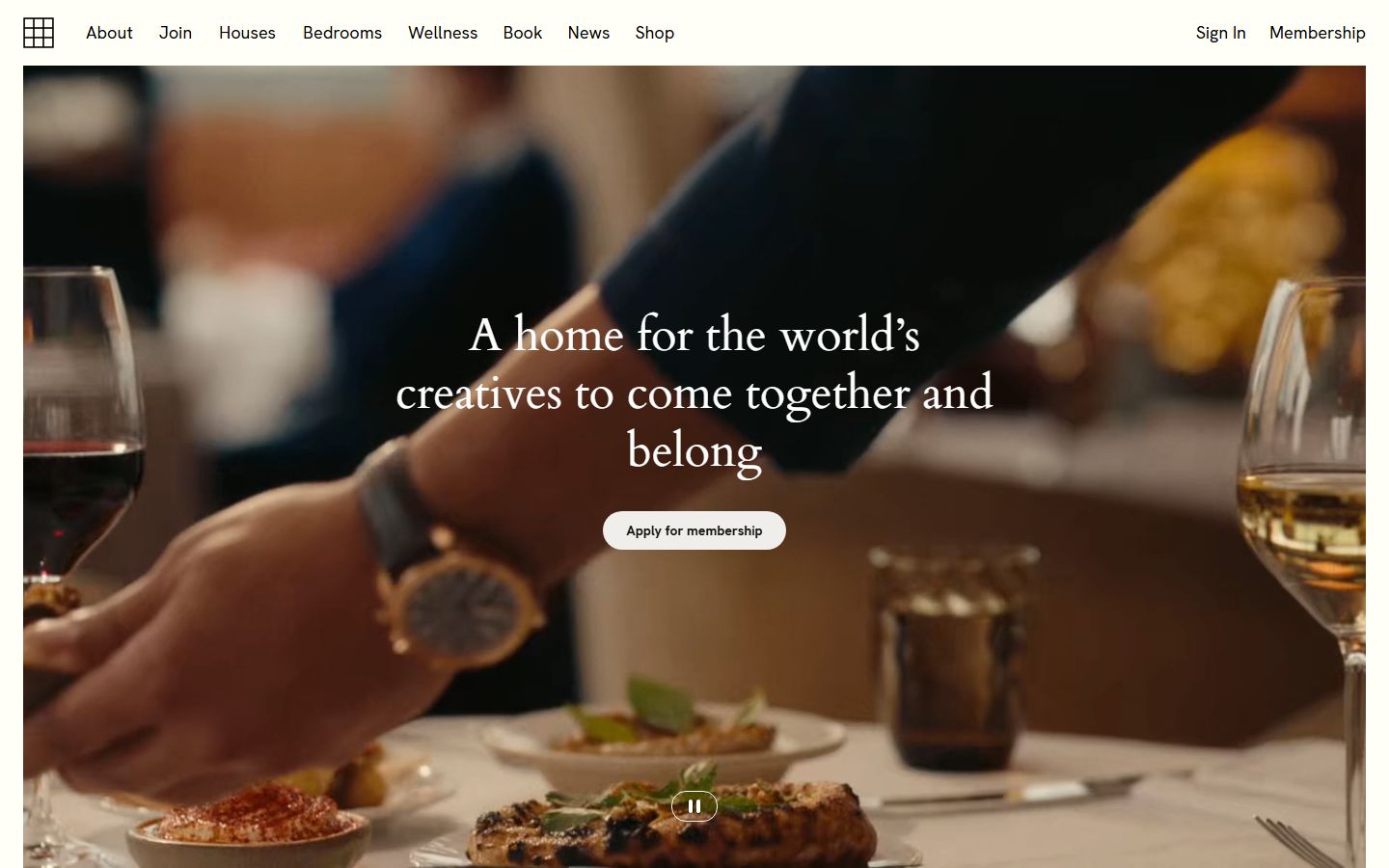
The photography across sohohouse.com is beautiful. Warm-toned interiors, rooftop pools at golden hour, candlelit dining rooms that make you want to be in them. This is a brand that understands visual mood — every image feels curated, every space looks like somewhere you would choose to spend an evening. But the imagery carries the entire weight of the brand proposition on its own. There is almost no editorial layer beneath the photographs. No long-form content about what happens inside these rooms. No member stories. No cultural programming archive. No founder narrative. The site presents Soho House as a collection of aspirational spaces, not as a living community with three decades of creative history. For a brand whose entire value proposition is the people inside the building, the website is remarkably empty of people’s voices, experiences, and stories.
Thirty years of heritage, invisible online
In 1995, Soho House was a single room above a cafe. Today it operates on three continents. That journey — from a London members’ club to a global hospitality brand — is one of the most compelling founding stories in the industry. It predates the co-working movement, the boutique hotel boom, and the membership economy by years. Soho House did not follow these trends. It helped create them. But you would not know this from the website. There is no heritage section, no timeline, no narrative about how the brand evolved from one room to forty Houses. The history is not hidden — it simply is not told. Competitors like The Ned and Habitas launched in the last decade and can present themselves as fresh concepts. Soho House has 30 years of cultural capital that none of them can match. It just does not deploy it.
Membership conversion without membership story
The path from curious visitor to member is not clearly mapped on the site. There is a membership section, but it reads like an information page rather than an invitation. The criteria, the process, the timeline — the practical mechanics of applying — are present but feel administrative rather than aspirational. What is missing is the emotional case for membership. Why would someone want to join? What does it feel like to be a member? What changes once you are in? For a club where the membership itself is the product — not the rooms, not the restaurants, not the pools — the digital experience does remarkably little to convey what membership actually means. The rooms are the backdrop. The community is the value. The website has the ratio inverted.
What Works
The visual identity is genuinely distinctive. The warm, analogue-feeling photography across every House has a consistent tone that is immediately recognisable — you can identify a Soho House image before reading the caption. This is not easy to achieve across 40+ properties in different countries, and it speaks to a strong creative direction that extends from the physical spaces to the digital presentation.
The multi-format model (clubs, hotels, restaurants, spas, co-working, retail, magazine) creates an ecosystem that no competitor can replicate at this scale. A member can work, eat, sleep, exercise, shop, and socialise within the Soho House world. The brand is not a hotel chain or a restaurant group — it is a lifestyle infrastructure. This breadth is a genuine moat.
The curation model itself — vetting applicants for creative credentials rather than selling open-access membership — is the brand’s most powerful differentiator. It creates a self-reinforcing loop: creative people want to be around other creative people, which makes the membership more valuable, which makes the waitlist longer, which makes the membership more desirable. This is a network effect that money alone cannot buy.
The Wider Pattern
Across the hospitality brands we have reviewed, heritage is the most consistently underused digital asset. Greene King has brewed beer since 1799 and leads its homepage with voucher codes. The Calcot Collection sits in Cotswolds properties with centuries of history and presents them through a booking engine. Soho House has 30 years of defining creative hospitality and shows you the swimming pool. The pattern is that brands with earned cultural authority default to transactional presentation online — showing what you can book rather than why you would want to belong. The brands that break this pattern (Habitas with its community storytelling, Birch with its creative programming content) tend to be younger brands with less heritage to draw on. They tell their story because they are still building it. The established players assume you already know theirs.
If We Were Starting Fresh
We would build the digital experience around the concept of creative belonging — not “look at these rooms” but “this is what happens when creative people gather in them.”
The homepage would lead with culture, not property. Member stories, creative programming, editorial content from Soho House magazine woven into the main site rather than sitting as a separate publication. Each House would have its own page that conveys character and community, not just amenities and booking links. The 30-year journey from Greek Street to a global network would sit prominently as a narrative that no competitor can replicate — a timeline of cultural moments, creative partnerships, and the evolution of what a members’ club can be.
The membership section would become an invitation rather than an information page. What does it feel like to walk in? Who will you meet? What will change? The emotional case for belonging, told through the voices of people who already do. The physical spaces are extraordinary. The digital experience needs to convey why those spaces matter — and that answer has never been about the furniture.
Wondering if YOUR brand has the same gaps?
We will tell you -- for free. Our team will analyse your website and brand, then send you an honest review.
Get Your Brand ReviewFeature Your Review
Display this badge on your website to showcase your independent brand review.