Stanwell House
Industry: Hospitality
Verdict: “A Georgian gem freshly restored, presented through a website that has not had the same renovation.”
Reviewed: April 2026
Who They Are
Stanwell House is a boutique hotel in Lymington, Hampshire, occupying a Georgian townhouse on the high street of one of the New Forest’s most attractive sailing towns. The property has undergone a significant refurbishment, transforming the interiors while preserving the period architecture — high ceilings, sash windows, the proportions of a building designed to impress. The hotel includes a restaurant, a bar, and gardens that open onto views toward the Solent. Lymington itself is a yachting town with a Saturday market, independent shops, and ferry connections to the Isle of Wight. The location gives Stanwell House something that the New Forest’s woodland retreats cannot offer: a town centre address with coastal proximity, Georgian elegance, and the national park on the doorstep.
What We Noticed
A renovation completed in one medium, not the other
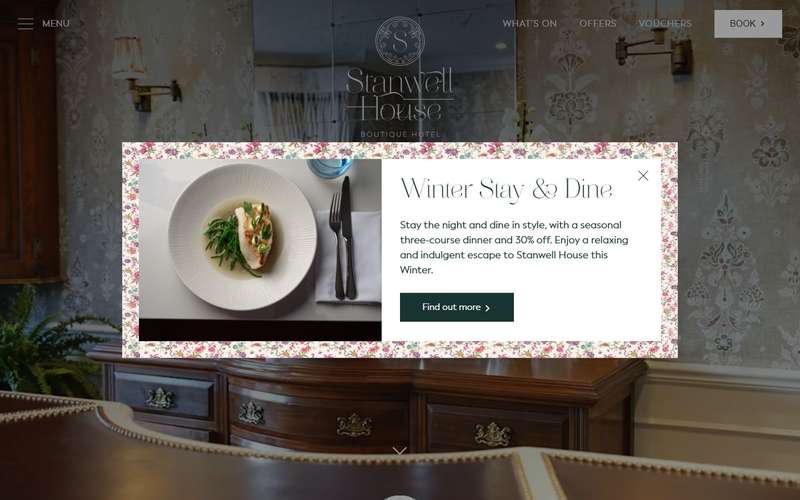
Stanwell House has clearly invested in its physical product. The refurbishment has brought the interiors up to a standard that competes with the upper tier of New Forest hospitality — contemporary furnishings within Georgian proportions, the kind of design work that balances respect for a building’s history with the expectations of a modern guest. But the website belongs to a different era. The visual presentation — photography, layout, typography, overall design quality — does not reflect the standard of the refurbished property. A potential guest researching New Forest hotels would encounter a digital experience that undersells what is actually waiting in Lymington. The renovation stops at the screen. In a market where first impressions are formed online, this gap between physical and digital quality costs bookings.
Georgian character as atmosphere, not identity
Georgian architecture has a specific character: symmetry, proportion, light through tall windows, the elegance of a building designed with mathematical precision. These qualities are not just aesthetic — they create a particular feeling of space, calm, and permanence that is difficult to manufacture in a modern building. Stanwell House has this character inherently. But the website does not use it as a design language. The Georgian proportions of the building could inform the proportions of the page. The quality of light through those tall windows could define the photography style. The architectural precision could translate into typographic precision. Instead, the digital presence uses a generic hospitality template that could house any hotel. The building’s character — its greatest visual asset — is documented but not expressed.
Lymington’s story, untold
The New Forest market is dominated by woodland retreats and country estates. Lime Wood is in the forest. Chewton Glen sits in its own parkland. The Pig is in a kitchen-garden estate. Stanwell House is different — it is in a town. A Georgian town with a harbour, a high street, a weekly market, and a sailing culture that draws visitors from across the south coast. This is a meaningful distinction. A guest choosing Stanwell House is choosing Lymington as much as the hotel. They want to walk to dinner, browse the chandleries, watch the boats. But the website does not make the case for Lymington as a destination. The town is mentioned but not explored. The harbour, the market, the coastal walks, the Isle of Wight ferry — the things that make this location unlike any other in the New Forest — are not woven into the brand’s story.
What Works
The Lymington location is a genuine competitive advantage. In a market of rural retreats set behind long driveways, Stanwell House offers a town-centre experience with all the independence and walkability that implies. This is not a weakness to overcome but a position to own — the hotel for guests who want the New Forest and a living town, not just the forest in isolation.
The Georgian building itself is an asset that cannot be replicated. Period proportions, original features, and the quiet authority of a building that has stood on Lymington High Street for centuries. In the boutique hotel market, architectural authenticity is increasingly rare. Most competitors are either modern builds styled to look old or country houses converted to hotels. Stanwell House is the real thing.
The scale is right for a boutique proposition. This is not a 200-room property trying to feel intimate. It is an actual townhouse, which means the boutique positioning is inherent, not aspirational. Guests staying at Stanwell House are genuinely staying in a Georgian townhouse, not in a large hotel that calls itself one.
The Wider Pattern
Across the brands we have reviewed, the visual identity gap — where a brand’s physical product has evolved faster than its digital presence — is one of the most common and most costly mismatches. Soho House has invested billions in physical spaces and presents them through atmospheric but editorially thin pages. Candy Kittens has redefined British confectionery and sells it through a standard Shopify template. Stanwell House has completed a physical renovation and has not yet started the digital one. The cost of this gap is invisible but real: every potential guest who forms their first impression online and moves on to a competitor with better photography, clearer storytelling, and a more polished visual identity. The physical product cannot speak for itself until the guest is through the door. Everything before that moment is the website’s job.
If We Were Starting Fresh
We would treat the digital presence as the second phase of the renovation — applying the same design standards to the screen that have been applied to the building.
New photography would be the foundation: shot to capture the Georgian proportions, the quality of light, the textures of restored stone and contemporary furnishings. The visual identity would draw its design language from the building itself — the symmetry, the restraint, the precision of Georgian architecture translated into typographic and layout choices.
Lymington would become a central character in the brand’s story. The harbour, the high street, the market, the sailing culture — these are not amenities to list but reasons to visit. The hotel sits at the intersection of the New Forest and the Solent coast, and the digital experience would make this dual identity tangible: forest walks in the morning, harbour sunsets in the evening, a Georgian townhouse in between. The renovation is done. The building is ready. The website needs to catch up.
Wondering if YOUR brand has the same gaps?
We will tell you -- for free. Our team will analyse your website and brand, then send you an honest review.
Get Your Brand ReviewFeature Your Review
Display this badge on your website to showcase your independent brand review.