Story of Home
Industry: Property
Verdict: “An estate agency that sees homes as stories — told through a WordPress theme with no narrative arc.”
Reviewed: April 2026
Who They Are
Story of Home is a design-led, RICS-accredited London estate agency selling and letting architecturally interesting and characterful homes. Founded on the proposition “Beautiful Homes, By Design,” the agency takes a storytelling approach to property marketing, promising to understand “what is unique and special about every home, and what a life in that home and the surrounding area offers.” Their portfolio spans a wide London geography, from Hampstead and Covent Garden to Clapton, Nunhead, and Putney, with properties typically ranging from GBP 1.5 million to GBP 4 million. The agency operates on the Street.co.uk platform and competes in the same philosophical space as The Modern House, Inigo, and Domus Nova — agencies that treat homes as cultural objects rather than units of housing.
What We Noticed
The name promises what the website does not deliver
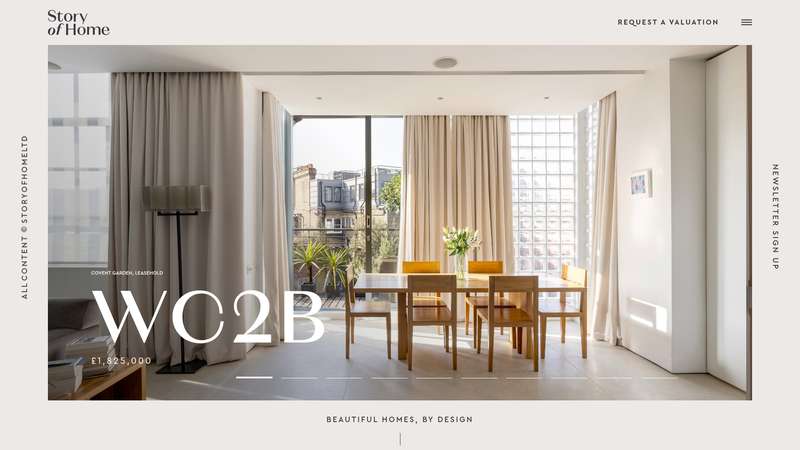
“Story of Home” is one of the strongest brand names in London estate agency. It immediately communicates a philosophy: homes are not transactions, they are narratives. Every room has a reason. Every renovation has a backstory. Every garden has been shaped by someone’s particular idea of outdoor life. The brand name creates an expectation of editorial depth — long-form property profiles, architectural commentary, owner interviews, neighbourhood narratives. The website delivers none of this. The homepage is a scrolling grid of property listings: location, tenure, postcode, price. There is no visible editorial section, no featured property story, no design journal. The most narratively ambitious brand name in the market sits above the most conventional property listing interface.
Template limitations in a storytelling business
The site runs on Street.co.uk, a property CMS that serves hundreds of UK estate agents. It handles the operational requirements competently: property listings, search filters, status updates (Sold STC, Let Agreed). But Street.co.uk is built for efficiency, not editorial. The platform does not offer native support for long-form property narratives, embedded video stories, or the kind of magazine-style layouts that a storytelling agency needs. Story of Home’s competitors have solved this problem differently. The Modern House built a bespoke platform that integrates editorial seamlessly with listings. Inigo commissions standalone editorial content alongside its property pages. Story of Home has chosen a platform that serves the listing function but constrains the editorial one. The template is doing its job. The job is not the one the brand name promises.
Photography doing the storytelling alone
The property photography across the Story of Home portfolio is noticeably stronger than the market average. Images are composed to show architectural character — a Victorian bay window lit by afternoon sun, a mid-century extension opening onto a garden, a period fireplace against a contemporary colour palette. This is clearly curated for design-conscious buyers, and it demonstrates the agency’s eye for what makes a home architecturally interesting. But the photography carries the entire narrative weight. Without accompanying written stories, the images communicate atmosphere but not provenance. A buyer browsing the site sees beautiful homes but does not learn who built them, why the extension was designed that way, or what the neighbourhood offers someone who values architecture. The photography is doing the storytelling work of an entire editorial team, alone.
What Works
The curatorial sensibility is genuine. Story of Home does not list every property that comes its way. The portfolio is visibly curated for architectural interest and design quality. A buyer browsing the listings sees period conversions, characterful freehold houses, and properties with genuine design distinction, not a generic mix of ex-local-authority flats and new-build developments. This curation is itself a form of editorial — it communicates taste and standards through selection.
The geographic range is broader than most design-led competitors. The Modern House focuses on a particular architectural register. Inigo operates primarily in the period market. Story of Home covers Hampstead and Clapton, Covent Garden and Nunhead, which positions it as an agency for people who value design and character wherever it exists in London, not just in the fashionable postcodes.
The RICS accreditation signals professional rigour, which matters for an agency that could otherwise be perceived as prioritising aesthetics over substance. It provides institutional credibility that supports the creative positioning.
The agency’s stated approach — spending time with owners to understand what makes each home unique — is exactly the methodology that would produce extraordinary editorial content. The raw material for property stories exists. The system for publishing them does not.
The Wider Pattern
The gap between brand promise and digital execution is not unique to property. Grind, the coffee brand, has a compostable pod innovation that genuinely differentiates it from Nespresso, but its homepage leads with discount codes rather than the environmental story. The White Company has Chrissie Rucker’s founding narrative — the kind of origin story brands spend millions fabricating — buried several clicks deep. In each case, the differentiating asset is present but subordinated to convention.
Story of Home faces a sharper version of this tension because the differentiating asset is declared in the name itself. When your brand is literally “Story of Home,” the absence of stories is more conspicuous than it would be for an agency called “Simpson & Partners” or “Knight Frank.” The competitors who occupy the same philosophical space — The Modern House, Inigo, Domus Nova — have invested in editorial infrastructure that matches their positioning. The Modern House publishes property features that rival architectural magazines. Inigo’s photography and writing are commissioned to the standard of design publications. Story of Home has the positioning and the curatorial eye. The editorial infrastructure has not yet been built to match.
If We Were Starting Fresh
We would rebuild the digital experience around the concept that gives the agency its name. Every property in the portfolio would receive a written story alongside the photography: who built it, who has lived there, what the renovation choices reveal about the owner’s relationship with the home, what the neighbourhood offers someone who values design. These stories would be the primary content on the homepage, not the listing grid.
The platform would either be rebuilt or supplemented with an editorial layer that the current Street.co.uk CMS does not provide. A “Journal” or “Stories” section would publish regular features on architecture, renovation, neighbourhood character, and the design philosophies of the homes Story of Home represents. This is not content marketing. It is the product itself. When a buyer chooses Story of Home over Foxtons, they are choosing an agency that sees homes the way they do. The website should be the evidence of that shared perspective.
The owner conversation — the time spent understanding what makes each home unique — would become visible content rather than invisible process. If Story of Home already has these conversations, recording them (with permission) and publishing them as short-form property narratives would create an editorial programme that no competitor can replicate, because no competitor is having the same conversations.
Wondering if YOUR brand has the same gaps?
We will tell you -- for free. Our team will analyse your website and brand, then send you an honest review.
Get Your Brand ReviewFeature Your Review
Display this badge on your website to showcase your independent brand review.