The Calcot Collection
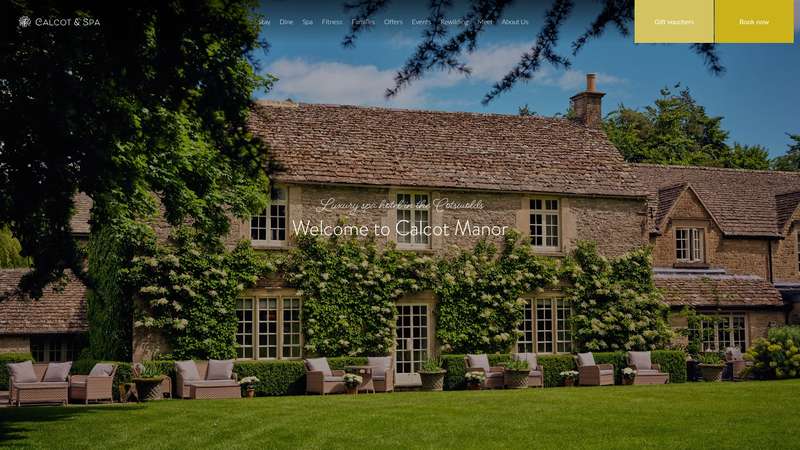
Screenshot of The Calcot Collection’s website, captured April 2026
The Calcot Collection
Industry: Hospitality
Verdict: “Cotswolds luxury where the grounds do the talking — and the website does not.”
Reviewed: April 2026
Who They Are
The Calcot Collection is a group of luxury hotels in the Cotswolds, each set within a historic property with its own character. Calcot & Spa occupies a 14th-century farmstead with ancient stone barns and a family-friendly spa. Barnsley House, once the home of celebrated garden designer Rosemary Verey, is known for its gardens as much as its rooms. The Painswick brings a more contemporary sensibility to a Palladian-style building in one of the Cotswolds’ most picturesque villages. Together, the properties offer spa breaks, dining, weddings, and countryside retreats. The Collection is positioned at the upper end of the Cotswolds market — not the country house hotel formality of Lucknam Park, but something warmer, more relaxed, and more personally run.
What We Noticed
A landscape experienced, not conveyed
The Cotswolds is not a backdrop. It is a co-author. The honey-coloured stone, the rolling hills, the quality of light that shifts across the seasons, the particular silence of a valley at dusk — these qualities are inseparable from the experience of staying at a Calcot Collection property. Guests choose these hotels in part because they are in the Cotswolds, and the Cotswolds is best understood through the senses. But the website presents the landscape primarily through standard hotel photography: well-lit room interiors, swimming pool exteriors, dining table settings. The rolling grounds, the kitchen gardens, the approach down a country lane, the frost on a stone wall in January — the sensory texture of the Cotswolds experience — is not given the editorial space it deserves. The place is more than its rooms. The digital experience does not yet convey this.
Historic properties without history
A 14th-century farmstead has stories in its walls. Barnsley House has Rosemary Verey’s garden — a horticultural landmark that brings visitors from around the world. These are not generic luxury hotels that happened to choose attractive buildings. The buildings themselves are part of the proposition. But the website treats the history as a background fact rather than a living narrative. A single line about the property’s age or provenance is not the same as letting a guest understand why these buildings matter, how they have been adapted, and what it means to sleep in a room that has existed for 700 years. Heritage is not a feature to list. It is a story to tell, and these properties have stories that most hotels could not invent.
Three properties, one tone of voice
Calcot & Spa, Barnsley House, and The Painswick are different places with different characters. One is a family-friendly farmstead. One is a garden lover’s retreat. One is a design-forward village hotel. These distinctions are visible when you visit — the atmosphere in each property is distinct. But the digital presentation uses a consistent tone and structure that smooths out the differences rather than celebrating them. A luxury collection’s strength lies in offering multiple experiences under one banner. When the digital voice is uniform, the collection feels like a chain rather than a curated portfolio.
What Works
Rosemary Verey’s garden at Barnsley House is a genuine cultural asset. It is one of the most influential English gardens of the 20th century, visited by Prince Charles and referenced in horticultural literature worldwide. Very few hotels can claim a garden with this level of cultural significance. It gives Barnsley House a reason to exist that extends far beyond accommodation.
The family positioning at Calcot & Spa fills a genuine gap in the Cotswolds luxury market. Most high-end Cotswolds properties target couples. Calcot’s family-friendly spa, children’s facilities, and relaxed atmosphere make it one of the few places where families can experience luxury hospitality without feeling that their children are an inconvenience. This is a specific, defensible position.
The geographic concentration within the Cotswolds is a strategic advantage. Rather than spreading across the country, the Collection has deepened its presence in a single region. This allows each property to benefit from the Cotswolds’ reputation while offering a different facet of the experience. A guest who loved Barnsley House might try The Painswick next. The collection cross-sells itself.
The Wider Pattern
Across the hospitality brands we have reviewed, the physical-digital gap is most pronounced in heritage properties. The more extraordinary the physical space, the harder it seems to be to convey that experience online. Stanwell House has undergone a complete physical renovation and presents itself through a website that has not had the same treatment. Soho House has 40 beautiful properties and a website that shows the pools but not the culture. The Calcot Collection has 14th-century farmsteads and Rosemary Verey’s garden and a website that functions as a booking engine. The pattern suggests that brands with exceptional physical products often underinvest in digital storytelling because the physical experience “speaks for itself.” It does — once you are there. The website’s job is to get you there.
If We Were Starting Fresh
We would build the digital experience around the idea of the Cotswolds as a living character in the brand’s story, not just its location.
Each property would have a rich, editorially distinct page that conveys not just what the hotel looks like but what it feels like — seasonally, sensorially, historically. Barnsley House would lead with the garden and its story, because that is what makes it unlike any other hotel in England. Calcot would lead with the family experience and the ancient stone. The Painswick would lead with village life and contemporary design within a period setting.
The Cotswolds itself — its food producers, its walking routes, its seasonal rhythms — would be woven throughout the site as a destination layer, positioning the Collection as the definitive guide to this landscape. The history of each building would be told as narrative, not as a fact box. Seven hundred years of stories, presented with the same care that the properties themselves receive.
Wondering if YOUR brand has the same gaps?
We will tell you -- for free. Our team will analyse your website and brand, then send you an honest review.
Get Your Brand ReviewFeature Your Review
Display this badge on your website to showcase your independent brand review.