Titanic Spa
Industry: Wellness
Verdict: “The UK’s first eco-spa, in a restored Victorian mill — and the website opens with a voucher.”
Reviewed: April 2026
Who They Are
Titanic Spa is a multi-award-winning destination spa housed in a restored textile mill in Linthwaite, near Huddersfield, set amongst the Pennine hills of West Yorkshire. Opened in 2005, it holds the distinction of being the UK’s first eco-spa. The building draws water from a natural spring 100 metres below the earth’s surface — the same borehole that served the mill during its working life. Solar photovoltaic panels generate renewable electricity. An OTEX laundry system eliminates the need for external laundry transport. The kitchen sources locally and seasonally. The building invested GBP 1.5 million in carbon-neutral infrastructure. Accommodation is apartment-style, set within the mill itself, with panoramic windows overlooking the surrounding countryside. Titanic Spa partners with Elemis, NEOM Organics, and Comfort Zone for its treatment range and has won World Luxury Spa Awards.
What We Noticed
The offer carousel as front door
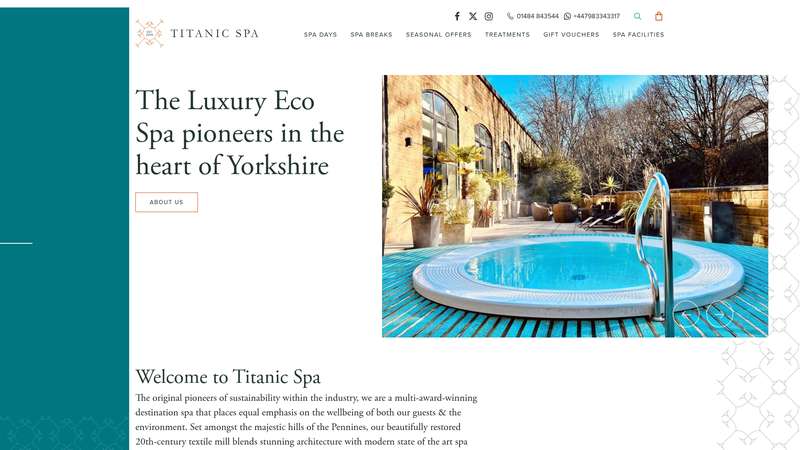
Arrive at titanicspa.com and the first thing below the hero text is a carousel of seasonal offers. April Twilight Evening, GBP 55pp. April Spa Day, GBP 145pp. Fabulous Friday, GBP 199pp. Sunday Night Stopover, GBP 189pp. Simply Spa Sale, saving 50%. Thirteen offer cards scroll through in a loop, many repeating. The building that pioneered eco-spa design in Britain, that draws its water from a spring a hundred metres underground, that sits inside the stone walls of a textile mill overlooking the Pennines — it introduces itself with a price list. The most interesting things about Titanic Spa are not priced. They are experienced. But the website has chosen to lead with what the experience costs rather than what it feels like.
The heritage on the About page
The story of Titanic Mill — its industrial past, its redevelopment, the discovery that the old borehole still produced clean water, the decision to invest GBP 1.5 million in making the building carbon-neutral — all of this lives on the About Us page. It does not appear on the homepage. A visitor who arrives, scans the offers, and leaves has encountered none of the narrative that makes this spa genuinely different from every other destination spa in Yorkshire. The Gainsborough Bath Spa in Somerset leads with its Georgian architecture and natural thermal waters. Rudding Park leads with its grounds and heritage. Titanic Spa leads with “April Overnight Spa Break, from GBP 169pp.”
The eco claim without the eco story
“The UK’s first eco-spa” appears in the homepage headline and the page title. It is a strong claim. It is also the only place on the homepage where ecology is mentioned. The supporting evidence — solar panels, borehole water, OTEX laundry, locally sourced food, a dedicated Eco Focus Group — requires navigating to the About page. For a positioning that defines the brand’s market category, the supporting narrative is remarkably absent from the first impression. A visitor could read the entire homepage and understand that Titanic Spa has competitive prices for spa breaks without ever learning why “eco” appears in the brand name.
The photography gap
The physical space sounds extraordinary: stone mill walls, Pennine views, a spring-fed plunge pool, apartment balconies overlooking the countryside. The website photography captures this functionally but not atmospherically. The gallery carousel shows clean, competent shots of treatment rooms, the pool, and the exterior. But they read like estate agent photography — they document the space rather than evoking the feeling of being in it. Ragdale Hall and The Gainsborough invest in editorial-quality imagery that makes the viewer feel the warmth, the quiet, the textures. Titanic Spa’s photography tells you what the rooms look like. It does not tell you what the stone feels like underfoot, or how the light falls through the mill windows in the afternoon.
What Works
The eco credentials are the real thing. This is not greenwashing. Solar photovoltaic panels, a borehole spring providing all bathing and drinking water, an OTEX laundry system that washes with ozonated water at cool temperatures, locally sourced seasonal food, GBP 1.5 million in carbon-neutral infrastructure, an active Eco Focus Group driving continuous improvement. When Titanic Spa says “eco,” it means something specific and measurable. Most spas that use environmental language are referring to a recycling programme and some bamboo towels. Titanic Spa redesigned a building from its foundations.
The product house selection is smart. Elemis is the UK’s number one luxury skincare brand. NEOM Organics is 100% natural with genuine wellbeing credentials. Comfort Zone delivers results-driven clinical treatments. Together, they cover the full spectrum from indulgence to efficacy, and all three carry ethical credentials that align with the eco positioning.
The apartment-style accommodation within the mill itself is genuinely distinctive. Guests sleep inside the building’s history. The panoramic windows, the balconies, the mill architecture — this is not a purpose-built spa hotel. It is an industrial building that has been given a second life. That physical experience is unlike anything Rudding Park or Ragdale Hall can offer.
The Wider Pattern
Across the hospitality and wellness brands we have reviewed, the same structural problem recurs: physical spaces with extraordinary character that default to promotional mechanics online. Greene King has 225 years of pub heritage and opens its website with food photography. Hawkstone Park has a historic estate and championship golf courses and leads with seasonal rates. Titanic Spa follows the same pattern. The physical experience — the mill, the spring, the Pennines — is inherently sensory and atmospheric. The digital experience is transactional. The brands in this space that close the gap are the ones that make you feel the place before they ask you to book it. The Gainsborough Bath Spa does this by leading with its thermal waters and Georgian architecture. The digital experience becomes an extension of the physical one, not a booking form with pictures.
If We Were Starting Fresh
We would build the entire digital experience around the mill. The building is the brand. A textile mill that wove cloth for over a century, fell silent, and was reborn as a spa drawing water from the same spring that powered it in the 1900s — that is not a backstory. That is the story. The homepage would open with the mill, the landscape, the water. Not with a price.
The eco credentials would be woven into every page, not confined to an About section. The borehole spring would be part of the pool experience. The solar panels would be part of the arrival. The locally sourced menu would be part of the dining proposition. “UK’s first eco-spa” would not be a tagline — it would be a narrative thread connecting every element of the experience.
The photography would shift from documentation to atmosphere. What does the light look like through those panoramic windows at dusk? What does the stone feel like? What does the outdoor hot tub look like with the Pennines behind it in winter? The building has more character than most spas will ever have. The photography should capture it.
The offers would still exist. A spa needs to fill rooms. But they would sit behind the experience, not in front of it. A visitor would understand why Titanic Spa is worth visiting before they see what it costs. The mill would sell the stay. The stay would justify the price.
Wondering if YOUR brand has the same gaps?
We will tell you -- for free. Our team will analyse your website and brand, then send you an honest review.
Get Your Brand ReviewFeature Your Review
Display this badge on your website to showcase your independent brand review.