TLT
Industry: Legal & Law
Verdict: “A law firm that says it challenges convention, through a website that follows every one.”
Reviewed: April 2026
Who They Are
TLT is a UK-headquartered law firm with offices across the country and an international network. The firm positions itself as “curious and creative” legal advisers — language deliberately chosen to distinguish itself from the traditional law firm lexicon of “trusted” and “experienced.” TLT has invested in a FutureLaw programme, a dedicated innovation initiative exploring legal technology, alternative delivery models, and the future shape of legal services. They compete against firms like Pinsent Masons, Addleshaw Goddard, and DWF — all of whom have staked significant ground in the legal innovation space. It is a firm with ambition to be seen as different, backed by genuine investment in making that difference real.
What We Noticed
The convention paradox
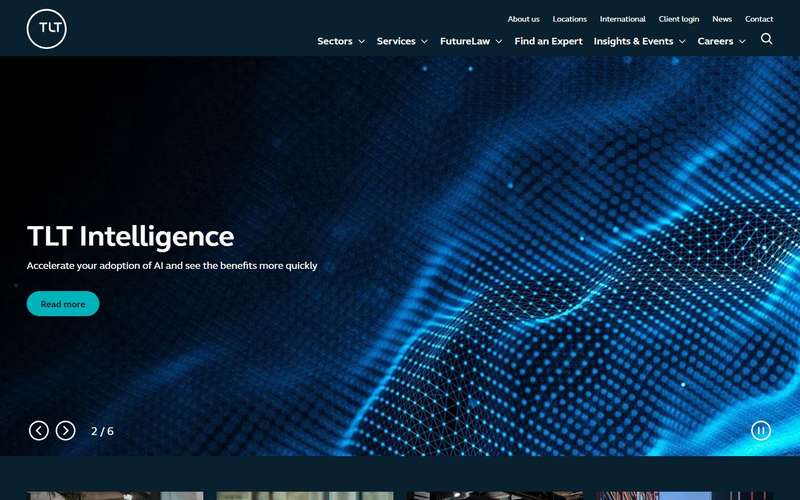
TLT’s stated positioning is that it challenges convention. Its website does not. The site is well built, competently designed, and entirely conventional. Hero imagery cycles through professional photography. Practice areas are arranged in a grid. The people section follows the standard headshot-and-bio format. News articles sit in a chronological feed. None of this is wrong. All of it is exactly what every law firm of similar size does. The result is a specific kind of irony: a firm that has made “challenging convention” its tagline, delivered through a digital experience that could have been assembled from a template labelled “Mid-Tier UK Law Firm.” The design does not look dated — it looks like everything else. For a firm whose entire brand promise is about being different, that is the problem.
The FutureLaw burial
FutureLaw is TLT’s most interesting asset. It is a dedicated innovation programme that goes beyond the standard law firm “innovation page” (which typically amounts to a paragraph about technology and a stock photo of a circuit board). TLT has invested in this. It is real. And on the website, it is buried. FutureLaw sits in the navigation as a sub-section rather than leading the firm’s story. A visitor who does not already know about it is unlikely to find it through casual browsing. For a programme that represents TLT’s strongest claim to being a different kind of law firm, this is a strategic misallocation of real estate. FutureLaw should be impossible to miss. Instead, it is easy to overlook.
Information competing with itself
The homepage carries a high density of content — practice areas, sector expertise, people, news, awards — all competing for attention. Multiple calls to action appear on the same screen. The effect is that no single message wins. A visitor arriving at the homepage encounters a professional firm that does many things well. What they do not encounter is a firm with a clear point of view. The “curious and creative” positioning gets diluted by the sheer volume of conventional content surrounding it. When everything is given equal weight, nothing has weight.
Modern without meaning
The design itself is clean. Typography is professional. Layout follows contemporary web standards. But “modern” and “meaningful” are different things. A modern design that does not express the brand’s distinctive qualities is simply a well-executed commodity. TLT’s website is modern in the way that a well-lit corporate reception area is modern — pleasant, professional, and indistinguishable from the one next door. The design competence is there. The design intention — the expression of what makes TLT specifically TLT — is not.
What Works
The FutureLaw programme is genuine. This is not a marketing exercise bolted onto a traditional firm — it represents real investment in exploring how legal services will be delivered in the future. That investment gives TLT a credible claim to the innovation space that many firms talk about but few fund.
The “curious and creative” positioning is the right instinct. In a sector where most firms default to “trusted advisers” and “commercial solutions,” choosing language that signals intellectual curiosity and creative problem-solving is distinctive. The words themselves are good. They just need a website that lives up to them.
The firm’s scale is also an advantage. TLT is large enough to be credible across multiple sectors and practice areas, but not so large that it disappears into the “Big Law” category. This middle ground — substantial enough to be serious, nimble enough to be different — is exactly the space where a “challenge convention” positioning can be most effective. If the digital experience matched the ambition, TLT would occupy a genuinely unique position.
The Wider Pattern
Across the legal firms we have reviewed, a consistent gap keeps appearing: firms with genuinely progressive ambitions whose websites default to sector norms. Bexley Beaumont is a B-Corp certified purpose-led firm with a 2015-era template. Beyond Law Group is an innovative multi-brand operation with six disconnected websites that fragment rather than amplify their scale story. TLT adds a third variation — a firm that has invested in innovation and then presented it through a digital experience that looks like every other firm in the market.
The pattern is not about capability. These are strong firms doing interesting things. The pattern is about expression. The legal sector has a collective blind spot when it comes to digital: firms will invest in genuine operational innovation but treat the website as a brochure to be filled in rather than a platform to be designed. Pinsent Masons has started to close this gap — their innovation narrative is visible from the first interaction. DWF has repositioned entirely around being a “legal business” rather than a law firm. The firms that integrate their differentiators into the digital experience, rather than listing them in a sub-menu, are the ones changing how the market perceives them.
If We Were Starting Fresh
The direction for TLT starts with one decision: put FutureLaw at the front of the building, not in the back office. The innovation programme should be the first thing a visitor encounters — not as a separate section but as the lens through which the entire firm is presented. TLT is a law firm that invests in the future of legal services. That story should shape the homepage, the navigation, and the visual language.
The “curious and creative” positioning needs a design system that embodies it. This means moving beyond the conventions the firm claims to challenge. Typography, layout, interaction patterns, and content architecture should all express intellectual curiosity — the unexpected question, the different angle, the willingness to think differently about how legal information is structured and presented. The design should make a visitor feel the difference before they read a word about it.
Information density needs reduction. Rather than presenting everything at equal volume, the site should have a clear narrative hierarchy — what TLT believes, how that belief manifests in FutureLaw and its practice areas, and why that matters for clients who want a firm that thinks differently. Every page should answer one question clearly rather than attempting to answer five questions at once.
Wondering if YOUR brand has the same gaps?
We will tell you -- for free. Our team will analyse your website and brand, then send you an honest review.
Get Your Brand ReviewFeature Your Review
Display this badge on your website to showcase your independent brand review.