Woven Rosa
Industry: Homewares
Thesis: A world of handmade pieces from Morocco, Portugal, and India — browsed through a Squarespace grid.
Reviewed: April 2026
Who They Are
Woven Rosa is a curated homewares brand founded by Laura, specialising in handmade ceramics, glassware, textiles, and accessories. Every piece is made by artisan partners in Morocco, Portugal, India, Peru, and Bolivia — sourced directly, with relationships built over years rather than through wholesale catalogues. The brand describes itself as “inspired by sunlit sojourns and a life of adventure,” and the product range reflects this: hand-painted ceramic tableware with Mediterranean character, artisan-blown glassware, Peruvian and Bolivian woven textiles in rich colour palettes. Products sit in the GBP 25–80 range, positioning Woven Rosa as accessible premium — affordable enough for a dinner party upgrade, distinctive enough to feel like a discovery. The brand operates on Squarespace, with categories spanning Tableware, Textiles, Glassware, Serveware, and Accessories.
What We Noticed
The Artisan Who Made Your Plate
The Woven Rosa homepage includes a “Meet Our Makers & Artisans” section with a photograph of a Peruvian craftswoman at her loom and a brief statement about partnering with artisans worldwide. The About section includes an “Artisan Partners” page and a “Sustainability” page. These are genuine relationships — direct sourcing, collaborative design, traditional techniques preserved. But the artisan story stops at the category level. Browse the Florita Dessert Plate (hand-painted, GBP 25) and the product page shows a clean photograph, a price, and a one-line description. It does not name the potter, the region, the clay, or the painting technique. The artisan story exists as brand context. It does not exist at the point of purchase. For a customer choosing between Woven Rosa and Anthropologie, the artisan connection is the deciding factor — but only if they encounter it while they are making the decision.
Beautiful Grid, Flat Depth
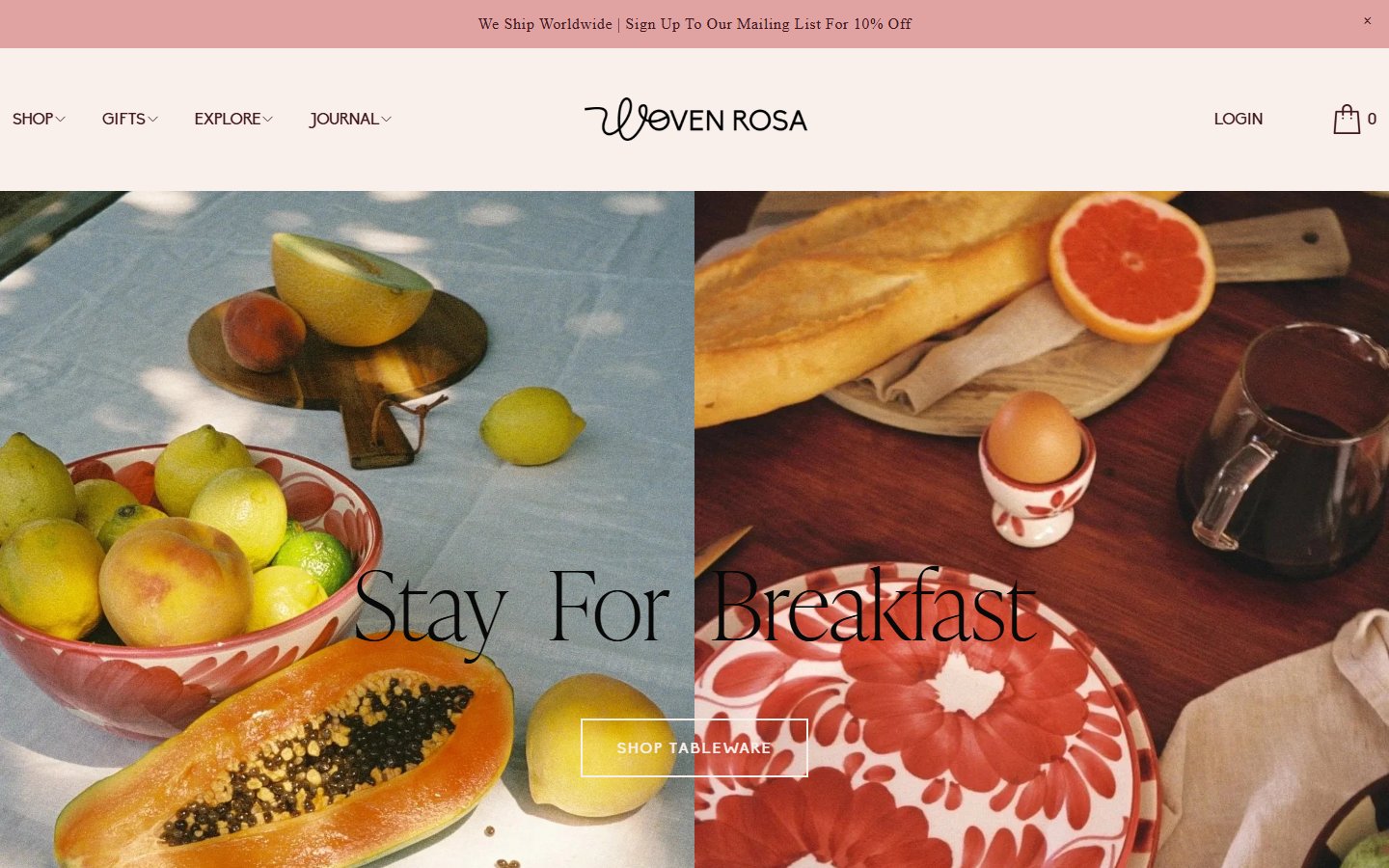
The homepage is genuinely attractive. The lifestyle photography — flowers in hand-painted vases, table settings for a spring soiree, cushions arranged on sunlit chairs — creates an immediate sense of the Woven Rosa world. The aesthetic is warm, Mediterranean, colour-rich. Laura’s visual eye is clearly strong. But scroll past the homepage and into the shop, and the experience flattens. Product pages are minimal: one or two images, a price, a short description. No maker profile. No material story. No care guidance. No “complete the look” suggestions. The homepage promises a journey. The product page delivers a transaction. Squarespace’s native e-commerce tools — limited filtering, basic product pages, constrained cross-selling — contribute to this flatness, but the content gap is the larger issue. The photography is there. The words and stories are not.
Five Countries, One Grid
Morocco, Portugal, India, Peru, Bolivia. Five countries, each with distinct craft traditions, materials, and visual character. Moroccan ceramics feel different from Portuguese glassware, which feels different from Peruvian textiles. But on the website, all of these traditions are presented through the same Squarespace product grid, with the same thumbnail format, the same minimal descriptions. The geographic and cultural richness that makes Woven Rosa distinctive is flattened by the platform’s uniformity. A customer browsing ceramics does not feel transported to a Moroccan atelier. They feel like they are shopping on a well-photographed Squarespace store. The difference matters, because at this price point, the customer is buying the story as much as the object.
Travel Content as Missed Engine
The “Stories” section of the site includes categories for Travel, Collections, and Interiors. This is exactly the right editorial instinct for a brand built on “sunlit sojourns and a life of adventure.” Travel content — the markets where pieces are sourced, the landscapes that inspire collections, the artisan workshops in their settings — would drive organic search traffic, social sharing, and brand depth. But the editorial layer appears thin. The categories exist as structural shells without the volume of content needed to make them a destination. The brand’s photography is strong enough to support rich editorial. The content simply has not been built at scale.
What Works
The lifestyle photography is Woven Rosa’s standout asset. The table settings, the flower arrangements, the way products are styled in warm, natural-light interiors — this is the kind of imagery that stops a scroll on Instagram and makes someone want to host a dinner party. Laura’s curatorial eye is evident in the “Founder’s Favourites” selection, which adds a personal voice that curated homewares brands need. The product range itself is well-considered: ceramics, glassware, textiles, and accessories that work together as a collection, not as isolated categories. And the direct artisan relationships across five countries give the brand a sourcing story that mass-market competitors simply cannot replicate. Anthropologie can approximate the aesthetic. It cannot replicate the relationship with a specific Peruvian weaver whose textiles are made using techniques passed down through generations.
The Wider Pattern
The artisan homewares space faces a particular version of the story-depth problem. Brands like Woven Rosa, Wicklewood, and others in this segment have genuine maker relationships, genuine craft provenance, and genuinely handmade products. Their mass-market competitors — Anthropologie, H&M Home, Zara Home — have enormous digital budgets, sophisticated e-commerce platforms, and lifestyle editorial teams. The smaller brands have the better story. The larger brands tell it better online. This is the gap that defines the segment. We have observed the same dynamic in sustainable fashion (BIBICO, with its fair trade partners presented through a generic Shopify template) and in artisan food (where small producers routinely lose online to supermarket “artisan” ranges that simply look more premium on screen). The solution is not to match the budget. It is to match the depth — to make every product page as rich in story as the homepage is in imagery.
If We Were Starting Fresh
Woven Rosa does not need a different aesthetic. The visual identity is warm, distinctive, and consistent. What it needs is a digital experience that matches the depth of the sourcing story. Every product page should connect the object to its maker, its material, and its place of origin. The travel editorial that the brand is clearly capable of producing should become a regular content programme, not an empty category. And the platform itself needs to support the commerce ambitions: better product discovery, richer cross-selling (“complete the table”), and a gifting experience built around the kind of customer who gives a hand-painted bowl rather than a gift card. The artisans are real. The relationships are real. The objects carry the character of the hands that made them. The digital experience should carry the same character.
Wondering if YOUR brand has the same gaps?
We will tell you -- for free. Our team will analyse your website and brand, then send you an honest review.
Get Your Brand ReviewFeature Your Review
Display this badge on your website to showcase your independent brand review.