Chocolarder
Industry: Food & Drink
Verdict: “A circular economy chocolate range that deserves a bigger stage than a WordPress sidebar.”
Reviewed: April 2026
Who They Are
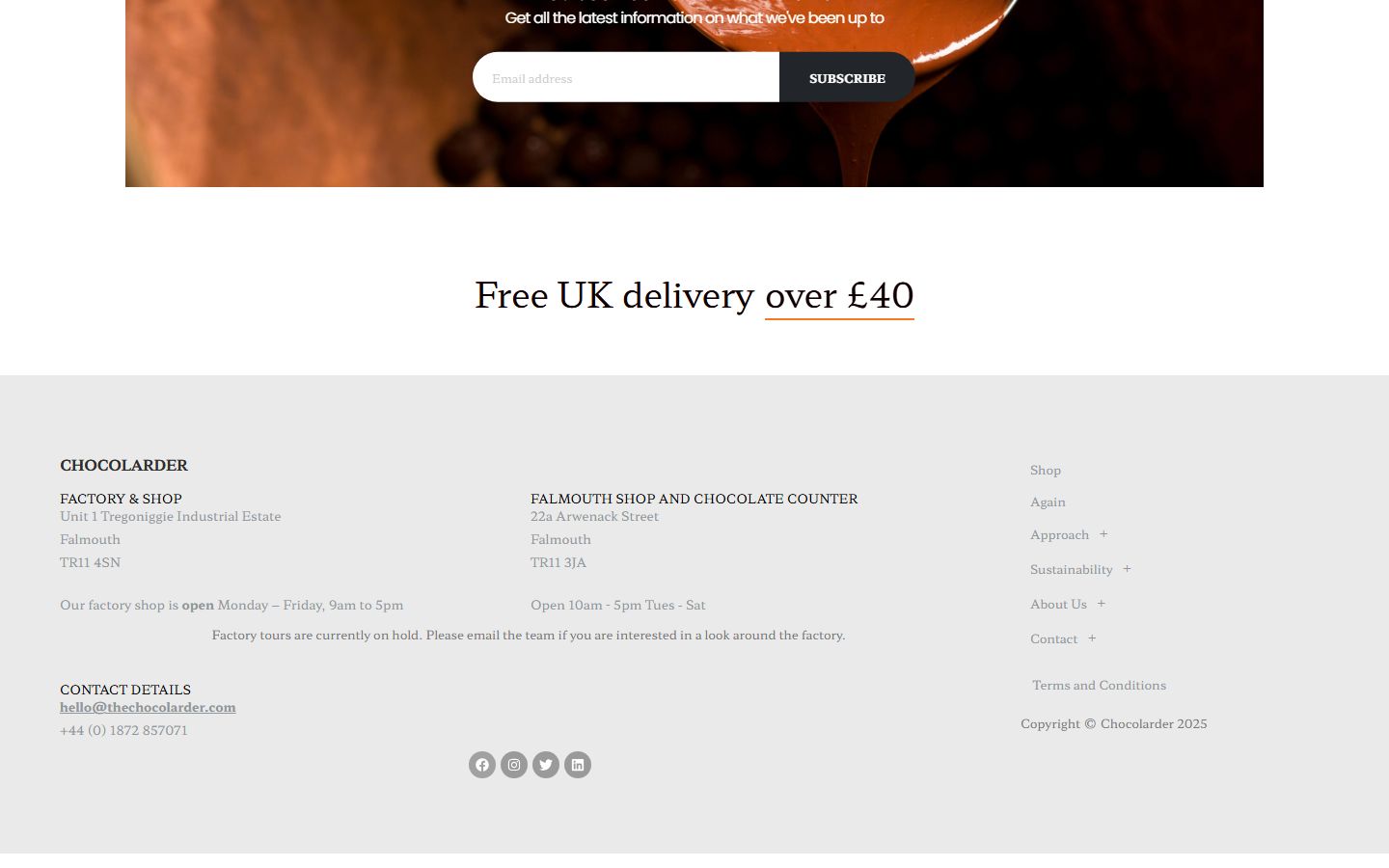
Chocolarder is a bean-to-bar chocolate maker based in Falmouth, Cornwall. The company crafts chocolate by hand from raw cocoa beans, controlling the entire process from roast to wrap. The range includes single-origin bars, flavoured bars, and a distinctive sub-brand called Again — a circular economy line that uses ingredients like orange peel, rhubarb and ginger, fig, and croissant offcuts that would otherwise go to waste. Chocolarder also collaborates with Verdant Brewing Company on chocolate-beer crossover products. A physical shop at 22a Arwenack Street in Falmouth serves as both retail and a connection point to the Cornish food scene.
What We Noticed
The innovation hiding in the navigation
Chocolarder’s Again range is genuinely unusual. Circular economy chocolate — bars made from upcycled ingredients like croissant offcuts and surplus fruit peel — is not a marketing angle. It is a product innovation that addresses food waste at the ingredient level while creating something worth eating. In a craft chocolate market where most brands differentiate on origin percentages and tasting notes, this is a real structural differentiator. But on the website, Again sits as one navigation item among several, competing for attention with standard shop categories and seasonal promotions. There is no homepage section dedicated to explaining what Again is, why it exists, or why it matters. A brand whose competitors would love to have this story treats it as a sub-category.
A Christmas banner in spring
Open chocolarder.com and the hero image is a Christmas promotion. In March. In April. The seasonal content that was presumably timely in December now reads as neglect. This is a common pattern with WordPress sites that lack a content calendar — the last major update stays frozen in place until someone manually replaces it. For a brand selling handmade chocolate with seasonal relevance (Easter is the second-largest chocolate buying moment in the UK), this is a missed opportunity. More than that, it signals to a first-time visitor that the site may not be actively maintained, which undermines trust in a food brand.
Product discovery without the story
The shop section uses square tile images with category labels and no additional context. Clicking through to a category reveals product listings, but at the browse level there is no indication of what makes a Chocolarder bar different from any other craft chocolate. No origin information on the tiles. No cocoa percentages. No tasting notes until you reach the individual product page. For a bean-to-bar maker whose entire proposition is provenance and craft, the browsing experience communicates none of that. The customer has to already know why Chocolarder matters before the website helps them understand it.
Cornish partnerships that whisper
The Verdant Brewery collaboration and the Falmouth shop are mentioned on the site, but neither gets the visual treatment their stories deserve. A chocolate maker partnering with one of Cornwall’s most respected craft breweries is the kind of cross-pollination that builds cultural credibility. A physical shop in a town known for its food and art scene grounds the brand in something real. Both are presented as text blocks rather than as the lived, local, specific stories they actually are.
What Works
The bean-to-bar process is the real thing. Chocolarder controls every stage from raw cocoa to finished product, which is a claim many chocolate brands make but few actually deliver. This gives the brand genuine ownership of quality — not outsourced, not white-labelled, not “crafted” in the marketing sense.
The Again concept has substance. Circular economy products in food are often tokenistic (one SKU for the press release). Chocolarder has built a range — Orange Peel, Rhubarb and Ginger, Fig, Croissant and Coffee — which suggests the idea is operationally real, not just a brand story. The ingredients are specific and traceable, which is exactly the kind of detail that builds trust with sustainability-minded buyers.
The Falmouth shop gives the brand a physical anchor. In a market where most DTC chocolate brands exist only as websites and subscription boxes, having a place you can walk into, see the production, and meet the people makes Chocolarder tangible in a way that competitors trading solely online cannot match.
The Wider Pattern
Across the food and drink brands we have reviewed, we keep seeing products that outperform their packaging. Gail’s Bakery has achieved craft baking at a scale of 130+ locations but never mentions the number on its homepage. Grind has a genuine ocean plastic recovery foundation but leads with a discount code. Chocolarder has built a circular economy chocolate range — something that food journalists, sustainability buyers, and specialty retailers would actively seek out — and presents it through a WordPress template with an outdated Christmas banner. The gap is not between the brand and its competitors. The gap is between the product and the website.
If We Were Starting Fresh
We would put the Again range on the homepage. Not as a product category link. As the opening story. “We make chocolate from ingredients other people throw away” is a proposition that stops people mid-scroll. It is unusual, it is specific, and it immediately tells the visitor that this is not another craft chocolate brand selling origin percentages.
The bean-to-bar process would become visible at the browsing stage, not buried on individual product pages. Each category tile would carry origin, cocoa percentage, and a one-line tasting note so that the browsing experience itself communicates craft rather than requiring the customer to click through to discover it.
The Falmouth shop and Verdant collaboration would become content anchors — short visual stories that connect the brand to Cornwall’s food and drink culture. Not just listed as facts but shown as the living relationships they are.
The seasonal content management would run on a calendar so the homepage reflects what matters now — Easter, summer gifting, harvest season — rather than what mattered four months ago.
Wondering if YOUR brand has the same gaps?
We will tell you -- for free. Our team will analyse your website and brand, then send you an honest review.
Get Your Brand ReviewFeature Your Review
Display this badge on your website to showcase your independent brand review.