Friarwood Wines
Industry: Food & Drink
Verdict: “Fifty-five years of handshake relationships with winemakers, invisible behind a Shopify grid.”
Reviewed: April 2026
Who They Are
Friarwood Wines has been an independent wine merchant in London for over 55 years, specialising in fine wines from family-owned estates. The business serves private clients, restaurants, and events with a carefully curated selection built on personal relationships with producers. Where larger merchants buy through brokers and agents, Friarwood’s team has spent decades visiting vineyards, tasting with winemakers, and selecting wines based on direct knowledge of the people behind them. The result is a catalogue that reflects personal conviction rather than market trends.
What We Noticed
Relationships reduced to product listings
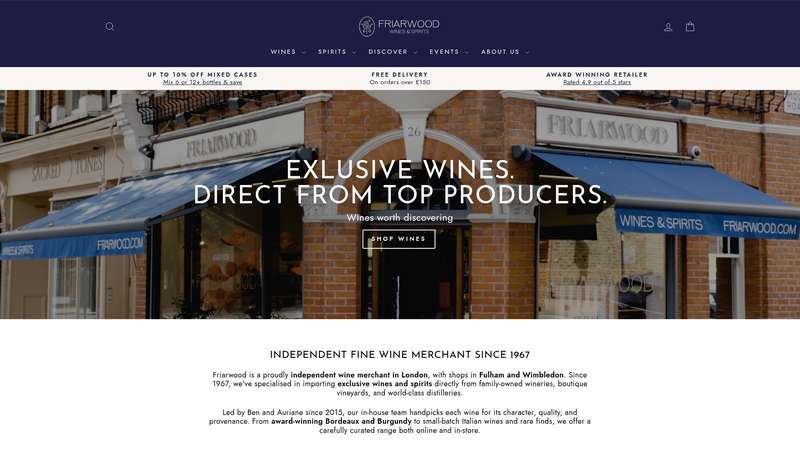
Friarwood’s entire value proposition is built on 55 years of relationships with family-owned estates. The team knows the winemakers. They have walked the vineyards. They have tasted vintages over decades and selected the ones they believe in. This is a profoundly personal form of curation — the opposite of an algorithm, the opposite of a bulk buying desk. But on the website, these relationships are invisible. The Shopify store displays wines as product cards: image, name, price, add to cart. There is no indication that the Burgundy was chosen after a visit to the domaine, or that the Rioja comes from an estate the team has known for thirty years. The wine grid looks like every other wine grid on the internet. The fifty-five years of relationship-building that fill those shelves do not appear.
A 55-year story told in one sentence
Over half a century in business is an extraordinary credential for any independent merchant. It means the company has survived recessions, changes in drinking culture, the rise of supermarket wine, and the explosion of online retail — and emerged with its reputation and client base intact. But on the website, this history gets a passing mention rather than a narrative. There is no founding story. No timeline of how the business evolved. No sense of what London wine culture looked like when Friarwood started and how the merchant’s role has changed. The heritage is stated but not explored, mentioned but not made meaningful.
The sommelier behind a screen
Friarwood’s in-person experience is defined by personal service — a sommelier-like approach to recommendation, tailored to the client’s palate, occasion, and budget. This is the human layer that separates an independent merchant from a supermarket wine aisle or a subscription algorithm. Online, this personal service disappears entirely. The browsing experience is self-service: filter, browse, buy. There is no digital equivalent of the conversation that happens when a client walks into the shop and says “I need something for a dinner party next Saturday.” The expertise that defines Friarwood in person has no expression in pixels.
What Works
The curation itself is the asset. Friarwood does not stock everything — it stocks what it believes in, from producers it knows personally. This is a fundamentally different proposition from a retailer offering 5,000 wines sourced through wholesalers. The selectivity is the product, and the relationships are the selection criteria.
The London base and private client model create a defensible position. Private clients who trust their wine merchant stay for decades. This is a business built on retention and relationship, not on acquisition and advertising. That loyalty is evidence that the service delivers.
The event and restaurant supply side demonstrates commercial breadth. Friarwood is not just a retail shop — it operates across channels that require different expertise (cellar management, event pairing, menu curation), which reinforces the depth of knowledge behind the brand.
The Wider Pattern
Union Coffee, which we reviewed in this batch, faces a similar gap: a brand built on personal relationships with producers (coffee farmers in Union’s case, winemakers in Friarwood’s) that presents itself as a product catalogue online. The relationships that justify the premium, that differentiate the selection, that make the brand worth choosing — they sit behind the product grid rather than in front of it. The pattern repeats across food and drink: brands whose human connections are their strongest asset default to e-commerce conventions that strip those connections out.
If We Were Starting Fresh
We would build the site around the estates, not the bottles.
Each producer relationship would become a page: the vineyard, the winemaker, the history of how Friarwood came to work with them, and the wines currently available from that estate. Navigation would offer “Browse by Estate” alongside the standard “Browse by Region” and “Browse by Style.” The estates are the curated collection; the wines are what the collection contains.
The 55-year story would become a visible timeline, not because history is interesting in the abstract, but because it proves something: that Friarwood has been choosing wines from family estates for longer than most online retailers have existed. Longevity is credibility in a market flooded with newcomers.
A digital recommendation service — a brief form asking about the occasion, the palate, and the budget — would bring the in-store sommelier conversation online. Not as a chatbot, but as a curated response from the team. The personal service that defines Friarwood in person should not vanish the moment a client opens a browser.
Wondering if YOUR brand has the same gaps?
We will tell you -- for free. Our team will analyse your website and brand, then send you an honest review.
Get Your Brand ReviewFeature Your Review
Display this badge on your website to showcase your independent brand review.