Allplants
Industry: Food & Drink
Verdict: “A proprietary nutrition system developed with Deliciously Ella, treated as a sidebar feature.”
Reviewed: April 2026
Who They Are
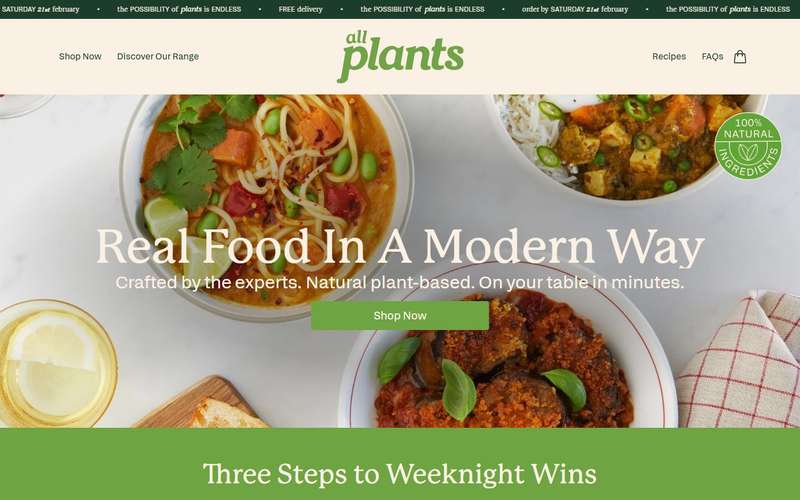
Allplants is a UK plant-based frozen meal delivery service, offering chef-made dishes ready in under ten minutes. Meals are priced between four and six pounds and ordered in boxes of four to eight. The menu covers curries, stews, lasagne, mac and greens, and other comfort food favourites made entirely from plants. The brand’s most distinctive feature is Plant Points — a proprietary system developed in collaboration with Deliciously Ella’s founder, targeting 30 different plants per week. The visual identity uses a sophisticated three-font typography system and a muted green, cream, and amber palette that positions the brand as modern, warm, and intentional.
What We Noticed
The innovation that should organise everything
Plant Points is a genuinely original concept. A gamification system that tracks plant diversity — not just plant consumption, but variety across 30 different plants per week — is something no competitor in the UK meal delivery space offers. Gousto does not have it. Abel & Cole does not have it. Mindful Chef does not have it. Developed in collaboration with Deliciously Ella, it carries both nutritional credibility and influencer reach. This is the kind of branded mechanic that could define a category. But on the website, Plant Points reads as a product feature rather than as the lens through which the entire brand experience is structured. It sits alongside other selling points rather than above them. A concept this distinctive should not share the stage. It should own it.
Broken placeholders where confidence should be
The delivery interface shows date placeholders that appear broken — “Order by – – -” where actual dates should appear. This is a functional error that directly affects the purchase decision. A customer ready to order needs to know when the food will arrive. Broken date fields introduce doubt at the exact moment the brand needs to project reliability. For a frozen meal service where timing and freshness expectations are part of the product promise, visible interface errors undermine the core proposition. The meals may be chef-made and carefully frozen, but the ordering experience suggests the digital infrastructure has not received the same care.
Design sophistication, content restraint
The visual identity is notably well-considered. Mackinac for warmth, Early Sans for clarity, Cheltenham for emphasis — a three-font system that feels intentional rather than accidental. The muted green and cream palette reads as natural without being predictable. The food photography is clean, realistic, and appetising. But this design sophistication sits alongside thin content. No customer reviews or testimonials on the homepage. Limited navigation that may hide the full product range. The Plant Points concept, the Deliciously Ella collaboration, and the nutritional philosophy all deserve more depth than they currently receive. The design says premium. The content says MVP.
What Works
The Plant Points system has genuine substance. The target of 30 different plants per week is grounded in nutritional science — research consistently links plant diversity to gut health and overall wellbeing. Turning this into a trackable, gamified system gives customers a framework for their eating habits that extends beyond any single meal. It is the kind of mechanic that creates retention: once you start tracking Plant Points, switching to a competitor means losing the system.
The Deliciously Ella collaboration adds mainstream credibility. Ella Mills has built one of the UK’s largest plant-based brands, and her involvement signals that Plant Points is nutritionally serious, not just a marketing gimmick. This is borrowed authority that most meal delivery startups cannot access.
The pricing (GBP 4.50-6.00 per meal) positions Allplants in the accessible premium range — more than a supermarket ready meal, less than a restaurant delivery. This is a considered positioning that makes plant-based convenience eating a daily option rather than an occasional indulgence.
The three-font typography system and colour palette demonstrate a level of brand craft that most food delivery startups do not invest in. The visual identity would hold its own against brands many times Allplants’ size.
The Wider Pattern
Across the food and drink brands we have reviewed, we see a recurring tension between design investment and content investment. Gail’s Bakery has beautiful photography and a warm palette, but no editorial depth about its baking philosophy. Chocolarder has a strong brand identity, but its most innovative product line sits in a navigation sidebar. Allplants has a sophisticated visual system and a proprietary nutrition mechanic, but the website has more design than content. The pattern suggests that many food brands invest in how they look before investing in what they say — and that the gap between the two is where the digital experience falls short.
If We Were Starting Fresh
We would make Plant Points the organising principle, not a feature callout.
Every meal page would show its Plant Points contribution. The homepage would frame the entire brand around the 30-plants-per-week target — not as a nutritional claim buried in small print, but as the reason Allplants exists. “We make it easy to eat 30 different plants a week” is a proposition that is specific, measurable, and different from “we make plant-based meals.” The Deliciously Ella collaboration would anchor the credibility.
Customer reviews and testimonials would appear on the homepage. Social proof is particularly important for frozen meal delivery, where the gap between expectation (the photograph) and reality (what arrives in the box) is the primary purchase anxiety. Real customers confirming that the meals taste as good as they look does more for conversion than any amount of brand photography.
The broken date placeholders would be fixed immediately. Interface errors on the ordering flow are not cosmetic issues — they are conversion killers. Every broken placeholder is a customer who paused, doubted, and potentially left.
The navigation would be expanded to show the full range. If the menu is broad enough to support 30 different plants per week, the website should make that breadth visible rather than hiding it behind limited navigation.
Wondering if YOUR brand has the same gaps?
We will tell you -- for free. Our team will analyse your website and brand, then send you an honest review.
Get Your Brand ReviewFeature Your Review
Display this badge on your website to showcase your independent brand review.