Tomfoolery London
Industry: Retail & DTC
Verdict: “Thirty years of curating independent designers, reduced to a product carousel.”
Reviewed: April 2026
Who They Are
Tomfoolery London has been a jewellery destination in Muswell Hill since 1994, founded by Nicki and Peter Kay. The boutique curates over 50 independent designers from around the world — a roster that includes emerging makers and established names you will not find on the high street. Laura Kay, Nicki and Peter’s daughter, now leads the business, bringing a second generation of curatorial instinct to a shop that has survived three decades of retail upheaval. The Metier by Tomfoolery sub-brand positions the shop as London’s first stop for unique engagement rings, with a bespoke design service that turns the ring-buying process into something collaborative. The platform runs on WordPress with BigCommerce handling the catalogue.
What We Noticed
Catalogue structure where curation should live
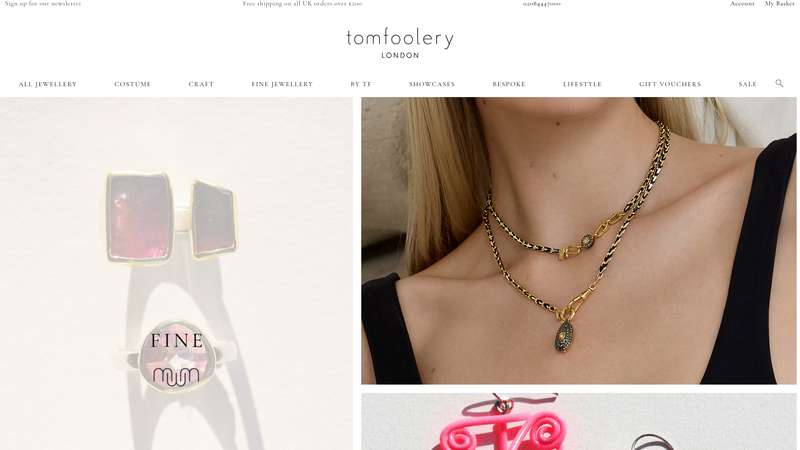
Open the Tomfoolery website and you are met with product carousels. Rings, necklaces, earrings — sorted by category, displayed by type. This is functionally identical to how any jewellery e-commerce site organises itself. But Tomfoolery is not any jewellery site. It is a boutique that has spent 30 years finding designers that other shops have not heard of, building relationships with makers across continents, and developing an eye for pieces that sit outside the mainstream. That curatorial authority — the reason someone would choose Tomfoolery over a department store or an algorithm-driven marketplace — is invisible in the navigation. The site shows you what they sell. It does not show you why they chose it.
The family story told in footnotes
A 30-year family business with a generational handover is inherently compelling. Nicki and Peter built something. Laura is carrying it forward. That is a narrative arc most brands would fabricate if they could. But on the site, this story sits deep in the About section — a page most visitors will never reach. The homepage does not mention the founders, the family, or the three decades of history. For a boutique whose entire value proposition rests on trust, taste and personal relationships, the absence of personal voice on the landing page is a structural gap. You cannot feel the warmth of a family shop from a product grid.
Bespoke expertise behind a generic door
The Metier by Tomfoolery sub-brand and the bespoke engagement ring service represent the highest-value work the business does. These are not off-the-shelf purchases — they are collaborative design processes that require trust, expertise and time. Yet the bespoke journey is not visible from the homepage in a way that distinguishes it from a standard product listing. The experience of designing a unique engagement ring with a second-generation jewellery curator should feel different from adding a pair of earrings to a cart. Right now, both paths start from the same generic entry point.
What Works
The designer roster is the real asset. Fifty-plus independent jewellery designers, curated over 30 years, is a collection that cannot be replicated overnight. Each designer relationship represents a judgment call — someone at Tomfoolery saw the work, understood its value, and chose to stock it. That accumulated taste is what makes the boutique irreplaceable.
The Metier by Tomfoolery sub-brand is a smart structural move. It gives the bespoke engagement ring service its own identity within the wider business, separating the high-consideration purchase from everyday browsing. The positioning — “London’s first stop for unique engagement rings” — is specific, ownable and difficult for competitors to claim.
The product photography across the site is consistent and well-lit. Individual pieces are shown clearly, with enough detail to assess craftsmanship. The visual quality meets the standard you would expect from a premium independent jeweller.
The generational continuity — Laura Kay taking the reins from her parents — gives the brand a narrative dimension that purely commercial operations lack. It signals longevity, commitment and personal investment in a way that a corporate “About Us” page never could.
The Wider Pattern
Across the brands we have reviewed in the retail and DTC space, we keep encountering businesses whose offline identity far exceeds their digital expression. P.Louise built a community of 3 million followers on TikTok but presented them with a generic Shopify storefront. Grind earned cultural credibility through compostable innovation and a Shoreditch origin story but greeted website visitors with discount codes. Tomfoolery has the same structural tension in a different register — a boutique with 30 years of earned authority, presenting itself with the same navigation patterns as a jewellery brand that launched last year.
The pattern is consistent: the thing that makes each brand genuinely different is the thing their website is least likely to show you first. The curation, the story, the philosophy — these are treated as supporting content rather than the front door. Products lead. Identity follows. And the gap between the two is where brand value quietly erodes.
If We Were Starting Fresh
We would rebuild the digital experience as an editorial boutique — a space where Laura Kay’s curatorial voice is as visible as the jewellery itself. The homepage would open with designer spotlights rather than product carousels, introducing visitors to the makers behind the pieces and the reasoning behind each selection. Every designer would have a dedicated profile page telling their story, their process and why Tomfoolery chose to work with them.
The bespoke engagement ring journey would become a visible, distinct pathway from the homepage — not just a product category but a guided experience that communicates the collaborative nature of the process. Visitors considering a bespoke piece should feel the difference before they make an enquiry, not after.
The family story — 1994 to now, Nicki and Peter to Laura — would sit at the heart of the brand narrative rather than buried in an About page. Not as nostalgia, but as proof of sustained taste and commitment to independent design.
The site would feel like walking into the Muswell Hill shop: warm, knowledgeable, personal. Someone has chosen these pieces for a reason, and that reason is part of the experience. Right now, the website sells jewellery. It should sell the eye behind it.
Wondering if YOUR brand has the same gaps?
We will tell you -- for free. Our team will analyse your website and brand, then send you an honest review.
Get Your Brand ReviewFeature Your Review
Display this badge on your website to showcase your independent brand review.