BrewDog
Industry: Hospitality
Verdict: “Punk beer that built a cult, selling itself like a supermarket end-cap.”
Reviewed: April 2026
Who They Are
BrewDog was founded in 2007 by James Watt and Martin Dickie in a garage in Fraserburgh, Aberdeenshire. The origin story is the stuff of brand mythology: two men and a dog, brewing small batches of beer and selling it at local markets from the back of a van. What followed was one of the most provocative brand-building campaigns in UK food and drink history. Stunts that courted outrage. A manifesto that positioned craft beer as a rebellion against corporate brewing. “Equity for Punks” — a crowdfunding model that let customers buy shares in the company, turning drinkers into co-owners. Punk IPA became the UK’s best-selling craft beer. The company opened bars on every continent except Antarctica. The DogHouse brewery hotel let guests sleep above the fermentation tanks. BrewDog did not just make beer. It made a movement.
What We Noticed
A Shopify store where a manifesto used to be
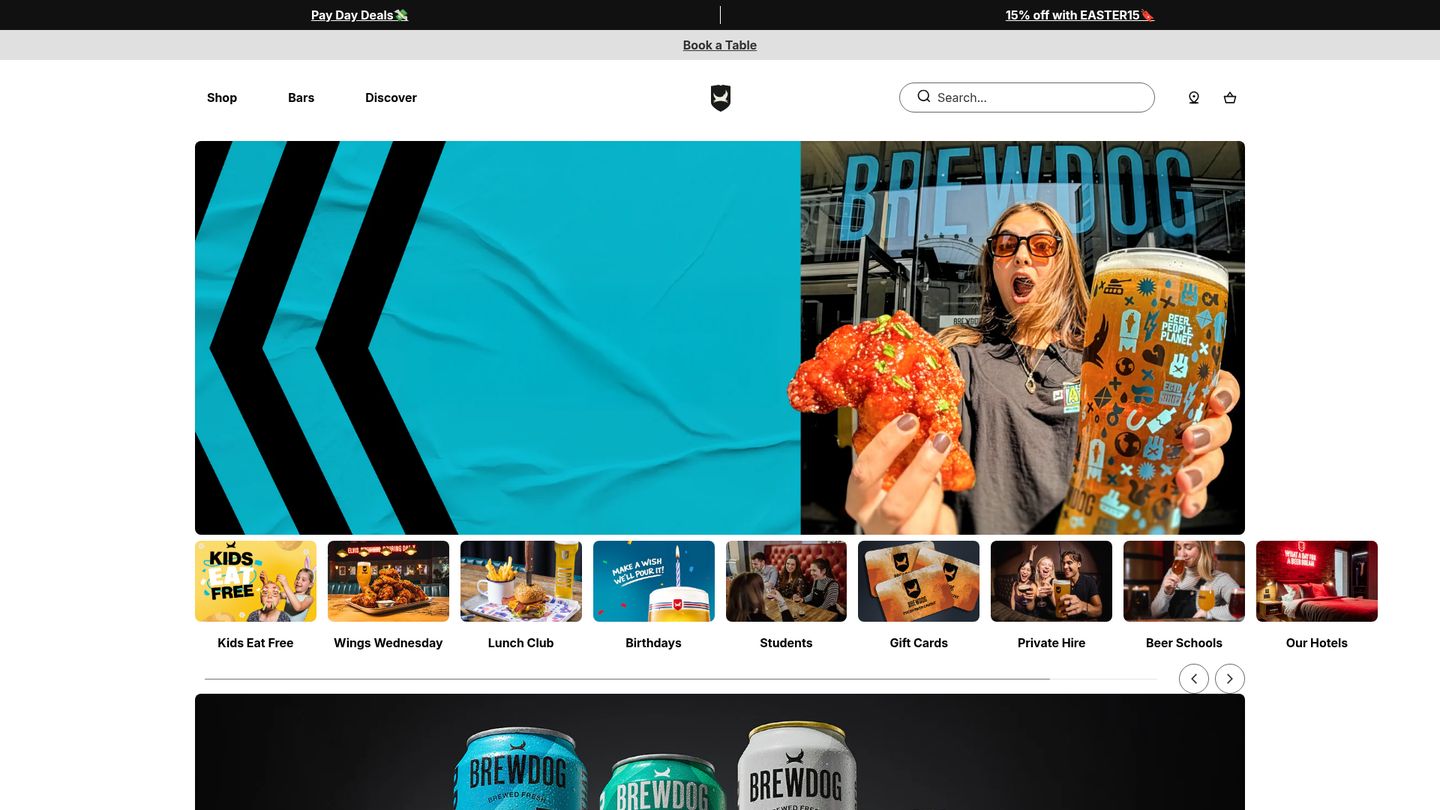
Open brewdog.co.uk and you are presented with a product grid. Beers organised by category. Bundle deals. Promotional banners. A subscribe-and-save mechanic. The experience is clean, functional, and indistinguishable from any mid-market DTC alcohol brand. This is a company that once projected a slogan onto the Houses of Parliament, taxidermied a squirrel around a beer bottle, and challenged the Advertising Standards Authority as a marketing strategy. The garage, the van, the punk manifesto, the Equity for Punks community — none of it is present on the shopfront. The brand that defined itself through attitude now presents itself through product tiles. The rebellion has been replaced by a Shopify template.
The founding story, archived
A garage in Fraserburgh. Two men and a dog. Local markets and word of mouth. A company built by the people who drank its beer, literally — through share ownership. This is one of the most compelling founding stories in British business, and it is one that BrewDog told brilliantly for years. But the website has moved on. The founding narrative is not prominently placed. The Equity for Punks story — the crowdfunding model that raised over £90 million from ordinary beer drinkers — is not woven into the shopping experience. A new visitor discovering BrewDog through the website would encounter a beer brand. They would not encounter the story that built the brand’s following, the attitude that made it famous, or the community that funded its growth.
Product merchandising without brand merchandising
The beer is well-presented. Product photography is consistent. Descriptions are informative. The commerce mechanics work. But the site merchandises products without merchandising the brand. Every beer on the grid carries the BrewDog name, but nothing on the page explains what that name stands for. Punk IPA is positioned as “the beer that started it all” — a phrase that implies a story without telling it. The bars, the brewery hotel, the Equity for Punks programme, the global bar network — these are all facets of a brand world that is larger than a beer catalogue. The website presents the catalogue and gestures vaguely at the world.
What Works
The beer itself remains a strong product. Punk IPA is the UK’s number one craft beer for a reason — it is well-brewed, distinctive, and genuinely accessible. The range has expanded intelligently: Hazy Jane for the haze trend, Lost Lager for the lager drinker, Elvis Juice for those who want something different. The brewing is sound and the portfolio covers multiple entry points.
The Equity for Punks model, regardless of what the website does with it, was a genuine innovation. Over 200,000 shareholders. Multiple rounds of crowdfunding. A community of co-owners who have a financial and emotional stake in the brand. This is not a loyalty programme — it is ownership. No other beer brand in the UK has anything comparable.
The bar network provides physical brand experiences across the world. Walk into a BrewDog bar and the brand identity is immediately present: industrial interiors, extensive tap lists, the punk aesthetic expressed through space rather than screen. The physical experience still carries the energy that the website has lost.
The Wider Pattern
Across the brands we have reviewed, origin story burial follows a consistent trajectory. Brands build their following through story, attitude, and cultural identity. They scale. They optimise for conversion. The story gets pushed deeper into the site. The attitude softens into commercial neutrality. The cultural identity is replaced by product merchandising. We saw this with Grind — a Shoreditch espresso bar that became a DTC subscription brand leading with discount codes. We see it with Greene King — 225 years of brewing heritage buried under promotional offers. BrewDog’s version is particularly stark because the founding story was not just distinctive — it was the product. People did not buy Punk IPA because it was the best IPA available. They bought it because buying it meant something. The website no longer conveys what it means.
If We Were Starting Fresh
We would rebuild the digital experience as a manifesto with a checkout, not a checkout with a logo.
The homepage would restate what BrewDog stands for. Not in 2007 language — the brand has evolved, the controversies have come and gone, the company has matured. But the core proposition — beer made by people who care about beer, owned by the people who drink it — is as relevant now as it was in the garage. The Equity for Punks community would sit visibly alongside the product catalogue, because buying a beer from a company you co-own is a different experience from buying a beer from a company you do not.
The bar network, the brewery, the DogHouse hotel — these would be woven into the digital experience as proof points for the brand’s world, not as separate navigation items. The product pages would carry the attitude that the physical bars still express. And the founding story would sit where it belongs: not in an “About” page but in the fabric of the brand’s digital identity. A garage in Fraserburgh is not ancient history. It is the reason any of this exists.
Wondering if YOUR brand has the same gaps?
We will tell you -- for free. Our team will analyse your website and brand, then send you an honest review.
Get Your Brand ReviewFeature Your Review
Display this badge on your website to showcase your independent brand review.