CANDEY
Industry: Legal & Law
Verdict: “An elite litigation firm on Squarespace — the platform says startup, the cases say Supreme Court.”
Reviewed: April 2026
Who They Are
CANDEY is an elite disputes law firm specialising in high-value commercial litigation and international arbitration across three jurisdictions — London, New York, and the British Virgin Islands. The firm handles cases valued in the millions to billions, has argued before the Supreme Court, and holds the title of Litigation Boutique of the Year 2025. Chambers and Legal 500 rankings confirm top-tier positioning. CANDEY also has a distinctive access-to-justice story — contingency fees, third-party funding, and parliamentary engagement on lawyers’ rights. In the elite disputes space, the firm competes with Enyo Law, Stewarts, and Harcus Parker, all of which have invested in digital presence that matches their courtroom ambitions.
What We Noticed
The platform signal
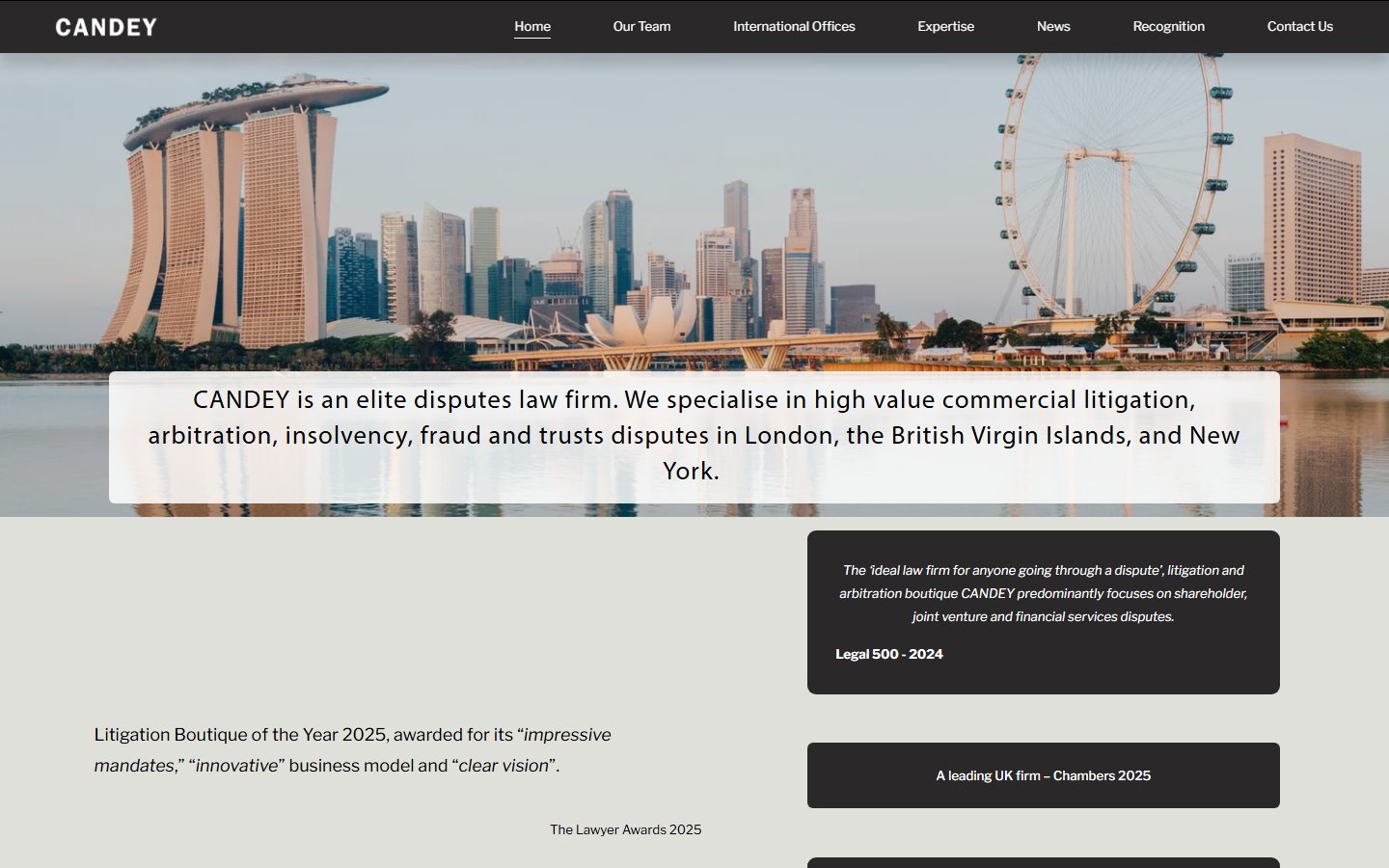
Every website platform sends a signal. WordPress says “established.” A custom build says “invested.” Squarespace says “startup” — or at best, “small business getting started.” CANDEY is on Squarespace. This is a firm that argues before the Supreme Court, manages disputes worth billions, and operates across three international jurisdictions. The platform beneath the website communicates none of this. Squarespace imposes constraints on layout, interaction, and sophistication that are perfectly adequate for a boutique consultancy or a creative freelancer. For a firm whose clients are selecting legal representation for nine-figure disputes, the platform itself undermines the positioning before a single word is read. The gap between what CANDEY does and the tool it uses to present itself is one of the most striking we have encountered.
Awards mentioned, not displayed
Litigation Boutique of the Year 2025. Chambers ranked. Legal 500 recognised. These are credentials that belong in a hero section, rendered as prominent visual elements with the weight and gravitas they carry in the legal market. Instead, they appear as inline text references within dense paragraphs. A managing partner evaluating potential litigation counsel scans for proof of pedigree. Awards mentioned in flowing prose require reading. Awards displayed as visual signals require only a glance. In a sector where credibility is the purchase trigger, the difference between displaying credentials and mentioning them is the difference between commanding a room and whispering from the back.
Three jurisdictions, one footnote
London, New York, and the British Virgin Islands. For a boutique litigation firm, three-jurisdiction coverage is a genuinely rare capability. Most boutiques operate from a single office. CANDEY’s international reach — particularly the BVI, which is critical for offshore disputes and asset recovery — is a structural differentiator. On the current website, this information sits in the footer. The three-jurisdiction story is not told; it is noted. There is no explanation of why this combination matters, what types of disputes require multi-jurisdictional capability, or how CANDEY’s coverage compares to competitors who are limited to a single market. A powerful differentiator is treated as an address line.
Invisible people, invisible cases
The homepage shows no team profiles. There are no case studies. There is no conversion pathway beyond a single “Contact Us” link. For a firm where the individual lawyers are the product — where a client is buying the judgment, experience, and courtroom presence of specific advocates — the absence of people from the homepage is a structural gap. Similarly, the absence of case narratives means that a prospect has no way to understand CANDEY’s track record without already knowing it. The firm’s work speaks for itself only to people who have already heard it speak.
What Works
The cases themselves are the most powerful asset. Supreme Court arguments, multi-jurisdictional disputes, outcomes in cases valued at billions — this is a track record that commands attention. The substance of what CANDEY does is extraordinary. The challenge is entirely one of presentation, not capability.
The three-jurisdiction model is genuinely distinctive. London-New York-BVI is not a standard boutique configuration. It reflects a deliberate strategic choice about where complex disputes originate and where they are resolved. This is the kind of structural advantage that cannot be replicated through marketing alone.
The access-to-justice dimension — contingency fees, third-party funding, Supreme Court advocacy on lawyers’ rights — adds a narrative layer that most elite firms lack. CANDEY is not just fighting cases; it is fighting for how cases can be fought. This is a brand story that goes beyond competence into conviction.
The dark aesthetic on the current site has the right instinct. Darkness communicates seriousness, weight, and authority. The visual direction is not wrong — it is simply constrained by a platform that cannot deliver the sophistication the brand requires.
The Wider Pattern
In the legal firms we have reviewed, a recurring dynamic appears: firms whose operational reality significantly outpaces their digital presentation. Bexley Beaumont has won UK Business of the Year through a website that reads like a template. Beyond Law Group has built a five-brand legal group presented through six disconnected websites. CANDEY represents perhaps the most extreme version of this gap — a firm arguing before the Supreme Court, presented through a platform designed for small businesses.
The legal sector’s relationship with digital presence is uniquely conflicted. In most industries, the website is understood as a commercial tool that directly influences revenue. In law, there remains a lingering sense that the work should speak for itself — that reputation travels through referral networks and ranking directories rather than through digital experience. This is increasingly outdated. General counsel research firms online. Clients in dispute evaluate options before making contact. The website is not the firm’s shopfront in a metaphorical sense. It is literally where most first impressions now form. Stewarts has recognised this — their digital presence matches their courtroom ambition. The boutique firms that follow will not just look better. They will convert better.
If We Were Starting Fresh
The direction for CANDEY begins with the platform. Squarespace must go. The firm needs a digital presence built to the same standard as its legal work — bespoke, authoritative, and designed to command respect. A custom build, or at minimum a modern CMS with full design flexibility, would unlock the visual and interactive sophistication that the brand requires.
Awards and rankings should lead the experience. Litigation Boutique of the Year, Chambers, Legal 500 — these are not details to be mentioned. They are the opening statement. Visual prominence, branded badge design, and hero-level placement would give a visitor the credibility signal within seconds of arrival.
The three-jurisdiction story needs its own narrative architecture. Why London, New York, and BVI? What types of disputes require this combination? How does CANDEY’s international capability compare to single-jurisdiction competitors? This is not an address — it is a strategic capability that deserves explanation and visual expression.
Partners and cases need to be visible. Individual profiles with rankings, notable cases, and areas of specialism. Case narratives structured around the dispute, the stakes, and the resolution. These are the proof points that convert interest into instruction. A firm selling the judgment of individual advocates needs those advocates to be present on the website.
Wondering if YOUR brand has the same gaps?
We will tell you -- for free. Our team will analyse your website and brand, then send you an honest review.
Get Your Brand ReviewFeature Your Review
Display this badge on your website to showcase your independent brand review.