Beyond Law Group
Industry: Legal & LawTech
Verdict: “Five specialist brands, six disconnected websites.”
Reviewed: March 2026
Who They Are
Beyond Law Group is a multi-brand legal group headquartered in Manchester, with offices in Leeds and Alderley Edge. Founded in 2017 by CEO Mark Dawson, the group has grown to over 100 legal specialists across five distinct practices: Beyond Corporate, McAlister Family Law, Home Property Law, Vault Private Client, and Hawkswell Kilvington Construction Law. The growth trajectory is striking — from launch to the Financial Times’ list of Europe’s fastest growing companies, and into the Times Top 200 Law Firms, in under a decade. Recent acquisitions of Vault Private Client and Hawkswell Kilvington signal that the multi-brand strategy is accelerating, not slowing down.
What We Noticed
The six-website problem
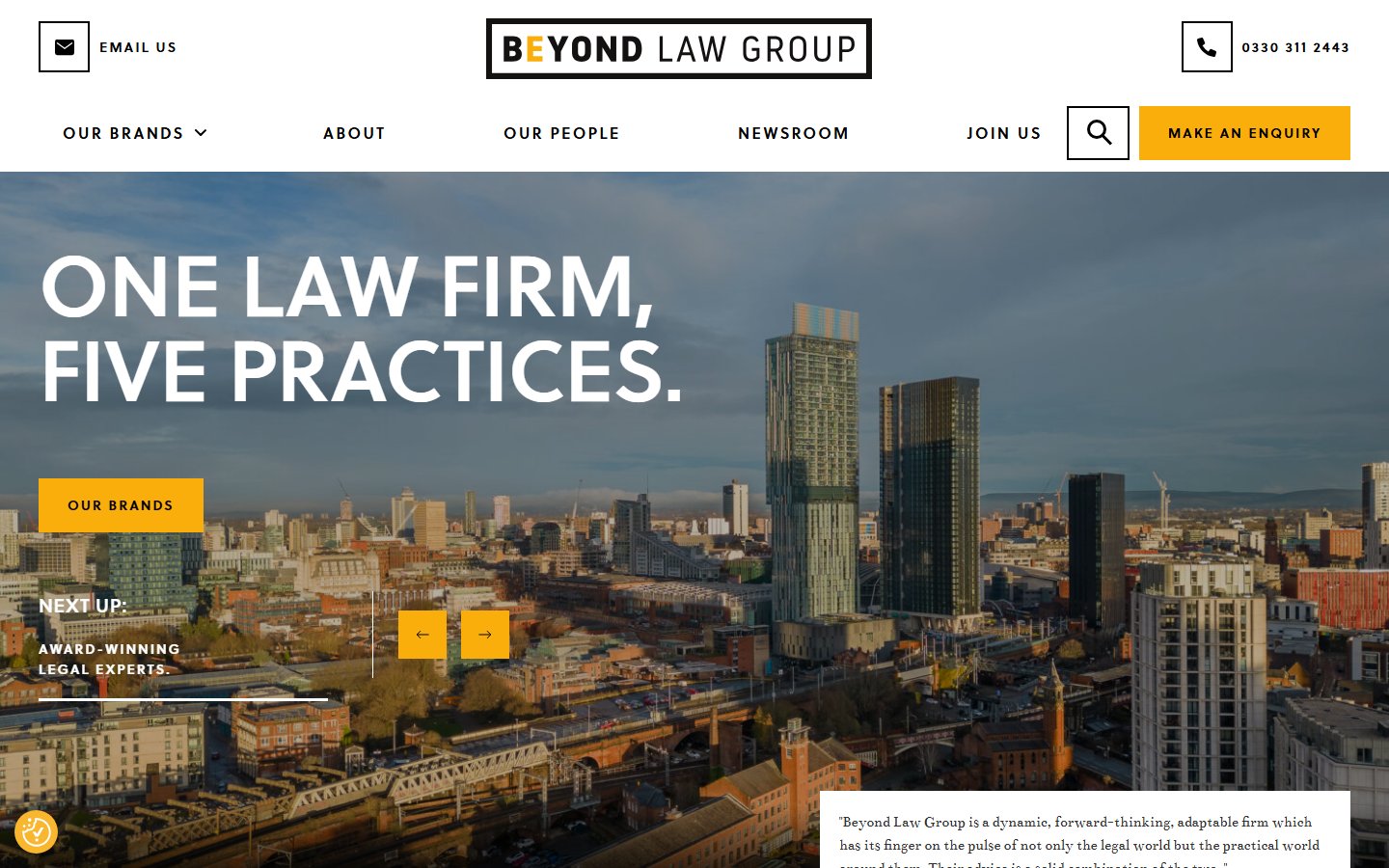
Beyond Law Group operates a group website and five separate practice websites. Each brand has its own domain, its own design, its own navigation. The intention is clear: specialist brands for specialist markets. The effect is different. A visitor arriving at beyondlawgroup.co.uk sees an impressive group story — scale, awards, momentum. But the moment they click through to a practice area, they leave. Different URL. Different template. Different experience. The group site builds credibility that the practice sites do not inherit. This is not a branding problem in the conventional sense. It is an architecture problem. The structure actively prevents the group’s strengths from reaching the places where clients actually make decisions.
Scale told, not shown
The group site handles the growth narrative well. Awards are displayed. Brand logos are present. The FT ranking and Chambers recognition are referenced. But “Our People” only shows leadership — not the 100-plus specialists who make the group’s scale real. In professional services, people are the product. A firm that has grown to this size in under a decade has a remarkable talent story to tell. Right now, that story is a leadership headshot grid and a number.
Cross-selling that does not happen
Five specialist practices serving different legal needs should create natural cross-referral opportunities. A corporate client may also need property support. A family law client may need private client advice. But the current architecture makes no attempt to connect these journeys. Each practice operates in its own silo, with no recommendations, no shared navigation, no “you might also need” logic. The multi-brand model is the group’s biggest strategic asset. The website treats each brand as if the others do not exist.
Content without strategy
The news section on the group site is well-maintained. Articles are published regularly, press coverage is referenced, and the tone is professional. But the content sits as a chronological feed rather than a structured resource. There is no categorisation by practice area, no thought leadership positioning, no SEO architecture that would turn this content into an acquisition channel. Good content is being produced and then buried in a blog roll.
What Works
The growth story is genuine and impressive. Building a multi-brand legal group from scratch to 100-plus specialists, FT recognition, and 20-plus industry awards in under a decade requires more than good marketing. It requires a model that works. The specialist brand approach — rather than one firm trying to be everything — shows strategic clarity about how legal services are actually bought.
The acquisition strategy adds another layer. Vault Private Client and Hawkswell Kilvington were not random additions; they filled specific practice gaps (private client, construction) that rounded out the group’s coverage. This is portfolio thinking applied to law, and it is unusual at this scale in the UK mid-market.
The culture signals are also notable. Record promotions, the “Be Social” programme, and people-first language suggest a firm that understands retention matters as much as recruitment. In a sector losing talent to burnout and alternative careers, this is not a soft differentiator — it is a structural one.
The geographic expansion from Manchester into Leeds and Cheshire follows the client base rather than chasing prestige postcodes. Practical and deliberate.
The Wider Pattern
There is a recurring dynamic in the legal firms we have reviewed: progressive operating models undermined by conventional digital presence. Bexley Beaumont, which we reviewed alongside this piece, is a B-Corp certified purpose-led firm whose website reads like a 2015 brochure. Beyond Law Group has the opposite version of the same problem — an innovative multi-brand architecture that fragments online rather than amplifies.
Both firms are doing genuinely interesting things. Bexley Beaumont with structural commitment to purpose. Beyond Law Group with a specialist brand portfolio that mirrors how clients actually think about legal needs. But in both cases, the website is the weakest expression of the strategy, not the strongest.
Fortune Law and London Law Collective show similar patterns. The legal sector is full of firms whose digital presence lags their operational reality by several years. The firms that recognise this gap — and close it — will not just improve their websites. They will change how the market perceives them. In professional services, the website is not a brochure. It is the front door. And right now, too many strong firms have front doors that undersell what is inside.
If We Were Starting Fresh
The direction is a unified group platform. Not one brand replacing five — the specialist identities have value — but a single domain with smart routing that lets each practice maintain its character while inheriting the group’s credibility. A visitor should feel the weight of 100-plus specialists, 20-plus awards, and FT recognition on every page, whether they are looking at corporate law or family law.
A unified people directory would transform the “Our People” section from a leadership grid into a searchable resource that shows the actual depth of the group. Cross-practice recommendations would turn the multi-brand model from a structural advantage into a client-facing one — connecting journeys that currently terminate at each practice’s boundary.
The content engine needs architecture, not more articles. Categorisation by practice, by sector, by type. Thought leadership pieces that position partners as authorities. An SEO structure that turns the group’s publishing effort into measurable acquisition.
And recruitment needs to match the culture story. Record promotions and people-first values deserve more than a careers page — they deserve a narrative that competes with the firms trying to poach the same talent.
Wondering if YOUR brand has the same gaps?
We will tell you -- for free. Our team will analyse your website and brand, then send you an honest review.
Get Your Brand ReviewFeature Your Review
Display this badge on your website to showcase your independent brand review.