Bodyism
Industry: Wellness
Verdict: “A luxury wellness brand that does corporate training, supplements, and studio classes — and the website cannot decide which one it is.”
Reviewed: April 2026
Who They Are
Bodyism is a global luxury wellness brand with over twenty years of expertise in fitness, nutrition, and recovery. Founded in London, the company operates across corporate wellness partnerships, personal training, group class concepts (yoga, reformer Pilates, barre), a supplement range, and international retreat experiences with partners including Soneva and Camp Kerala. The brand positions itself around five health pillars and describes its approach as blending “cutting-edge science with holistic principles.” Bodyism has worked with luxury hotels and corporate clients worldwide, building a reputation that sits at the intersection of premium fitness and executive wellbeing. The company’s website describes it as a “global corporate wellness brand specialising in fitness, nutrition, and recovery solutions.”
What We Noticed
Four businesses sharing one front door
Open bodyism.com and the first thing you encounter is a corporate wellness pitch. Scroll down and there are studio class concepts. Below that, a supplement category. Further still, retreat listings for Camp Kerala and Soneva Soul Festival. Each of these is a legitimate business line, and each has a different audience with different needs. A corporate HR director looking for an employee wellness programme and an individual searching for reformer Pilates in London arrive at the same page and receive the same message. The homepage does not route them. It does not ask who they are or what they need. It simply presents everything at equal weight and hopes one of the four propositions sticks. The result is a page that communicates breadth without giving any single audience a reason to stay.
The broken pathway
Bodyism’s homepage links to a personal training page at their Notting Hill studio. The link returns a 404 error. This is not a minor technical issue buried in the site architecture — it is a primary call to action on the homepage, one of the few places a potential client can click to learn about the most personal, highest-value service the brand offers. A luxury brand whose core promise is bespoke, expert-led care cannot afford a dead end at the moment a visitor decides to engage. The 404 is a symptom of a wider structural problem: the website has not been maintained as a functional customer journey. It has been built as a brochure and left.
The supplement shop that is not there
The homepage lists supplements as one of four core offerings and even displays a popup offering 15% off a first order with the code WELCOME15. But there is no visible shop. No product pages, no pricing, no “add to basket” flow accessible from the homepage. A visitor who arrives ready to buy encounters a discount code for a store they cannot find. For a brand competing in the same space as LYMA — which has built an entire premium identity around a single supplement product with clinical positioning and sharp e-commerce — this is a significant structural gap.
Motivational wallpaper
Two scrolling marquees run across the homepage. One repeats “be kind to yourself.” The other repeats “love always wins.” These are warm sentiments, but they communicate nothing about what Bodyism actually does, believes, or offers that is different from any other wellness brand. In a market where Barry’s owns intensity, Third Space owns premium variety, and LYMA owns clinical supplementation, Bodyism’s digital voice defaults to motivational platitudes. The brand’s genuine differentiator — twenty years of methodology bridging corporate performance and personal wellbeing — is nowhere in the copy. The marquees fill space where a point of view should be.
What Works
The partnership portfolio is the real signal. Soneva is one of the world’s most exclusive resort brands. Camp Kerala operates high-end wellness retreats. The fact that these partners chose Bodyism to deliver their wellness programming says more about the brand’s credibility than anything on the website. Twenty years of operation in luxury wellness is an asset almost no competitor can claim — Barry’s launched in 1998 but as a fundamentally different proposition; most boutique wellness brands are less than a decade old.
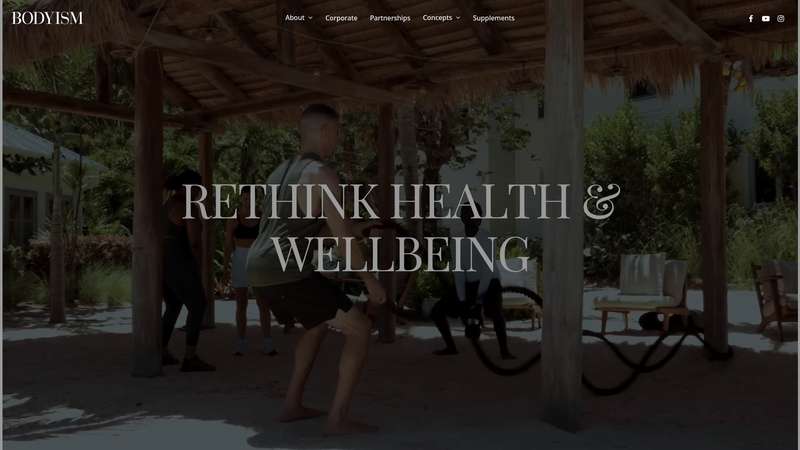
The photography is consistent and atmospheric. The visual language — clean, aspirational, warm — is appropriate for the positioning. The design, built by RHDG, has the bones of a premium brand experience even if the content and structure let it down. There is a visual confidence to the site that suggests the brand knows what it looks like, even if it has not yet decided what it says.
The corporate wellness positioning is commercially interesting. Most luxury fitness brands compete for individual consumers. Bodyism’s corporate offering — expert-led sessions designed for busy professionals — occupies a space that Barry’s and Third Space largely ignore. In a post-pandemic market where corporate wellbeing budgets have expanded significantly, this is not just a differentiator — it is a structural advantage. The brands that can credibly serve boardrooms and studios simultaneously are rare, and Bodyism has two decades of relationships to prove it belongs in both.
The retreat partnerships deserve particular attention. Collaborating with properties like Soneva — where a single night can cost several thousand pounds — places Bodyism in an experiential bracket that no amount of marketing spend can fabricate. These partnerships are endorsements from brands whose own standards are among the highest in global hospitality.
The Wider Pattern
Across the wellness brands we have reviewed, this structural tension keeps appearing: brands that serve multiple audiences through a single digital experience, hoping the visitor will self-select. Lush tries to serve activists, gift buyers, and routine purchasers on one homepage. Green People presents sensitive skin sufferers, sun care shoppers, and organic beauty converts through a single scroll. But the wellness sector makes the problem acute because the audiences are not just different shoppers — they are fundamentally different buyers. An HR director evaluating corporate wellness programmes has nothing in common with a Notting Hill resident looking for a Wednesday morning Pilates class, and neither of them is browsing for supplements. The brands that get this right — Third Space with its clear membership tiers, LYMA with its singular product focus — give each audience its own entrance.
If We Were Starting Fresh
We would split the digital experience into two distinct worlds. The corporate wellness proposition — partnerships, employee programmes, executive wellbeing — would have its own entrance, its own language, and its own proof points. The individual wellness experience — studio classes, personal training, supplements, retreats — would have its own journey, built around discovery, booking, and purchase.
The twenty years of expertise would sit at the centre of both. That is the connective tissue. But the way each audience encounters it would be shaped entirely by their needs. A corporate buyer needs case studies, methodology, and a conversation. An individual client needs a timetable, a booking flow, and a product page that works.
The supplement range would get a proper e-commerce experience — product pages, ingredient stories, clinical evidence, and a checkout that does not require a treasure hunt to find. The retreats would be framed as the pinnacle of the Bodyism experience, not a footnote in the footer.
And the marquees would go. In their place, a point of view. Twenty years of working with the world’s most demanding clients — corporate leaders, luxury hotel guests, elite performers — has taught Bodyism something about how health actually works. That knowledge is the brand. The website should let it speak.
Wondering if YOUR brand has the same gaps?
We will tell you -- for free. Our team will analyse your website and brand, then send you an honest review.
Get Your Brand ReviewFeature Your Review
Display this badge on your website to showcase your independent brand review.