Nala’s Baby
Industry: Baby & Children’s Skincare
Verdict: “Born from a mother questioning what goes on baby skin — now leading with a cartoon tie-in.”
Reviewed: April 2026
Who They Are
Nala’s Baby was born from a specific moment. Sasha, pregnant and newly conscious of what would touch her baby’s skin, used the Think Dirty app to check the ingredients in mainstream baby products. What she found — sulphates, phthalates, synthetic colours, petrolatum — convinced her and her husband Casyo that there had to be a better option. They built one. Nala’s Baby is now a full baby and children’s skincare range: 99% natural, paediatrician-approved, vegan, cruelty-free, and made in Britain, with individual products priced from five to six pounds. The range has grown to include the original baby line, Tropical Blast kids’ haircare, a fragrance-free sensitive collection, and a licensed PAW Patrol collaboration. Multiple industry awards validate the formulations. The brand sits in a sweet spot: premium ingredients at an accessible price.
What We Noticed
The licensed product as the front door
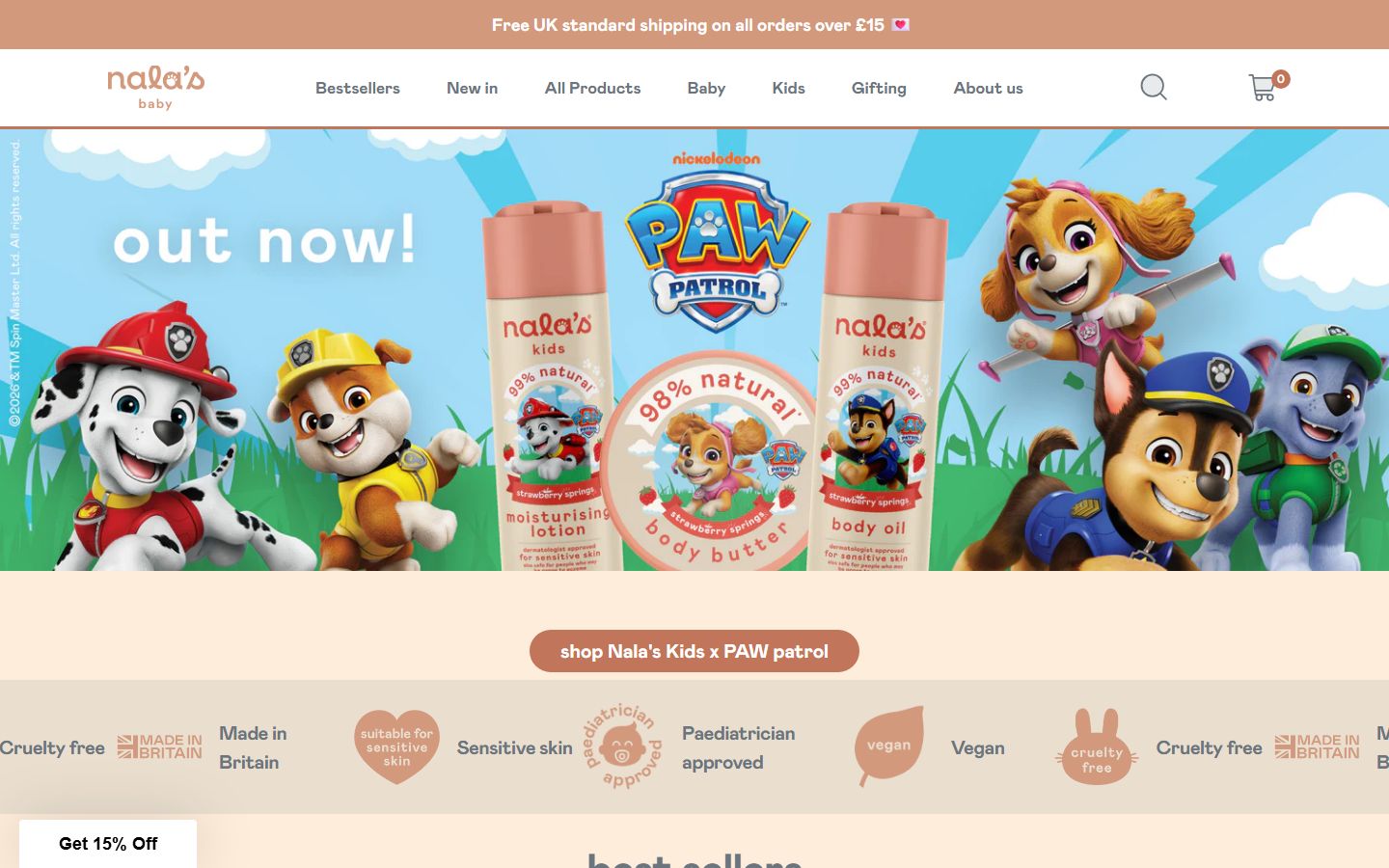
Open nalasbaby.com and the first thing you see is PAW Patrol. The collaboration banner fills the hero section, above the fold, on both desktop and mobile. The call to action reads “Shop Nala’s Kids x PAW Patrol.” For an existing customer who already knows and trusts the brand, this is fine — it is a new product, it gets prominent placement. For a first-time visitor — a parent searching for natural baby skincare — the initial impression is of a licensed character product, not an ingredient-led skincare brand. The PAW Patrol collaboration is commercially smart. It brings shelf recognition and gateway appeal. But when it leads the homepage, it answers a question nobody was asking (“do they do cartoon tie-ins?”) before addressing the question every new parent has (“can I trust what is in this?”).
Ingredient transparency without ingredient depth
Five trust badges sit prominently on the homepage: Sensitive Skin, Paediatrician Approved, Vegan, Cruelty Free, Made in Britain. A section titled “Naturally Derived Ingredients” links to deeper pages. These are the right signals. But for a brand whose entire origin story is about questioning ingredients, the depth is surprisingly thin. There are no dedicated ingredient pages explaining why each formulation choice was made. No comparison showing what Nala’s Baby leaves out and why it matters. No sourcing stories about where the natural ingredients come from. Childs Farm, the category leader, has built a content-rich website with strong editorial around ingredients and skin concerns. Kokoso Baby leads with its organic coconut oil sourcing story. Nala’s Baby states its credentials clearly but does not build the case in the way its founding story demands.
The founders as invisible advocates
Casyo and Sasha’s founding story — a pregnant mother, a smartphone app, an alarming discovery — is one of the most relatable origin narratives in British DTC. Every new parent has had the moment of reading a label and wondering what those ingredients actually are. The founders lived that moment and built a company from it. On the website, this story sits on a text-only page with no visual storytelling, no video, no prominent homepage presence. The “All About Nala’s Baby” section frames the brand around accessible pricing rather than the founding moment. For a category where trust is everything — parents are choosing what goes on their newborn’s skin — the founders’ personal investment is the strongest trust signal the brand has. It should not be buried.
Sub-brands without a brand architecture
The original baby range, Tropical Blast kids’ haircare, the fragrance-free sensitive line, and the PAW Patrol collection each have their own visual identity. Tropical Blast is bright and playful. The sensitive range is muted and clinical. PAW Patrol is cartoon-led. The original line is warm terracotta. These are different design languages serving different audiences, which makes sense. What is missing is the connective tissue — a clear brand architecture that shows how they all fit together under the Nala’s Baby umbrella. A first-time visitor browsing the site encounters what feels like four separate brands rather than one brand with four expressions.
What Works
The trust badge system is well-executed. Five circular indicators — Sensitive Skin, Paediatrician Approved, Vegan, Cruelty Free, Made in Britain — appear prominently and communicate the core credentials at a glance. In a category where parents are actively looking for reassurance, these badges do real work. They are not vague claims. Each one is specific and verifiable.
The accessible pricing is a genuine competitive advantage. Individual products from five to six pounds positions Nala’s Baby as premium-quality skincare that any family can afford. Childs Farm competes on distribution. Kokoso Baby competes on premium positioning. Little Butterflies competes on luxury. Nala’s Baby competes on the proposition that clean, safe skincare should not be a luxury. That is a powerful and inclusive message.
The warm terracotta and cream colour palette is distinctive and appropriate. It feels natural without feeling clinical, warm without feeling childish. In a category dominated by pastels and whites, the palette gives Nala’s Baby visual recognition on shelf and on screen.
The Wider Pattern
Across the DTC brands we have reviewed, licensing partnerships and promotional mechanics have a consistent tendency to crowd out founding stories. Grind has a genuine environmental foundation — 15,050kg of ocean plastic recovered — but leads with discount codes. P.Louise has a personal founder story and a world record in live shopping but runs a generic Shopify template. Nala’s Baby has one of the most relatable founding narratives in British skincare — a mother questioning what goes on her baby’s skin — but greets visitors with a cartoon character.
The pattern is not that licensing is wrong. It is that licensing works best when the brand story is already established in the visitor’s mind. The PAW Patrol collaboration makes perfect sense for a customer who already trusts Nala’s Baby’s formulations. It makes less sense as the first thing a new visitor sees, before they know anything about the brand’s ingredients, founders, or values.
If We Were Starting Fresh
The founding moment would be the homepage. Not as a paragraph of text, but as a visual story: the Think Dirty app, the alarming results, the decision to build something better. Every new parent has had a version of this moment. The brand would own it.
Ingredient transparency would be built out into genuine depth — dedicated pages for key ingredients, explanations of what is excluded and why, comparisons with conventional alternatives. The “Naturally Derived Ingredients” section would become a comprehensive resource, the kind of content that ranks for “is this safe for my baby” searches and builds trust through education rather than assertion.
The product range would be unified under a clear brand architecture. The original line, Tropical Blast, the sensitive range, and PAW Patrol would each have their place within a visual system that makes their relationship obvious. “Nala’s Baby for newborns. Nala’s Kids for growing up. Nala’s x PAW Patrol for bath time fun.” The umbrella should be visible at every level.
The founding story is the brand’s most valuable asset. It is personal, relatable, and true. Everything else — the credentials, the pricing, the partnerships — gains meaning when it is anchored in the moment a mother looked at a label and decided to do better.
Wondering if YOUR brand has the same gaps?
We will tell you -- for free. Our team will analyse your website and brand, then send you an honest review.
Get Your Brand ReviewFeature Your Review
Display this badge on your website to showcase your independent brand review.