Redemption Roasters
Industry: Hospitality
Verdict: “The world’s first prison-based roastery — the most powerful origin story in coffee, told with the volume turned down.”
Reviewed: April 2026
Who They Are
Redemption Roasters is the world’s first coffee company to roast inside a prison. The roastery operates within a correctional facility, training incarcerated individuals in specialty coffee skills — roasting, cupping, extraction, the full technical discipline of producing excellent coffee. The purpose is rehabilitation: graduates leave prison with a marketable skill in an industry that is growing and that values craft over credentials. The social mission is not an afterthought or a corporate responsibility programme bolted onto a coffee business. It is the reason the company exists. Around this mission, Redemption has built a specialty coffee brand with London cafes, DTC sales, and beans that are genuinely well-roasted. The coffee is the vehicle. The second chance is the destination.
What We Noticed
The most compelling story in coffee, told quietly
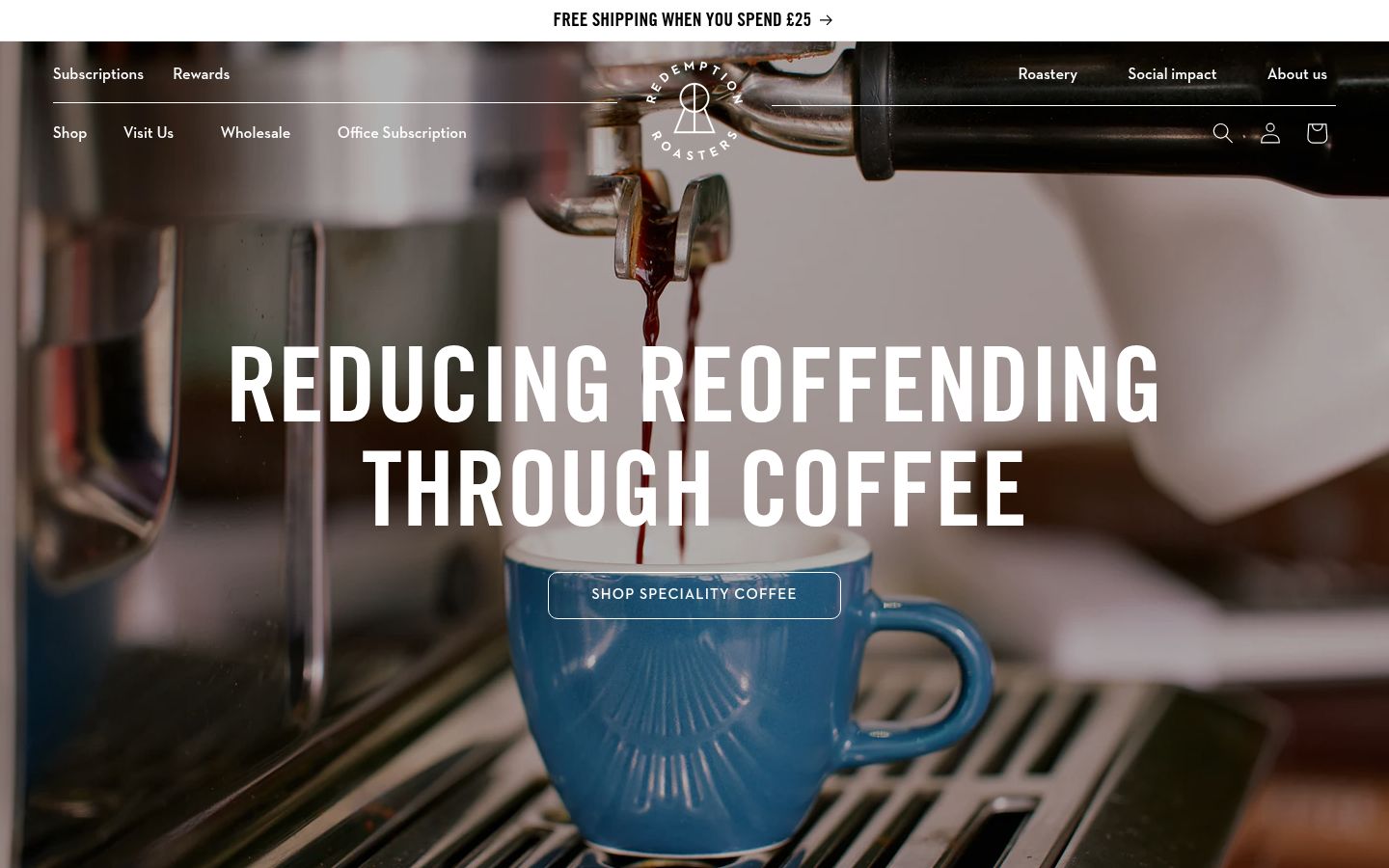
Every coffee brand has an origin story. Most involve a founder’s trip to Ethiopia, a revelation about direct trade, or a passion for specialty roasting that led to quitting a corporate job. Redemption Roasters has none of these. It has a roastery inside a prison and a mission to reduce reoffending through specialty coffee training. This is not a brand story. It is a human story — about people learning a craft behind bars and using it to rebuild their lives on the other side. There is nothing else like it in the coffee industry, or arguably in any consumer category. But the website tells this story at conversational volume. The design is clean, the tone is understated, and the mission is present without being prominent. There is an admirable restraint here — the brand clearly does not want to exploit the people it trains. But restraint and underselling are different things. A customer browsing specialty coffee brands online needs to understand quickly why this one is different. The prison-based roastery is the answer. It deserves more space, more depth, and more prominence than it currently receives.
Impact without evidence
The social mission’s credibility depends on measurable outcomes. How many people has the programme trained? What percentage find employment after release? How does the reoffending rate of graduates compare to the national average? These numbers, if they exist, would transform the brand’s proposition from “we do good” to “we do good and here is the proof.” Impact data is the language of accountability. It is what separates a genuine social enterprise from a brand that uses purpose as a marketing angle. Redemption Roasters is clearly the former, but the website does not provide the data that would make this unmistakable. A customer who wants to support a social enterprise — and there are many — needs evidence. A compelling story makes them care. Evidence makes them commit.
Utilitarian design as brand expression
The website’s visual approach is clean, minimal, and deliberately unshowy. This is a conscious design choice that reflects the brand’s values: no fuss, no exploitation, no dressing up a serious social mission in lifestyle aesthetics. There is integrity in this approach. But the utilitarian design also limits the brand’s ability to convey the emotional weight of what it does. The experience of visiting a Redemption cafe — knowing the coffee in your cup was roasted by someone learning a new life skill — has an emotional dimension that the website’s minimalism does not capture. The design matches the brand’s honesty. It does not match the brand’s significance. There is a version of Redemption’s digital presence that remains honest and restrained while also conveying the profound human reality of what the roastery represents.
What Works
The origin story is the strongest competitive advantage in UK specialty coffee. No other roaster can claim a prison-based training programme. It is not replicable, not follower-able, not something a competitor can announce next quarter. This is a structural differentiator that will remain unique for as long as Redemption operates.
The coffee quality is independently strong. Redemption does not rely on its social mission to justify the product — the beans are well-sourced, well-roasted, and genuinely good. This matters because it means customers who discover the brand through the mission stay for the coffee. The social purpose gets them through the door. The product keeps them coming back. This dual strength — mission and quality — is rare.
The London cafe locations provide physical proof points. A customer can walk in, drink a cup, and know that the person who roasted it was trained inside a prison. The cafe experience makes the mission tangible in a way that a website cannot easily replicate. These spaces are doing important brand work.
The Wider Pattern
Across the brands we have reviewed, the tension between content depth and design quality appears most acutely in purpose-driven brands. 200 Degrees has a roastery, a cafe chain, and a barista school — three stories that reduce to a product grid online. Grind has a genuine environmental foundation recovering ocean plastic — buried under discount codes. Redemption has the most powerful origin story in the category and presents it at a whisper. The pattern is that brands with the most to say often say the least, either because they fear appearing exploitative or because they have invested in design systems that prioritise visual cleanliness over narrative depth. The brands that find the balance — telling powerful stories with restraint but not silence — build the deepest customer loyalty.
If We Were Starting Fresh
We would build the digital experience around the impact story, told with the same integrity the brand already demonstrates but with significantly more depth.
The homepage would not just mention the prison-based roastery. It would explain it — what the training involves, what the graduates learn, what happens when they leave. Not as a sales pitch, but as transparency. This is what your coffee purchase supports. These are the outcomes. Here are the numbers.
Individual stories — anonymised and told with care — would provide the human dimension that statistics alone cannot convey. A graduate’s journey from the roastery to a barista role in London is a story that no other coffee brand can tell. It deserves to be told properly, with the consent and dignity of the person involved.
The coffee itself would be positioned within this context: specialty-grade beans roasted by people who are learning a craft that will change their lives. The quality of the product is not incidental to the mission. It is central to it. The better the coffee, the more valuable the skill. The website would make this connection explicit — great coffee and social impact are not separate brand pillars. They are the same thing.
Wondering if YOUR brand has the same gaps?
We will tell you -- for free. Our team will analyse your website and brand, then send you an honest review.
Get Your Brand ReviewFeature Your Review
Display this badge on your website to showcase your independent brand review.