Wild Nutrition
Industry: Wellness / Supplements DTC
Verdict: “A practitioner’s authority hiding behind a supplement shop.”
Reviewed: April 2026
Who They Are
Wild Nutrition is a British supplement brand founded in 2013 by Henrietta Norton, a clinical nutritionist who started the company in a garden shed in Sussex with her husband Charlie. The brand’s defining innovation is its Food-Grown methodology, a patented process that embeds vitamins and minerals within a food matrix for significantly better absorption than synthetic alternatives. Wild Nutrition is now headquartered at Lewes Old Brewery in East Sussex, ships to over 50 countries, holds B Corp certification, and uses zero-plastic packaging throughout its range. The brand is particularly well known for its women’s health products, spanning fertility through to menopause, and offers free nutritional consultations with qualified practitioners.
What We Noticed
The dispensary dressed as a shop window
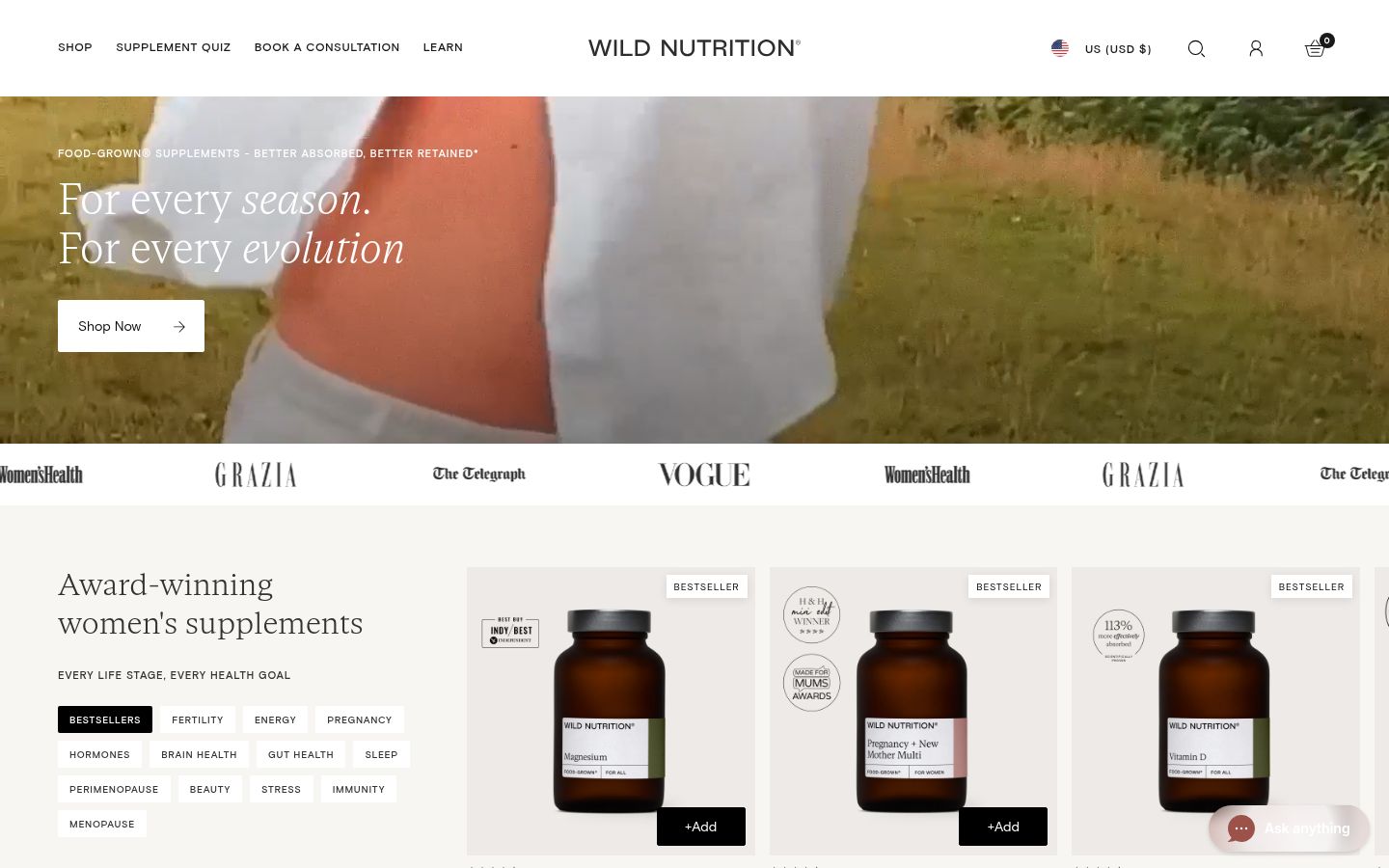
Wild Nutrition has something most supplement brands would pay millions to manufacture: a clinically trained founder with a patented process and a team of practitioners offering free consultations. This is not a brand selling capsules. This is, at its core, a practitioner’s dispensary that happens to have a Shopify storefront. Yet the website presents the experience in reverse. The elegant product grid comes first. The clinical authority, the founding story, the consultation service, these sit on sub-pages, waiting to be discovered by visitors who may never scroll that far. The hierarchy rewards browsing rather than trust-building, and for a category where trust is everything, that sequence matters.
A claim without its evidence
The Food-Grown methodology is the single most defensible thing about Wild Nutrition. Independent testing shows 113% better absorption than synthetic equivalents. That number, if properly surfaced, would do more selling than any hero banner or seasonal promotion. Currently, the claim exists but the evidence behind it does not receive hero positioning. There are no visible clinical study references, no comparison graphics, no digestible explanation of what “food matrix” means for someone encountering the concept for the first time. The methodology page exists, but it reads as one section among many rather than the centrepiece of the entire brand proposition.
Founder credibility buried beneath editorial styling
Henrietta Norton’s credentials are genuine and rare: a practising clinical nutritionist who built a supplement brand from first principles, not a celebrity who licensed her name. That distinction matters enormously in a market saturated with influencer-backed vitamin lines. Yet the founder story sits on its own page, disconnected from the product experience. A visitor could browse the full catalogue, add items to their basket, and check out without ever learning that the person behind the formulations is a qualified practitioner. The editorial design is sophisticated, but it treats the founder as background context rather than as the primary reason to trust what is being sold.
A consultation service hiding in plain sight
Wild Nutrition offers free nutritional consultations with qualified practitioners. In a market where competitors charge between 50 and 150 pounds for similar services, this is an extraordinary differentiator. It transforms the brand from a transactional supplement shop into a guided wellness experience. The problem is visibility. The consultation booking is available but not prominently surfaced in the purchase journey. It does not appear at the point of product consideration, where a hesitant buyer might convert if offered the chance to speak with a practitioner first. The service exists. The funnel to it does not.
What Works
The visual identity is genuinely accomplished. The colour palette of forest green, apothecary amber, and warm sand creates something that feels closer to a heritage apothecary than a DTC supplement brand, and that distinction serves the brand well. The product range is intelligently organised with smart bundling that encourages discovery across related products. The photography is consistent and considered, avoiding the clinical sterility that plagues most supplement brands without falling into the lifestyle cliche of smoothie bowls and yoga poses.
The B Corp certification and zero-plastic commitment are not just badge-collecting. They are woven into the brand presentation in a way that feels organic rather than performative. And the women’s health specialisation gives the brand a genuine point of authority in a space where most competitors try to be everything to everyone.
The Wider Pattern
Across the brands we have reviewed in the wellness and fitness space, this pattern repeats with striking consistency: companies with genuine, defensible differentiators whose websites fail to surface those differentiators prominently. The unique selling points are discoverable rather than unmissable.
Wild Nutrition’s version of this pattern is practitioner credentials buried beneath elegant e-commerce. Fitness Worx, which we reviewed alongside this piece, has its own variation: a father-son founding story and genuinely unique programming hidden behind generic gym marketing. In both cases, the brand’s most powerful story is sitting one or two clicks deeper than it should be.
This is not unique to these two brands. We see it across hospitality and wellness, from boutique hotels to independent restaurant groups. The operational truth of what makes a brand special often lives in the founder’s head or on an “About” page, while the homepage defaults to category conventions. The result is a website that looks like every other competitor in the space, when the reality of the business is anything but.
If We Were Starting Fresh
The direction would be to reframe the entire digital experience around what Wild Nutrition actually is: a practitioner’s dispensary, not a supplement shop. The website should feel like walking into a consultation room, not a retail aisle. Henrietta’s clinical expertise would anchor the experience from the first scroll. The Food-Grown methodology would sit at the centre of the product story, with the 113% absorption claim given the prominence and supporting evidence it deserves. The consultation service would become the primary conversion path for undecided visitors, not a feature buried in the navigation. And every product page would connect back to the clinical rationale behind its formulation, reinforcing the gap between Wild Nutrition and the influencer-backed, celebrity-endorsed brands competing for the same shelf space.
Wondering if YOUR brand has the same gaps?
We will tell you -- for free. Our team will analyse your website and brand, then send you an honest review.
Get Your Brand ReviewFeature Your Review
Display this badge on your website to showcase your independent brand review.