Yorkshire Pasta Company
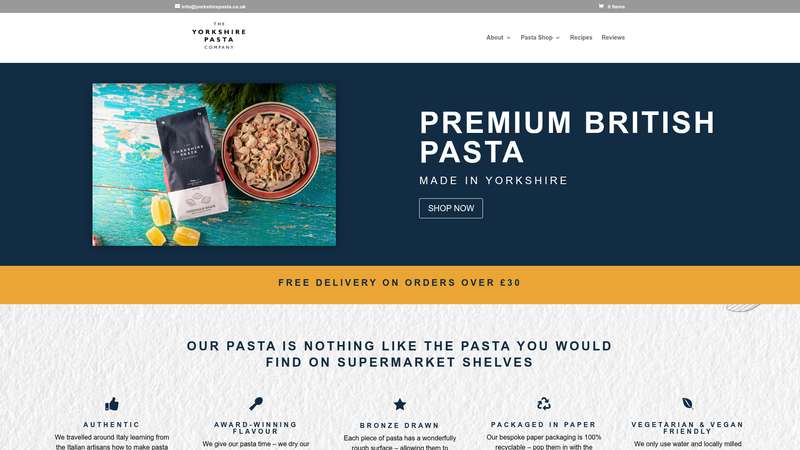
Screenshot of Yorkshire Pasta Company’s website, captured April 2026
Yorkshire Pasta Company
Industry: Food & Drink
Verdict: “Endorsed by James Martin and Gennaro Contaldo — and the website buries both.”
Reviewed: April 2026
Who They Are
Yorkshire Pasta Company was founded by Kathryn Bumby in 2020, a small family business dedicated to producing premium British dried pasta using traditional Italian methods. The pasta is bronze-drawn and slow-dried using locally milled Yorkshire wheat — Italian craft applied to British ingredients. The brand has won five Great Taste Awards, been recognised as a Best Selling Brand for three consecutive years, and earned features on James Martin’s ITV show alongside praise from Gennaro Contaldo. Products are stocked in over 500 independent shops across the UK.
What We Noticed
Credibility lost in clutter
Yorkshire Pasta Company has earned endorsements that most food brands would put on a billboard. James Martin featured the product on his ITV show. Gennaro Contaldo — the Italian chef who mentored Jamie Oliver — has praised the pasta. Five Great Taste Awards confirm that industry judges agree. But on the homepage, these proof points compete for attention with a social media feed, recipe blocks, scattered award badges, and promotional content. The James Martin feature gets no more visual weight than a recipe carousel. The Great Taste stars appear as small icons rather than as a headline credential. When you have credibility this strong, the design job is to let it breathe. Right now, everything is shouting at the same volume.
British pasta that does not explain itself
“British pasta made with Italian methods” is a genuinely interesting proposition. It raises a question that most visitors will have: why Yorkshire? What makes locally milled wheat different from Italian durum? Why does bronze drawing matter? These are the questions that justify the premium price and differentiate Yorkshire Pasta from both the mass-market brands (Napolina, supermarket own-label) and the imported premium brands (Garofalo, De Cecco). But the website assumes the visitor already understands. The process — bronze dies, slow drying, local sourcing — is mentioned but not shown. There is no visual storytelling around the wheat, the production, or the difference the method makes to the finished product. The brand’s most interesting claim needs more than a sentence to land.
A homepage that tries to do everything
The homepage carries product sections, recipe blocks, award badges, a social media feed, and an “as seen on” section. Each element is individually valid. Together, they create visual noise that weakens rather than strengthens the brand impression. A first-time visitor scanning the page gets fragments of many stories rather than the full arc of one. The difference between a premium brand website and a busy one is focus: choosing what matters most and giving it room. Right now, Yorkshire Pasta’s homepage reads like a market stall rather than a brand experience.
What Works
The product is genuinely endorsed by people who know what they are talking about. James Martin reaches millions of home cooks through ITV. Gennaro Contaldo carries the authority of Italian tradition. Both have praised Yorkshire Pasta — a brand founded by one person in 2020. That trajectory from kitchen table to national television in under five years speaks to product quality in a way that marketing spend cannot replicate.
The bronze-drawing and slow-drying method is a real differentiator. Most dried pasta on UK supermarket shelves is extruded through Teflon dies (smoother, faster, less textured). Bronze-drawn pasta holds sauce differently, has a rougher surface, and takes longer to produce. Yorkshire Pasta does this with locally milled wheat, which adds the provenance angle that imported Italian pasta cannot claim.
Five Great Taste Awards and three years as a Best Selling Brand are industry metrics that carry weight with wholesale buyers, deli owners, and food-conscious consumers. These are not self-awarded certificates. They are external validation from judges who taste thousands of products.
The 500+ independent shop presence shows commercial traction. Getting into indie retailers requires the brand to be known, requested, or discovered — and the product to sell through. This is evidence that the pasta works at the shelf level, not just online.
The Wider Pattern
Across the food and drink brands we have reviewed, there is a recurring pattern of brands that have earned powerful external validation but present it as decoration rather than narrative. Grind has an ocean plastic foundation and leads with discount codes. Gail’s has 130+ bakeries and never mentions the number. Yorkshire Pasta has James Martin and Gennaro Contaldo and presents their endorsements as one element in a cluttered homepage alongside recipe cards and social feeds. The pattern is this: brands earn credibility through product quality and industry recognition, then treat that credibility as a design element rather than the central argument for why someone should buy.
If We Were Starting Fresh
We would rebuild the homepage around the two strongest proof points: the endorsements and the method.
James Martin and Gennaro Contaldo would not sit in an “as seen on” strip at the bottom of the page. They would be part of the opening narrative. Not as celebrity endorsements in the traditional sense, but as evidence that this small Yorkshire brand makes pasta good enough for Italian and British authorities to notice.
The production method — bronze drawing, slow drying, locally milled wheat — would become a visual story on the homepage. A short video or a sequence of images showing the process from grain to packet. This is the content that explains why Yorkshire Pasta costs more than supermarket pasta and why it should. It answers the question that every first-time visitor has: “What makes this different?”
The awards would be consolidated into a dedicated section rather than scattered as badges across pages. Five Great Taste Awards, three years as a Best Selling Brand — presented together, these form a credibility wall. Spread across the homepage, they are wallpaper.
The recipe content and social feeds would move to secondary pages. The homepage would focus on one story: a British pasta maker, endorsed by the best, using Italian methods with Yorkshire ingredients. Everything else can follow once that story has landed.
Wondering if YOUR brand has the same gaps?
We will tell you -- for free. Our team will analyse your website and brand, then send you an honest review.
Get Your Brand ReviewFeature Your Review
Display this badge on your website to showcase your independent brand review.